
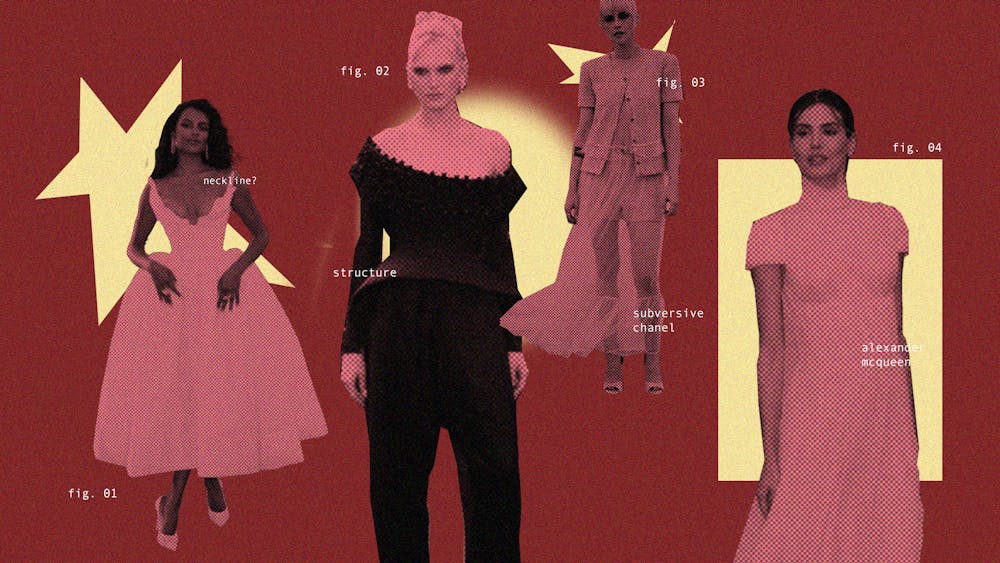
This year, I was lucky (and blistered) enough to be at Cannes Film Festival—hobbling down the Croisette in my mother’s vintage Manolos, which I wore so religiously I started bandaging in the shape of them. Every morning began with my beloved roommate’s sacred rites: “What are you wearing?” followed closely by “Does this purse look stupid?”
Between the downright absurd nudity ban and Bar Martinez’s frankly deranged vodka–on–the–rocks pours, Cannes felt like a fever dream of tulle, trauma, and tailoring. Let’s get into the looks: the good, the bad, and the ones that made me want to lie down and have another Bar Martinez concoction.
Alex Consani
Wearing Schiaparelli
There’s no denying the impact of that bodice. It’s pure Daniel Roseberry Schiaparelli—opulent, sculptural, anchored in fantasy with the obsessive handwork to back it up. The off–shoulder neckline sits like a garland of thorns and pearls, dense with jet embroidery, bugle beads, paillettes, and glass pearls. And crucially: it holds structure while resting off the shoulder, which means it’s almost certainly boned underneath with internal corsetry or bust support. Otherwise, the sheer weight of those embellishments would pull it flat against the chest.
The pleated basque flare at the waist—a stiff, folded peplum—nods to 1950s couture silhouettes (Dior’s Bar jacket) but is dramatized with almost an armor–like silhouette. That flare is likely reinforced with horsehair braid or a fused silk gazar interior, stiff enough to hold its angle without collapsing. It’s meant to exaggerate proportion—to create a waist not just through fit, but through contrast.
The idea, presumably, was to balance the extravagant top with something “masculine” or minimal. But these trousers land in a muddy middle ground. They appear to be a medium–weight wool or wool–silk blend, cut wide through the hip and thigh, with no real architectural tension. They don’t taper or flow; they just sit. And on the red carpet, where silhouette is everything, they feel … slack. The pooling at the ankle is a conscious choice—likely a reference to 1940s wide–leg pants or even Yves Saint Laurent’s 1966 Le Smoking—but here, without the razor–sharp tailoring YSL was known for, it just looks unfinished.
Historically, Elsa Schiaparelli herself was never a pants girl. She was about illusion, surrealism, spectacle—clothes that provoked. Think: lobster dresses, skeleton embroidery, trompe–l’œil fastenings, Salvador Dalí collaborations. Roseberry’s Schiaparelli takes that spirit and builds it into modern, structured fantasy—often with exposed corsets, heavenly body proportions, or absurdist proportions.
This top belongs to Schiaparelli. The pants don’t.
And that tension could be interesting—if it felt intentional. But here, it reads like a couture top interrupted by rehearsal trousers. Imagine this same bodice paired with a lean column skirt, a surrealist silk train, or even sharply pleated suiting. Instead, we’re left with a silhouette that’s top–heavy in the literal and figurative sense.
Alex herself sells it—she always does—but there’s a missed opportunity here. The look was sculptural heaven, but the pants brought us down to earth. Hard.
Irina Shayk
Wearing Yves Saint Laurent Fall 1987
There’s a reason no one makes gowns like this anymore: they’re a nightmare to build. This is archival Yves Saint Laurent at his most exacting—when drama wasn’t about embellishment, it was about silhouette, textile, and weight distribution.
The bodice is couture–grade velvet, which means every seam and every angle had to be basted by hand—pressed only from the reverse side, likely over velvet boards used during pressing to prevent bruising and crushing the pile. There’s no stretch. No forgiveness. Just a compression of space so perfect it denies the presence of flesh underneath. It’s cut like a shell—high neck, long sleeve, no visible shaping seams—so we’re looking at full internal scaffolding: hand–mounted interlinings, probably grosgrain facing inside the neckline and cuffs, and velvet boards. It looks minimal because it’s not allowed to wrinkle. This is velvet with the emotional presence of steel.
Then, the skirt: not tulle, not organza, not meant to dance. This is double–faced silk faille or gazar, historically favored by Saint Laurent and Balenciaga for its stiff, architectural memory. It’s constructed with inverted box pleats that release volume at the hips, held aloft by either a tacked–in horsehair hem or back–weighted lining. There is no bounce—only bloom. The high–low cut at the front breaks the otherwise monumental volume to expose legs in sheer black hose and ankle–strapped stilettos, echoing Saint Laurent’s Fall 1987 haute couture—where the eroticism came not from nudity, but from precisely controlled exposure.
Elsa Hosk
Wearing Mugler
This is Mugler’s legacy at its most operatic—and most subversive. Elsa Hosk, one of the most genetically blessed people alive, shows up to Cannes in a look that covers her up. What could’ve been just another sheer–bodycon moment (God knows we’ve seen enough) is elevated by silhouette and styling. The exaggerated choker neckline almost reads ecclesiastical—like a relic necklace or armor—while the black velvet cape trails behind like she’s about to deliver an operatic monologue. The paneling elongates her and highlights the hips without resorting to obvious tricks like padding or peplums.
Thierry Mugler always played with contradiction. He built his house on drag silhouettes—massive shoulders, snatched waists, hyper–femme armor—at a time when embracing queerness meant risking everything. His tailoring was divine, but rarely divorced from queerness or kink, which meant it was often dismissed as costume, excess, too much. But that was always the goal. Mugler believed fashion was “a trick and a game,” and he never let it forget that.
Covering up a supermodel in this day and age? That’s punk. That’s art.
Naomi Campbell
Wearing Alaïa
There’s a strange silence around this look, and maybe that’s exactly the point. It’s beautiful, obviously—Naomi Campbell in white Alaïa will never not be beautiful. But it’s not engineered for shock value, discourse, or even spectacle. It’s quiet. Softly sculptural. And almost aggressively timeless.
Azzedine Alaïa built his career on that kind of silence. He hated the fashion calendar, skipped shows on principle, and believed the body—not the hype—should always come first. He didn’t make clothes for clout; he made them to last beyond the noise. This gown reflects that ethos: asymmetrical, unadorned, tailored with monastic restraint. It doesn’t chase trends—it glides right past them.
Then there’s Naomi. This isn’t just a supermodel wearing a designer—this is chosen family. Naomi called Alaïa ‘Papa’—the father she never met—after decades of being dressed and cared for by him. So maybe this look isn’t trying to be a red carpet moment. Maybe it’s a quiet act of loyalty: a woman returning, once again, to the house that loved her first.
It’s not boring. It’s just personal. That can feel radical in a place like Cannes.
Dakota Johnson
Wearing Gucci and Boucheron
The halter cut, the gleam, the second–skin fit—it all echoes peak Tom Ford–era Gucci with a whisper of 1990s Versace. There’s a touch of chainmail goddess, a nod to disco minimalism, and more than a little slink of "Studio 54 if it had good lighting and a press wall." But the elegance is very Dakota—never overdone, just very poised.
While Demna’s Gucci era has just been announced, this is most likely a look from Sabato De Sarno’s team—or at least a continuation of his minimalist sensuality. De Sarno’s Gucci is all about the body, but in a different register than Alessandro Michele’s maximalist, referential chaos.
It’s a modern riff on 1970s disco chainmail (hello, Paco Rabanne), but stripped of its overt retro–ness. There’s something lethal and clean about it. The halter neckline and column silhouette lengthen her frame, while the crystal mesh diffuses light like she’s been dipped in stardust and sealed shut.
Jennifer Lawrence
Wearing Dior
Die My Love, directed by Lynne Ramsay, is about a woman losing her grip—trapped in postpartum psychosis, hypersexuality, and the isolation of rural motherhood. It’s a feral, fevered film set somewhere off I–95, deep in the emotional backwoods. And this look reflects that—an almost eerie softness. The skirt, delicate with nature embroidery, feels like something she might wear while unraveling in the woods. It’s beautiful, but detached. There’s no cinched waist, no body–hugging silhouette, no “sexy mom” styling. Just softness and dread.
Dior’s Fall 2025 show in Kyoto was all about translating Japanese craftsmanship through a feminine lens. The branches here feel like delicate overgrowth—something both blooming and suffocating. Which is exactly the emotional atmosphere of Die My Love, a film that traps you in a house in the middle of nowhere and dares you to admit how much you want to run.
Camila Queiroz
Wearing McQueen
I’ll admit it—I’m a McQueen apologist. But this look doesn’t need defending.
McQueen always said he designed to protect women, to make them untouchable so that men would be afraid of them. This is that idea distilled: strength disguised as softness, the suggestion of vulnerability rendered with such exacting control that it becomes untouchable. It’s not about shock—it’s about psychological power.
Lee McQueen trained on Savile Row, and that surgical understanding of the body is in everything he touched—from the bumsters to his infamous Jack the Ripper Stalks His Victims collection. That same instinct is preserved here. The gown looks like it floats, but it’s cut with precise knowledge of how a woman moves, breathes, and exists. The corset–seamed bust—visible but not sexualized—hints at the body without offering it. The high collar, the capped sleeves, the gauzy drape—they all suggest softness, but beneath that is structure.
However, you can’t talk about McQueen’s obsession with armor without naming what it was protecting. In biographies and recollections from those close to him, there are murmurs—never confirmed, but haunting—that McQueen experienced multiple cases of sexual abuse. He never shared details. His mission was always clear: build women into monuments. Make them untouchable. Make them terrifying, if need be.
Natalie Portman
Wearing Dior and Tiffany jewelry
Natalie Portman is a Dior girl through and through. And if you know your Dior history, the reference is clear: the house’s 1949 Junon gown, a masterpiece of layered tulle and scalloped embroidery. That original was a tribute to Hera, queen of the gods—a gown shaped like a blooming peacock tail, made of layered, beaded tulle petals. It’s a visual thesis on divine femininity. This is a more graphic, streamlined evolution, but spiritually aligned—an homage to one of Dior’s most iconic silhouettes without falling into full costume.
One of my friends called this her favorite look of Cannes, and she’s never wrong. We also saw Natalie Portman in person, so frankly, everyone else can pack it up.
Kristen Stewart
Wearing Chanel FW 2025
On paper, this is classic Chanel: pastel tweed, boxy jacket, ladylike proportions, and a sheer pink overlay that should evoke ballerinas or debutantes. But on Kristen Stewart, it doesn’t do any of those things. It’s uncomfortable. Off–kilter. A lot ugly.
The pink is drained of sweetness. The tulle doesn’t float; it clings awkwardly, almost limp. The cropped shorts and exposed torso refuse glamour. The whole outfit sits wrong, like it doesn’t want to be looked at for the reasons Chanel usually invites.
Chanel has always been about a particular kind of femininity: composed, heterosexual, French, aspirational. Kristen dismantles that by merely existing inside the clothes. She doesn’t smooth out the house codes. She slouches in them. She leaves the jacket unbuttoned. She wears the sheer skirt like a joke no one’s in on. On anyone else, this would be a misfire. On Kristen, it’s punk and a rejection of being palatable.
Nicole Kidman
Wearing Balenciaga
Cristóbal Balenciaga designed for the aristocracy. For silence. His pieces were known for their weight, their volume, and their complete refusal to pander to trends or movement. He believed in shape over sex, discipline over exposure. Women were meant to be contained.
Demna, decades later, has taken those same codes and turned them into anti–glamour. His Balenciaga is about surveillance and collapse: of taste, of elegance, of the fashion system itself. He pulls from industrial silhouettes, war zones, post–Soviet austerity, and forces them into fashion that feels intentionally hostile. Even when referencing the archive, the garments are never docile.
Which is why these two Nicole Kidman looks—worlds apart on the surface—feel spiritually aligned.
The red lace gown is a study in control. This is not stretch lace. It’s likely a firm, heavy re–embroidered lace with a mesh understructure. Zoom in: the floral motifs have texture, height. This isn’t yardage cut from a bolt. It’s placed lace, likely hand–appliquéd to follow the vertical line of the body. Matching the motifs at seams this clean requires invisible hand–stitching over reinforced backing, especially near the zipper and side seams where lace usually buckles or warps.
The silhouette reads simple, but it’s mathematically rigid. A classic Balenciaga trick: the column isn’t straight. It’s slightly trapezoidal—a subtle taper at the knee that forces posture and dictates movement. There’s no drape. No romance. Just tension. Shape over sex. Elegance as compression.
The jacket is a direct Balenciaga reinterpretation of a classic structured corset. Every leather panel is cut and molded separately—shaped over a bust form, then joined at topstitched seams that function more like exoskeletons. This isn’t soft lambskin. It’s medium–weight finished calfskin, chosen to hold shape and resist collapse. You can see it in the bust and waist: the silhouette stays rigid, even without visible boning, which means there’s likely internal taping inside the seams or high–tension panels backing each section.
The pants are just as intentional. They’re not soft denim. They’re raw or resin–coated, with an over–dyed wash and wide, stiff pooling at the hem. That low–slung, bootcut shape directly references early Demna runway collections, and nods back to the Ghesquière–era Balenciaga trick of balancing harsh sculptural tops with grounded, anti–glamour bottoms.
One look says: elegance is stillness. The other says: elegance is over. Both are Balenciaga at its best.
Imogen Poots
Wearing Rodarte
I have an embarrassing amount of secondhand Rodarte dresses saved on my Pinterest. The Mulleavy sisters (Kate and Laura) have always approached fashion like haunted archivists—drawing from fairy tales, horror films, decaying lace, and California Gothic. Their pieces don’t flatter so much as haunt, and this gown on Imogen Poots is a perfect example of that tension between beauty and decomposition.
From a textile perspective, this is layered Chantilly lace over power mesh, possibly stabilized with silk organza in areas where structure’s needed (bodice, hips). It’s intentionally heavy at the hem to anchor the ghostliness of the top. Rodarte uses lace the way Francis Bacon used flesh: for contrast and collapse. Notice how the floral motifs don’t align at the bust seam, allowing the eye to get lost in the noise rather than guided along structure. Even the opacity shifts—strategically placed appliqués hint at modesty without ever offering it.
And then: that black satin leaf on the shoulder, slinking upward like a parasite or an epaulette. It’s a callback to Rodarte’s early obsession with nature as a threat—dead flowers, creeping vines, forest rot. Think: their 2010 SS collection with the spiderweb knits and thorny textures. Here, it’s a single rotting bloom, weaponized.
Elle Fanning
Wearing Chanel and Cartier
The bodice sits in this awkward no–man’s land between empire and natural waist, and instead of elongating her frame, it bisects it. If they had fully committed to an empire line and hiked the waist up just a bit more, we’d be in Sofia Coppola’s Marie Antoinette territory—instead we’re in Coquette Tumblr gets sponsored by Joann Fabrics. The bodice structure looks too soft for the amount of tulle it’s supposed to anchor. There’s no real internal scaffolding (boning, corsetry, or even visible seam shaping) to keep the silhouette clean. So instead, everything collapses slightly inward, and not in a deliberate “undone French girl” way—more in a “we ran out of time backstage” way. The straps and off–shoulder sleeves also don’t offer tension or movement—they just hang, giving the gown a limpness that works against Elle’s otherwise ethereal vibe. The tiers of the skirt are also fighting each other: the double ruffle peplum effect adds width in an area that doesn’t need it, and it breaks up what could’ve been a gorgeous, elongated line. If they’d either raised the whole waistline or committed to a clean, drop–waist structure with actual corsetry, this could’ve sung. Instead, it mumbles.
The community is begging Chanel Haute Couture to make something new. Anything. A silhouette, a hemline, a single design choice that doesn’t feel like the ghost of collections past. Elle’s doing her part. The house is not. Elle in pastels is a Cannes tradition at this point—like bad Wi–Fi and cigarette breath on the Croisette.
Wearing Armani Prive
The mermaid flare at the hem is meticulously calculated—look at the curve at the back knee. It’s tight up until the last possible point, creating that iconic hourglass from every angle. That kind of patterning requires multiple fittings and perfect grain–line balance or else the hem would torque under the weight of the embroidery. The gown hugs her lower back with unnatural precision. That requires princess seams cut on compound curves, with the fabric laid against opposing grain directions to counteract the body’s pull. That’s why it doesn’t bunch or shift, even as she turns.
Simone Ashley
Wearing Vivienne Westwood bridal
This should’ve been a slam dunk. Westwood is known for her corsetry—baroque, boned, gravity–defying, with asymmetric drama that feels anarchic and controlled. This? This is what happens when you try to do Westwood without the structure. The bustline is absolutely the problem: the cups are too shallow, the shaping is awkward, and it’s neither framing her breasts nor supporting them. The sweetheart neckline is collapsing in on itself, and instead of the deliberate distortion that Westwood mastered, we’re getting sad gaping and tension in all the wrong places.
The mid–century silhouette is cute in theory, but the proportions aren’t working for her frame—the skirt has that signature Westwood weight, but the bodice doesn’t hold its own. It makes her look like she’s sinking into the dress rather than commanding it. And if Vivienne taught us anything, it’s that her women should look like they’re about to seduce a poet and burn down a parliament, not adjust their bodice mid–carpet.
I love Simone. I want this to work, but this one needed another round of tailoring and about five more steel bones.
Alba Rohrwacher
Wearing Valentino
Alba Rohrwacher’s red carpet appearance in Valentino reads, at first glance, like Edwardian revival—ruffled collar, fluted cuffs, prim jacket. But its power lies in how it refuses to be sweet or nostalgic. The oversized bow isn’t girlish—it’s ecclesiastical, calling back to the fichu neckwear of 18th–century clerical and court dress. The silhouette is restrained, but the message is loud.
Technically, this is pure couture sleight–of–hand, and it works beautifully. There are no visible darts on the jacket, a signature Valentino technique. Instead of shaping the torso with stitched darts, the garment is cut and sculpted through the angle of the sleeve–head and shoulder seam—a feat of drafting precision that relies on millimeter–perfect sleeve rotation and weight distribution. It’s subtle, but it changes how the garment rests on the body: there’s no tug, no tension, just ease. It requires advanced moulage skills to achieve, and reflects Valentino’s old–school atelier DNA.
The skirt stops exactly at the knee bend, with triple–layered crepe (probably) for body, not movement. It’s not a skirt for swishing or twirling—it’s engineered to hold a silhouette. There’s a discipline to the whole thing, a refusal to sway.
There’s a strong postwar cinema energy here: Fassbinder’s women, Ingrid Bergman in Europa ‘51, the kind of Catholic, post–idealist grief dressing found in mid century Italian or Polish films. It’s not nostalgic, though. It all ties back to Valentino’s home in Rome: a city of altars, iconography, vestments. Piccioli’s best work borrows from two churches—the house of Balenciaga, and the actual Church.