
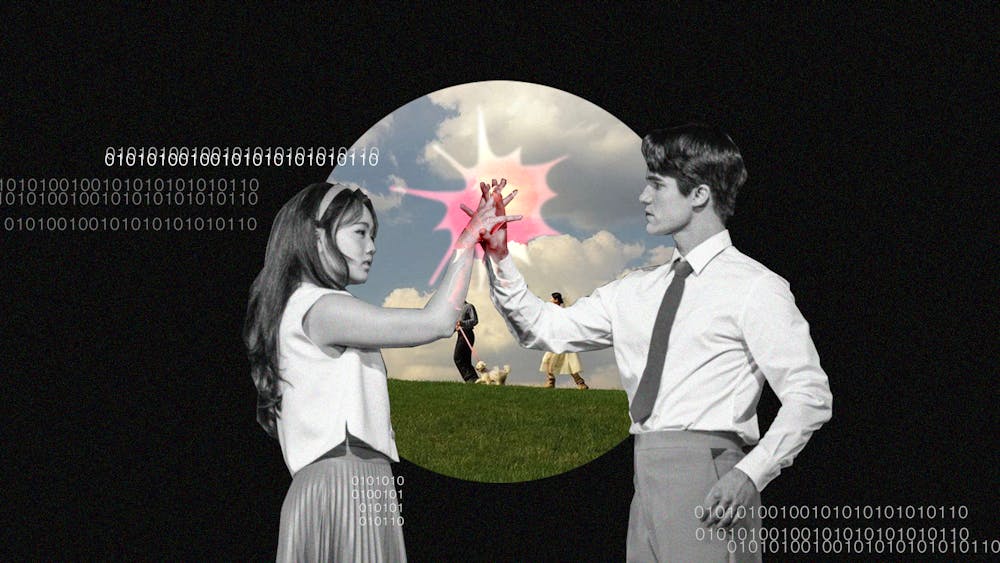
As someone who lives in New York, I am lucky to have Broadway so close to me—it’s really only a 40–minute Long Island Rail Road train ride away. So, when I won lottery tickets to see Maybe Happy Ending over winter break, I jumped at the chance. Alas, I entered the theater knowing only that it’s a love story about robots, not expecting to leave heartbroken and reflect upon my previous perspectives on love—specifically why we choose to love when we know there is only a short amount of time that we spend on Earth.
Maybe Happy Ending follows two Helperbots, Oliver (Darren Criss) and Claire (Helen Shen), who live in apartments for discontinued robots in Seoul, South Korea. They meet after Claire’s charger breaks and decide to take a trip to Jeju Island—Oliver hopes to reunite with his past owner, while Claire dreams of seeing fireflies. They promise each other they’ll remain only friends during their journey, but love quickly begins to blossom between them.
The show’s set is incredible, its musical soundtrack is beautiful, and the story is just so loveable. The critics agree—the show recently won six Tony Awards, including Best Original Musical, Best Original Score, Best Scenic Design of a Musical and Best Book of a Musical. It is rare to come upon such a dynamic set: Its use of projection, lights, and screens makes for a mesmeric viewing experience. Irises on the stage open and close, emulating colorful lights and guiding the audience’s focus to a specific part of the set—little opportunities to admire the close attention to detail in every creative decision, from the ever–growing stack of jazz magazines in Oliver’s room, to Claire’s tattered bean bag chair. Showgoers connect with the onstage personalities and put themselves in the shoes of the characters. Altogether, it brings us closer to a common theme throughout the narrative—mortality.
At the beginning of the show, the music has a robotic feel, slowly morphing and shaping into something of an organic sound as the story progresses. The steady rhythm produced by the orchestra from “The World Within My Room” and “Charger Exchange Ballet” is replaced with the free–flowing melodies of “Where You Belong” and “How Not To Be Alone.” While still committed to the characters’ perspectives as robots, the shift in musical number is representative of Claire and Oliver’s journey with a pivotal human experience: love. The show’s central conflict surrounds the fact that Claire’s battery is broken and she will soon have to be plugged directly into the wall before eventually becoming obsolete. Like humans, robots have a limited time on Earth: their “shelf life.” The pair grapple with the idea of their own mortality, presented to audiences through parallels between the characters and fireflies. The metaphor is especially evident in the “Chasing Fireflies/Never Fly Away” sequence, where the orchestra and conductors operate as moving elements or “parts” of the set to deliver the extended metaphor, visually. At the beginning of the musical number, Claire and Oliver are attempting to catch a firefly (controlled by an orchestral conductor—in this case Dez Duron) they see in Jeju. Suddenly, the music crescendos, and the orchestra rises from the stage, continuing their beautiful composition while the stage fills with glowing “fireflies”—even the musicians’ instruments light up. The show quickly draws a parallel between these insects and the Helperbots when Claire remarks to Oliver, “They only live for two months. But what a beautiful two months.” The moment mirrors their own difficult situation; they know their time together is short, but regardless, aim to make it worthwhile. At the end of the number, the duo looks out into the audience and says:
“Goodbye fireflies.”
“It was nice meeting you all. They’re just going home to charge.”
This conversation with the audience further deepens the relationships present: those between Oliver and Claire, the fireflies, and the individuals sitting in the audience. It’s an observation of death and grief as universal experiences, emphasizing the value of living life to the fullest.
Getting the opportunity to see the show again at the beginning of summer break (thanks again to Telecharge’s ticket lottery) only reminds me of the enduring impact that Maybe Happy Ending has on an audience. There is always something new to take away from the show, whether that be observing every small acting choice, like Oliver’s and Claire’s facial expressions when reacting to each other’s dialogue, or the appearances of fireflies throughout the show.
After Claire and Oliver return from Jeju, they admit their feelings for one another and kiss. As they spend more time together, the couple comes to terms with Claire’s declining battery life and, as a “Model 3” Helperbot, Oliver’s is also nearing obsolescence. They decide to end their relationship before either of them gets hurt—a decision conveyed playfully in the song “Then I Can Let You Go.” Nevertheless, after they try to break up, they realize that moving on is impossible unless they erase their memories of each other. Watching the show for the second time, I noticed a small but striking detail: in the number “Maybe Happy Ending,” right after Claire and Oliver say goodbye, they sing, “And maybe we’ll meet again sometime … is this our maybe happy ending? We’ll see.” At the end of the song, two fireflies appear, flying behind them and reuniting—a beautiful visual for their parallel lives as fireflies.
The show ends as it began, with the song “Why Love,” leaving the sniffling and teary–eyed theater–goers to reflect on the question at heart. As I left the Belasco Theatre, sprinting to Grand Central train station, I couldn’t help but think about the answer Maybe Happy Ending so beautifully offers. Why love? As love, even if fleeting, is worth fighting for (just wait for the plot twist that’ll leave you in tears). It’s worth sharing with someone—no matter how brief that may be.