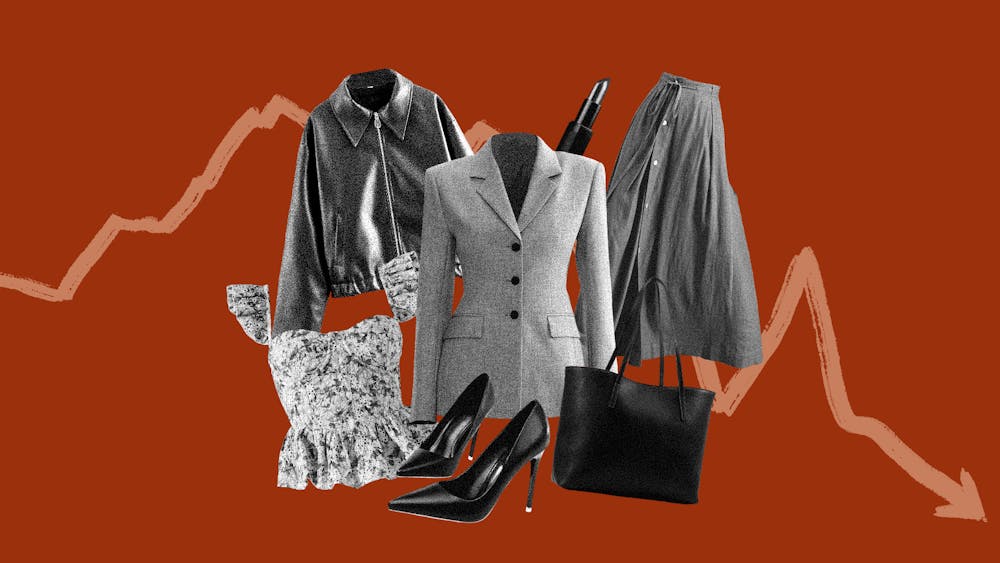
Blazers are trending, lipstick sales are rising, and hemlines are dropping. At first glance, it might seem like a chaotic, aesthetically confusing Pinterest board, but these shifts tell us a deeper story. The fashion industry has always captured cultural values, class tensions, and political undercuts. And as fears of a potential recession emerge, it becomes a mirror of our collective anxiety. What we choose to wear, buy, and display has always been political—a subtle signal for who we are, what we value, and how we navigate a world shaped by instability.
Stuck in the CVS makeup aisle—that one must–have mascara is sold out again? That minor inconvenience reveals a larger pattern: consumer habits shift when economic anxiety sets in. Since saving for the down payment on a $500,000 home may feel impossible in today’s economy, people start reaching for more attainable luxuries, like an $8.99 NYX lip oil. As big–ticket items like designer clothing, handbags, and jewelry become even more expensive during a recession, consumers often redirect their spending to smaller indulgences. With inflation driving up the costs of buying a home, leasing a car, or even taking a vacation, Americans tend to gravitate toward purchases they can justify, such as lipstick, perfume, or nail polish.
This phenomenon is known as the lipstick index, a term coined by Estée Lauder Companies Chairman and Leonard Lauder (W ‘54). During the 2001 recession, he observed that while sales of big–ticket items were declining, lipstick sales were actually rising. Tracing this pattern back further, Lauder noted that during periods of economic and political turmoil, such as World War II, women often turned to more affordable luxuries. The beauty industry continues to capitalize off of women’s purchasing power, especially in times of economic insecurity. Often marketing these products as affordable acts of self–care or empowerment, they emphasize “composure” as the world becomes unstable. For women, these recession–safe indulgences offer a sense of control, beauty, and dignity at a fraction of the cost.
One Instagram account in particular, DATA, BUT MAKE IT FASHION, explores the correlation between economic downturn and fashion trends. The page is run by Madeleine LaPuerta, a 2020 computer science graduate from Harvard University, who combines data science with fashion analysis, translating fashion trends into clear, digestible metrics. She’s created content on everything from the cost of Carrie Bradshaw’s iconic newspaper dress to the rise of ethical fashion shifts, including the decline of leather and fur. Curious about clothing material and color? LaPuerta’s covered that too. History has shown that neutral tones like brown, black, white, and gray tend to dominate during recessions, while neon colors, bold patterns, and fabrics like lace are less common. In another post, she reveals how the presence of maxi skirts and lipsticks have increased as the S&P 500 fell earlier this year.
For some brands, these changes have been anything but subtle. Until recently, the United Kingdom–based fast–fashion retailer PrettyLittleThing has been known for its bold, revealing clubwear, often worn by college students on a night out and promoted through celebrity collaborations with figures such as Doja Cat. The brand has since rebranded, adopting a more subdued “quiet luxury” aesthetic, like structured silhouettes, neutral tones, and an overall more polished image. Alongside this shift, many have pointed out that the brand feels increasingly singular. Critics have noted a noticeable decline in size, inclusivity and racial diversity among its models, suggesting that the new look is not just about style, but exclusivity aswell.
Consumers have noticed this shift and many have taken to social media to hypothesize on its meaning, often highlighting the broader political changes these trends tend to echo. This revived the “old money” aesthetic—longer hemlines, muted colors, and a more modest, traditional look—acts as a social indicator of political leanings. The rise of items that evoke restrained, traditional femininity, such as blazers and longer skirts, mirrors a growing cultural conservatism. PrettyLittleThing’s shift aligns with a larger movement, one that includes the popularity of “tradwife” figures like influencer Nara Smith and the resurgence of modest fashion as a signal of stability and tradition.
Much like the lipstick index, the hemline index is another theory suggesting a correlation between fashion choices and broader economic conditions. According to this hypothesis, when the economy enters a recession, longer hemlines, such as maxi skirts and midi dresses, tend to rise in popularity. These styles are seen as more practical, modest, and versatile across settings. There’s been several historical examples, such as the Great Depression, when the hemlines dropped as the stock market crashed. In contrast, the rise of the mini skirt in the 1960s coincided with a period of economic optimism. It’s a pattern that also connects to the rise of conservative fashion more broadly, as clothing becomes a way to signal personal values in times of uncertainty.
With rising tariffs and inflation, buying clothing has only become more expensive. As a result, people are increasingly drawn to versatile pieces they can wear across multiple occasions, whether to the office, a casual outing, or a more formal dinner. At the same time, with growing dissatisfaction with the government and a reduced faith in American democracy, people are starting to dress for their safety. In a cultural climate shaped by rising conservatism and even authoritarian tendencies, neutral colors and timeless styles offer a sense of protection. Fashion, in this context, has become a form of self–preservation, allowing the wearer to blend in, rather than attracting attention or provoking judgement.
These shifts also spark conversations about the nuances of cultural and political influence within modern literature. In the Ballad of Songbirds and Snakes, a prequel to The Hunger Games, Capitol fashion appears to be much more somber—dominated by modest silhouettes, darker palettes, and traditional styles. The Capitol’s conservative aesthetic in the early days of Panem reflects its fragile hold on power, as their citizens dress more cautiously, mirroring the regime’s need to maintain order and suppress dissent. This stands in contrast to the extravagant, experimental looks seen later in The Hunger Games series once the Capitol’s wealth, power, and control have been consolidated and firmly established. Much like in our own world, fashion becomes a tool of conformity under uncertain authoritarian rule. Pop culture captures these shifts clearly, from the Capitol’s conservative style in political uncertainty to its later use of fashion as a display of power and excess.
Fashion is and always has been politically and economically charged, offering us a window into financial conditions and personal identity. Through the rise of conservative dressing, the rebranding of companies like PrettyLittleThing, and theories like the lipstick index and the hemline index, we get a clear sense of how people express their values, fears, and desires when systems feel unstable. Consumer behavior shifts when people feel uncertain about the future, leading them to indulge in smaller luxury items. They begin to favor more versatile clothing and muted, understated colors. During periods of recession and economic turmoil, fashion becomes less about self–expression and more about survival.