I’m one of the first to arrive. The room is stuffy but bearable. I set my bag and skateboard down and get ready to learn something new. Homages–in–painting, rudimentary audio equipment, and loose pieces of furniture fill the room. Two dancers across the room are stretching to warm up. As more people stream in, the energy lifts. Practice eventually starts, and from the get go, I realize I will not be able to keep up. So I watch.
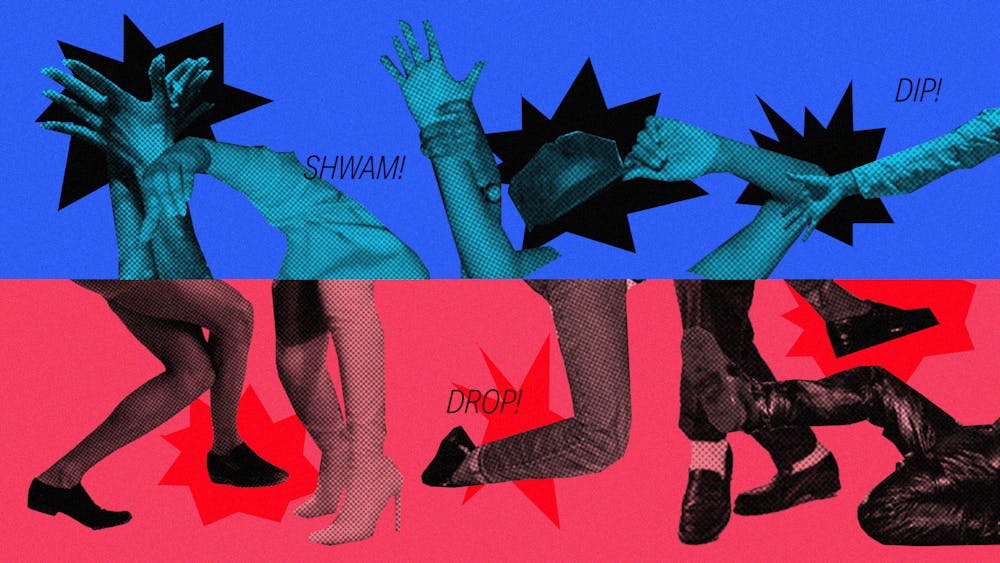
Hands. Catwalks. Duckwalks. Spins and dips. Floor performance. Death drops. Opulent wigs and costumes, extravaganza, charm and wiles, all in fierce competition. To the uninitiated, a simple collage of words. For those in the know, a call to witness. For participants, these words mean everything.
This is the essence of vogue.
A far cry from its quaint beginnings in trans, queer, people–of–color communities, the modern ballroom scene has taken the world by storm, permeating throughout pop culture, from initial hits like Paris is Burning, to millennial–age classics like hit television series POSE and RuPaul’s Drag Race. Ballroom lounges within the online antics of actor Channing Tatum and even cross–generational content, with voguing references appearing in the recently released, Gen–Z oriented Hulu series Adults.
While modern ballroom culture originated within Black and Latinx LGBTQ+ communities of Harlem, N.Y. in the early ‘70s, it eventually found its way to Philadelphia 20 years later, allowing for a different kind of emergence—the kind sparked by hungry upstarts like local voguing legend Alvernian Davis.
In the ‘70s, Alvernian Davis, known then as Alvernian Prestige, attended a ball in the capital of ballroom culture: Harlem. The events that transpired that night prompted the formation of House of Xavier, led by Davis at the age of 18, a stark contrast to most other Philly ballroom house parents, who tended to be anywhere in their late 20s to 30s. Although disagreements with house sponsors were a catalyst for the eventual disbandment of House of Xavier, the newly founded House of Prestige would be Davis’ next challenge at the behest of a crush, Michael Brown (better known then as Mike B). This venture proved successful, as the house went on to become one of Philly’s premier ballroom houses.
This story is only one of many. While ballroom centers competition, it thrives primarily on a communal sense of belonging, found abundantly within ballroom cultures across the globe, especially due to its queer roots.
Queer communities have often been at odds with the state of the world. The appearance of HIV/AIDs in the ‘70s and ‘80s was one such conflict. In a time where prejudice and health challenges tore through a community already ravaged by the continually oppressive practices and policies of Frank Rizzo, a commissioner of the Philadelphia Police Department in the late ‘60s, trailblazers like Davis provided safe spaces and created a milieu for unhindered creative expression.
The history of ballroom culture in the United States tells us a few things, of which the most important is perhaps the vitality of familial connection. Those on the fringes of an unrelenting society rarely find spaces that are safe, loving, supportive, and stable: This is a legacy that has persisted throughout history. Among the queer community, many have turned to prostitution or drugs for some form of community, and this has continued with contemporary alternatives coming in the form of sites like OnlyFans.
As a choice and expression–centered alternative, ballroom culture provides safety and security in many important forms. Ballroom houses often provide members with a roof over their head, as well as food and security from the dangers of living on the streets. Members of the ballroom community reveal that ballroom culture then gave those who participated three important things: financial incentive in the form of cash prizes—a means to live, creative expression—a way to survive, and a chance at fame—a chance to thrive.
Generally, it’s surprising to see viral moments retain a lot of their history and legacy, but this is something that can certainly be said for the ballroom culture of the ‘70s. The contemporary scene is much larger, seeing as participants now navigate a tech–centric world with more exposure and more ease of convenience. Collaborations such as the ever–famous Madonna “Vogue” music video and the smash–hit series RuPaul’s Drag Race have likewise exposed ballroom culture to a wider range of people than ever before.
Wanya Allen is a member of the House of Unbothered Cartier and an avid member of the Philly ballroom scene. Despite being a longstanding member, he is still relatively new to Philly’s “kiki” scene, a ballroom subculture that mirrors the “mainstream” most are familiar with, but on a more regionalized scale. Wanya participates under the ballroom pseudonym “Wanda,” a name gifted to them by their house parent.
Wanya’s story stands as a quintessential example of contemporary ballroom culture and the environment it fosters. “As someone who’s black and gay,” he starts, “I was not accepted by my family. So ballroom was my safe haven to be who I wanted to be and live my life as me.” Though this story is not wholly unique within the scene, that fact does not detract from the severity of its effects on the individual. He emphasizes that “a lot of us just want to feel loved, accepted, and at home. And a lot of us want that feeling of having a parent and having family to look up to. Because honestly, if it wasn’t for ballroom, I probably wouldn’t be as confident as I am, or the individual that I am.”
Growing from the strains of frayed family relationships due to queer identities and having a “found family” within the ballroom scene in the form of housemates, house parents and elders, and fellow competitors is the classic story within the ballroom scene—it operates as a vehicle for an unapologetic and encouraging love. But that’s not the only way to get into ballroom.
Drew Clarke, known in the scene as “Wally,” is a two–time Legend in the “All–American” and “Runners With a Twist” iterations of ballroom, and the current facilitator of the Rotunda’s (almost) weekly communal voguing sessions. Having previously been a part of such houses as the House of Unbothered Cartier and the House of Ninja, Clarke now stands as a pioneer in the Philly ballroom scene, being one of few to host regular balls.
Clarke’s story highlights another major tenet of ballroom: creative expression. As Wanya mentions, “It is really all about creativity, from your effects to your performance. … We create our looks using our way of how we see something.”
While attending Virginia State University, Clarke was part of an urban modeling group named Urban Couture. He progressed very quickly, teaching his own sessions by the end of his first year. Some friends of his involved in ballroom culture first introduced him to it, but he was unreceptive. This changed, however, after being stuck at home one Christmas break with his modeling “brothers and sisters.” Hours of scrolling through voguing videos together turned to fun sessions in the home, which in turn became an online presence that was enough to earn a practice session with the esteemed House of Ninja. Clarke now finds himself in the House of Gianni Versace.
Clarke is also a key part of a continuing movement to make ballroom more accessible to the people of Philadelphia, and the driving force behind these efforts has been his relationship with a local concert and community engagement venue, The Rotunda. This began in 2021 and 2022, when Clarke reached out to house director and liaison between Penn and The Rotunda Gina Renzi. After communications, the two have blocked out most Tuesdays since, and the time is now reserved for community ballroom efforts, such as house practices and (almost) weekly voguing sessions that are open and free to the wider Philly community, overseen by technician “Stro.” This particular endeavor points to a potential next step in Philly ballroom culture—increased community efforts.
As an event organizer and Hall of Famer hopeful, Clarke notes that perhaps the biggest challenge to the ballroom community now is the lack of wider community support. Difficulties arise in trying to secure diverse and consistent venues for balls and practices, as well as general accessibility to the craft.
Yet, ballroom is arguably at its most influential state, existing and operating on a global scale. The popularity of aforementioned shows, such as RuPaul’s Drag Race and POSE, have seen ballroom talents become stars with significant—and culturally groundbreaking—influences in mainstream pop culture. Still, their hold on their critical values is highly emphasized.
Philly ballroom definitely has space to grow, yet that only lends to its exciting nature. Community has been and will always be a part of the culture; The Rotunda’s involvement in the community stands as a testament to that. With a continued consistency and welcoming presence, Philly ballroom continues to spin and dip through strobing lights and bumping music, right around the corner of the street.