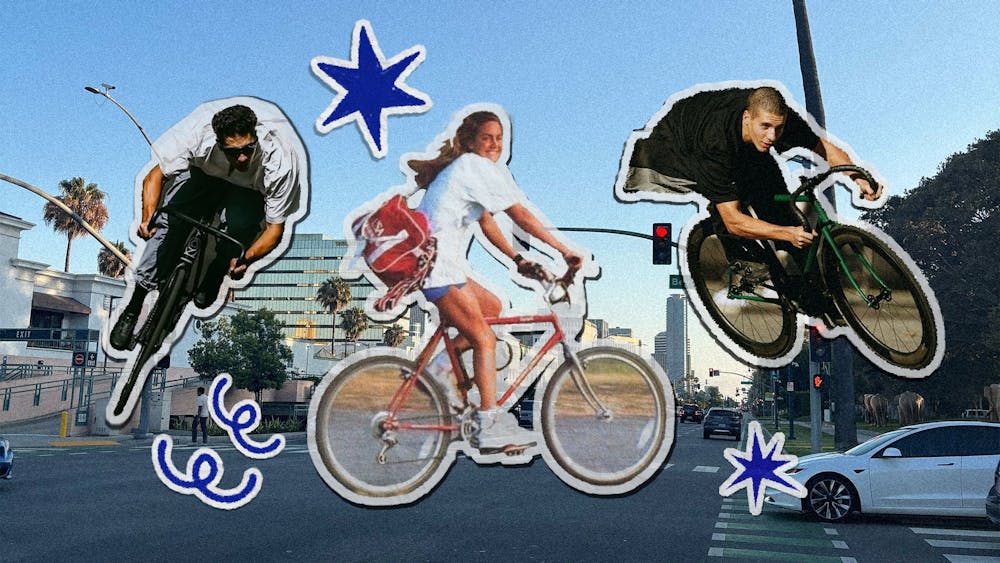
There’s nothing like almost getting hit by a car to drag you out of a Monday morning stupor. You slip recklessly through an amber light. A car comes out of nowhere as it makes a sharp right turn, unfortunately crossing your bike lane in the process. You swerve and raise an acknowledging hand as the driver lays on the horn, but you can’t help but think, “What do you want me to do about it now?”
You’re exposed to a very different world when taking on a car city from the tiny cockpit of a rented electric bike. Suddenly, I’m 16 years old again, learning how to drive with the “highways” feature of my Apple Maps toggled off. And at first, I was grateful for the handicap; I would hit the throttle and be terrified of the speed at which I accelerated, practicing on empty streets and stretches of the Santa Monica State Beach, starting and stopping with clumsy trepidation. But after a month, I weave, I squeeze, I soar past stop signs through clear intersections and leave my helmet to collect dust on my desk in Westwood (sorry, Dad). I look wistfully at the sleek motorcycles that inevitably overtake me and wish my top speed were over 20 miles per hour—25 going down a hill.
But I’m secretly grateful for the unconventional routes I take. A week will go by when I forget how highway–dominated Los Angeles is; I trade traffic minutes for distance, raw efficiency for new sights. I take Santa Monica Boulevard to work every day, Venice Boulevard down to the canals, and watch the billboards change over the weeks. I’ve learned to become endlessly grateful for bike lanes, and karmically regret every time I blocked one by parking illegally in high school. I see casual tennis players getting their late–night hits in at the Westwood Park, Culver City waking up in the morning, and muraled side alleys too narrow for cars to go down. Sometimes it’s dark and shady and a little scary, but I’ve romanticized every aspect of LA for too long.
You acclimate differently to a city when you take it on from a bike. Someone (rightfully) honks at me for blocking his right turn, but then rolls down his window to say thank you when I move out of his way—and I learn that LA drivers are far nicer than Philadelphia drivers. Horny–for–Jesus proselytizers shout at me from the crosswalk, and I can’t hide from them behind a tinted window. I’m now on eye–contact terms with the construction workers and crossing guards along my daily commute. I buy only enough groceries to fill my backpack and make small talk with the Trader Joe’s cashiers. I leave my work friends at their parking levels to descend to the back courtyard and trust that they’ll give me weekend rides when the function is just a little too far away. I know that even when I return home to my bikeless status quo, I will continue to see the world through bike racks and bike lanes.
The more I wax lyrical about this city—perfect weather and Hollywood and palm trees and Sunset Boulevard bars and that lingering salty breeze—the more I know that I will never beat the transplant allegations, and I’ve made my peace with that. Still, there’s nothing like getting a flat tire on my way home from work to feel like the tourist bubble, like my tragically punctured inner tube, has popped. I wake up at 9 a.m. the next day to wheel my bike 40 minutes to the repair shop, sweating in the rare morning humidity and vowing never to take a functional set of wheels for granted again. The owner tells me that it’s a nice bike while he toils away at the tire, and I don’t correct him. This life can be mine for a little longer. I like to think I’ve earned my place in it.
This summer’s been about learning to communicate: becoming closer with roommates and interns, having casual conversations between meetings or in the break room, and finding that perfect line to walk between networking and friendship. But I’ve also had to learn to communicate on the road, way more than I did tucked safely between the four walls of a car. I’ve realized how much I used to take that enclosure for granted, how common it’s become. But over the past six weeks, the distance between me and the mythos of the city has both literally and figuratively collapsed. Slower bikers reorient themselves behind me at red lights with a wave and a smile. I develop a new gesture–based relationship with cars trying to turn right across my lane, choosing the awkwardness of start–stopping and 8:30 a.m. eye contact in return for not getting crushed into the curb. Without the perceived security of complaining into an empty windshield—that physical echo chamber for every knee–jerk emotion—my road–rage instinct has slowly faded into patient grace.
It’s not a stretch to say that my daily commute is essentially a 30–minute SABS: I get to see the inner city, and it sees me. When I zip through wealthy Beverly Hills neighborhoods that buzz with their comfortable routine, I’m far more memorable than just another car on the road. And while there’s nothing inherently very profound about being seen—maybe some dog walker recognizes me, maybe some eco–activist is happy about one less source of carbon emissions, maybe no one cares at all—that visibility anchors me. If I’m not quite spreading joy into the streets around me, maybe I can at least choose tranquility and ease where we’ve all come to expect frustration and escalation.
I leave LA in two weeks, and I’m already starting to feel like it will be hard to say goodbye. But a part of me hopes that LA will miss me too—that someone will think about how, every morning at the same time, they saw a business–casual college student fly down Westwood Boulevard on a cherry–red bike and wonder where he might have gone.