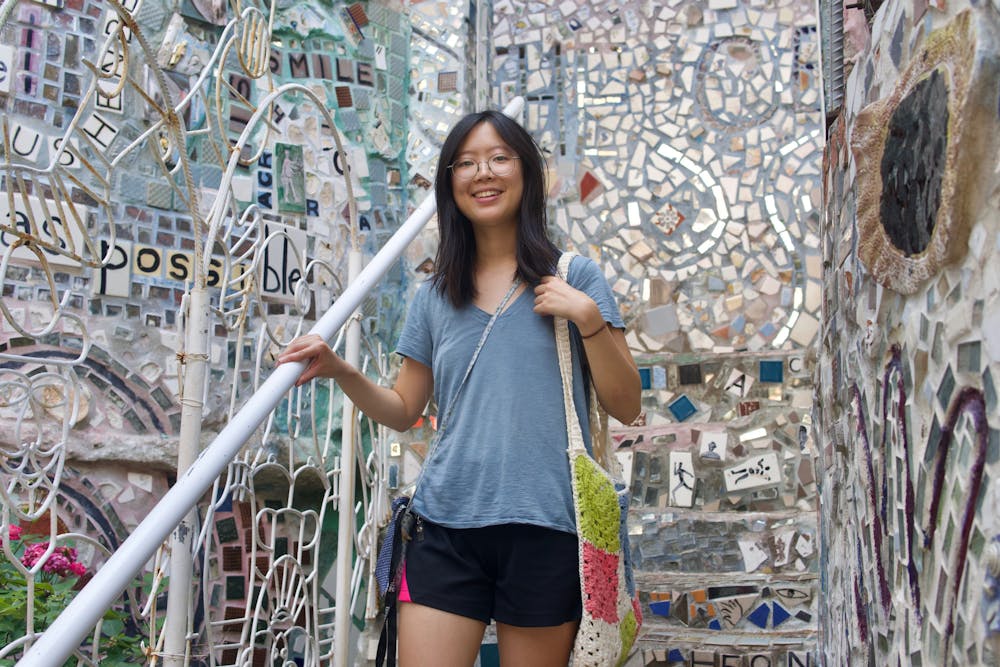
Can you tell the difference between house sparrows and song sparrows? Neither can I, but Syndey Liu (C ’26) can. As we sit by the Biopond, taking a break from the hustle and bustle of Locust Walk, Sydney helps me identify the birds hopping around us. She joined Penn's premier birdwatching club, UPenn Quackers, while trying to find leisurely activities she enjoys here at Penn. While she originally enrolled in the College with an interest in computer science and animation, Sydney later switched to the pre–med track. Later, she pivoted once again to embrace her true passion—teaching, which she discovered via one of the most infamous classes at Penn—CIS 1600.
Name: Sydney Liu
Hometown: Philadelphia (formerly Darien, Conn.)
Field of Study: Major in neuroscience, minor in computer science
Activities: SNF Paideia Fellow, UPenn Quackers, UnEarthed Magazine, Penn Arts
How would you describe your extracurricular experience at Penn?
Something that I’ve been thinking about is that a lot of my activities feel a little bit “unserious.” For example, when you talk to other seniors, they say: “I'm the president of this pre–health preprofessional club,” “I'm a consulting VP,” and so on. All these activities are extremely cool, but when these people ask me about my activities I reply with “I sew plushies and draw buzzards.” I think it feels unserious, but at the same time, there's something important about doing things as you want to do them. And there's no real value as to whether something is serious or not. Moreover, that's something that I'm learning about in education. Because I look really young—I think—I'm trying to take myself more seriously while I'm doing all these things.
Why did birdwatching catch your attention and what is your main takeaway from it?
Honestly, I didn’t get into birdwatching until very recently. I'd say I'm more of an amateur, but I have a couple of friends who are really into it. Ironically, I met one of them during a physics lab because we had the same specific yellow backpack. Still, I’ve always really been into nature and getting out. I grew up in the suburbs of Connecticut, so I just enjoyed nature. Biopond made me realize that I was missing that piece in my life once I moved to the city. So I felt that birdwatching was a nice way to get outside and meet down–to–earth people. Additionally, I think a lot of my experiences at Penn made me feel like I needed to shape myself in a certain way. I found that a lot of the clubs had high barriers to access, whereas the birdwatching one with an open membership felt really approachable.
How did you uncover your passion for teaching?
I’ve always enjoyed helping my friends with their homework, but I didn’t realize that I was really into teaching until a little bit later on. I first started getting into it during my freshman year. I had taken one computer science class—CIS 1600—which is more of a math class and felt very hard to me. Still, there was an opportunity to be a teaching assistant for this class later, so I applied for it, and I didn’t think I would get it because of imposter syndrome and the negative reputation surrounding 1600. I ended up getting the position, which really helped me, because I had a hard experience with the class.
Because of its strict collaboration policy, it's hard for people to study together for this course. So, I was happy to be there for other students and empathize with their emotions arising from this class. I had a student write me a post–it note at the end of my office–hours semester where she thanked me for helping her throughout her journey. That totally changed my perspective and sparked my interest in further pursuing education. It made me feel like I was giving back in some way, when I am settled in a really competitive environment where everyone is just all for themselves. So, this became a turning point for me, and I ended up doing more TA–related things.
How did family affect the way you make decisions about your future career?
I have a twin brother who's really smart, good at math, and going to work at Amazon as a software engineer. I'm really proud of him. Having a twin who I'm close with but who was always ahead of me made me feel constantly behind. This was a big experience that shaped my life, feeling behind academically and intellectually. So I wanted to teach because I think a lot of students feel a similar kind of pressure when they compare themselves to other people, the way I compared myself to my twin, and I want to help students get out of that mentality.
Along with this, when I realized that I like helping people in general, my Asian parents suggested that I become a doctor. I tried the more medical route, but over time, I realized that teaching is what I truly enjoy, so that is what I've been pursuing ever since.
As you shape the lives of your students in some way, how did teaching affect you?
I feel a lot more authentic to myself. I think at Penn, I've experienced a lot of feeling like I have to be something that I'm not. Like in this interview, I'm always really sensitive about questions about my Penn experience, in the sense that I'm used to working all the time and not having a lot of time to myself. My family also put a lot of pressure on what careers I should go into because of a feeling that when you go to Penn, you have to deliver this return on investment. So if I go into teaching, the question was whether I'm wasting the opportunity I’ve been granted and the resources that have been invested in me just to go down an easier route. That was hard. In addition to that, there's also a lot of pressure at Penn to become the leader of some club or to have your Google Calendar completely booked. I pressured myself to do that a lot early on, but I think now I do what I want to do. For example, I watch birds and I teach, and I feel that this has helped me retain my authenticity. Teaching makes me feel more connected to others; for example, I really enjoyed being a PennArts leader and helping orient the freshmen through the arts. It’s fun because I believe that teaching can be both creative and intellectual—in terms of math, science and other matters that I've been doing—but also creative in terms of the arts.
How do you see the interaction between art and education?
This is something I'm really thinking about right now. I'm in the SNF Paideia Program, and they give you a lot of flexibility for what you can do for your final project, so I'm hoping to do a project on how art facilitates dialogue and community building. For example, I made a comic for one class in the program called “Testimony: Life–Writing as a Dialogue” with Sarah Ropp. I created this comic about how I felt as a freshman dealing with burnout culture. It really is a broad metaphor: It's not meant to be specific to me, so I used different sorts of flowers to illustrate the feelings. I ended up sharing this comic with the freshmen in PennArts. It felt really special for me, as it allowed me to be vulnerable and create a piece that other people can also relate to. It helped start a conversation and a connection.
Additionally, I think that the arts can help make teaching feel more fun. This summer, I worked at Choate Summer Programs, which is at a boarding school in Connecticut. I was teaching neuroscience to middle schoolers and biology to high schoolers, and I got to try a lot of different things. For example, I had students model the stages of mitosis with clay. This was nice because I feel that teaching can be boring at times, so it was good to have the opportunity to try different things with them and let them apply their own creativity.
Another example of collaboration between art and education is the UnEarthed Magazine. I joined it pretty early as a freshman. That year, I was so overwhelmed with classes that I wasn't super involved with clubs, but I’ve always enjoyed making magazine spreads and things like that. So, it's been really fun to be part of a team where I collaborate with a writer to come up with the vision of the text. We also do distribution events, where we go to different schools and share our magazines. It is really rewarding to see the kids get excited about it.
As both a PennArts pre–orientation leader and a past participant, how has your vision of Penn changed since freshman year?
The program is meant to incorporate both the visual and the performing branches of art. I'm more of a visual artist, so I can’t dance or sing, but it's really fun to have this community of people who are trying new things. I don’t know how much the program or people have changed through the years, but I know that I changed a lot because of it. In my freshman year, I was really shy. I didn’t want to dance or do any of those things. Now, as a leader, I help other shy students to feel more comfortable in those spaces, which makes me feel really nice.
Even though I took the leadership position only this year, and it was a last minute decision, I'm really glad I did it because I met a lot of genuine, awesome people. I started with PennArts as a freshman participant. The pre–orientation program was my first introduction to Penn, and I wanted to end my time here the way it started. I really enjoyed the idea of having the full–circle experience and revisiting this community that I'm connected to now. Both this year and my freshman year, we had lots of similar activities—for example, we do this puzzle activity where you draw a puzzle piece, and then everyone has to put it together without words. They end up displayed in the Platt Performing Arts Center. Seeing another group of students do the same activity I did as a first year was really nostalgic. You can still see the puzzle from my freshman year on display—I think it's exciting to see how these puzzles evolve over time.
Lighting round:
Favorite bird? Catbird.
One subject to teach? Physics.
Best studying technique? Sitting in the David Rittenhouse Laboratory library.
Favorite visual artist? Carol Marine.
There are two types of people at Penn … slow and fast people.
And you are? Slow.
This interview has been edited and condensed for clarity.
Do you know that one senior who brings a smile to everyone’s face or always has the craziest stories? It is time to give them the recognition they deserve. Ego of the Week seeks to showcase seniors not for their grades or any other academic construct, but for who they are as a person and the joy they bring to the people around them! Nominate your favorite Penn seniors for Ego of the Week!