In between my two weeks of summer research in Palermo, Italy, a myriad of people and experiences entered my life. From Hinge dates to aimless wandering, I found myself experiencing a sort of urban Panismo—a concept born from the mind of Italian poet and political leader Gabriele D’Annunzio to explain a mystical fusion between humans and their environment. This fusion occurs during most of my travels, the experiences I collect leaving an imprint on my mind and body. I hope I’ve left my own in Palermo.
Via Aragona
“Here, come sit,” I tell her.
She’s German, and we’re sitting on my windowsill, staring at the crumbling building and the moon in the courtyard. Vines spew out from the windows, and lights flicker behind them. I took photos of it this morning, but at night, under the dimly glowing stars and surrounded by mosquitoes, it seems to shine a little more.
We met on hinge but never really “clicked” romantically, finding a platonically feminine connection instead. This almost always happens with women—romance feels out of reach. Still, the beauty of female friendship makes up for it. Her presence is scattered across my nights in the Sicilian capital.
I beat her four times in a row playing UNO earlier tonight while a drunk man mumbled nonsense and kicked a few chairs. A baby cried, and house music boomed from the graffiti–covered bar we sat outside. Sipping on my gin and tonic—the first drink that came to mind when our server hastily asked what we wanted—and joking about American politics, I could only think of how lucky she was to be born in the Europe. “I’ll move to Europe one day,” I tell her, “likely Paris.”
She asks why. The only answer I can muster is that after dedicating 15 years of my life to the French language, “it feels like an obligation.”
Back on the windowsill, her purple lipstick leaves a stain on the beer bottle she brought with her. While I sift through my playlists to find a good song to match the vibe, she reapplies three times, making sure it’s perfect for her date after. She sends me a photo later from the top of a mountain where a local boy took her to see the city lights. She forgets to send me the coordinates, but after four days in the city, it’s clear she’s scaled Monte Pellegrino, standing near the sanctuary of the city’s patron saint, Rosalia.
Piazza San Carlo
We’re only 36 meters from my apartment, in a speakeasy hidden behind a mini market. The man at the record bar was clearly given full jurisdiction over the record selection, mixing a variety of funk and Ethiopian jazz into Santana’s Supernatural. I shamelessly Shazam and give him a thumbs–up for each track I recognize, sipping on a daiquiri I didn’t order.
Sitting huddled in the corner, we take pictures of each other and laugh as girls clad in leather and neon green tops stream in and out of the room. Couples whisper over the snack–themed drink menu and, the staff gossip behind them. No one is dancing, but it doesn’t seem like they should be.
Clips from the black–and–white film era are shuffled together in a projection on the wall. Charlie Chaplin miraculously avoids death on roller skates and Marilyn Monroe adorns a tiara. Trains pass by silently and men with obnoxious mustaches taunt women in flowing dresses. I tell her about my German film class I took in the fall, and we muse over the nation’s Weimar era, when dance bars were full and fascism sat on its heels. A Jew and a German joking over drinks in Italy, funny.
Walking out a bit drunk, the hallway of mirrors and red lights disorients me as we whist through to the exit. We leave a tip in the mini shopping cart on the bar counter.
Villa Guilia
It’s scorching hot, and I can’t find the entrance to the botanical garden. Too embarrassed to ask anyone, I go next door to the public gardens. Wandering through the flowers and weeds, I see girls petting a cat and an old woman walking for leisure. Large exedras—ancient Roman semicircle structures built for conversation and contemplation—dot the area, with vibrant purple flowers growing around them. A couple picnics in the cemetery, and I brush my fingers along the names carved in the stone. Around the corner, I find a statue of a man perched on a pile of rocks. He’s naked and at peace, and so I lay with him on a lightly shaded bench, wanting to join his tranquil state away from the busy city streets. I find that I relax best thousands of miles from my bed, away from the spiraling thoughts the real world funnels into my brain.
Despite my distance from the exedras, I let my head dangle off the edge of the bench and reflect on how I ended up there. A wave of calm washes over me as larger ones crash into the nearby port. I can imagine women of the 18th century feeling the same after the park’s unveiling, their dresses trailing behind them as they explored the manicured gardens. I don’t think much has changed since then—the flora grow and whistle, and women enjoy it all the same. Only in historical places like this do I find myself connecting with the spirits of the past. Today I lie in a t–shirt and shorts, far more skin showing, though wishing it could be more.
No one comes near for nearly an hour as I play Maurice Ravel’s “Miroirs III: Une barque sur l’océan” on repeat. My skin cooks under the Mediterranean sun as the clouds shift. It’s good to be on my own in a city far from home, though the man’s presence keeps me from feeling lonely as we sit in comfortable silence, allowing my brain to go quiet. I sketch him and take photos of the palm trees and the vibrant array of flowers blowing in the wind. I’m glad he can’t speak.
Via Giosuè Carducci
On our first date, he takes me to a spot 30 minutes away from my apartment. I make it in 29, thanks to my astounding ability to ignore the pain of my chafing thighs. He’s got round sunglasses on and beach blond hair—we hug, and he guides me to a bar his friends recommended.
The bar is lined with green velvet loungers and ornate brass fixtures, as though American prohibition made it to Sicily and lasted into the 21st century. We talk for five hours as I sip the remnants of my long–gone Paloma. He tells me about his favorite books and his family, though he’s never read a book in English. I babble on about Yaa Gyasi’s Transcendent Kingdom—a novel on God, science, and growing up that I read when I was 17 and can’t seem to let go. He asks if I’m religious.“No,” I say, “but I like the idea of it.”
When the bartender kicks us out, he finally takes off his sunglasses. His eyes are pretty, and we walk to the square and sit on the edge of a flower bed. The theater glows behind him, and cars pass by quietly while kids set off fireworks nearby. “They do that when someone’s let out of prison,” he says, “but right now I think it’s just for fun.”
It’s midnight, and I show him my sketchbook—full of Parisian locals and research notes. A couple makes out behind us, but I’m too scared to kiss him. Instead, I try my best to maintain eye contact, hoping he’ll take the lead instead. He seems scared too.
After two hours, he walks me home, and we sit on the windowsill. By now, the doorstep of a nearby dive bar is full of drunk locals and tourists singing their hearts out. We hear them faintly through the alleyway.
Cattedrale di Palermo
It’s Pentecost, and we meet again when Mass begins. The tickets to the roof are €7—I search for coins in my purse while he buys them, trying to pay him back. He won’t let me. “I was taught to never let a lady pay,” he says. Fine by me.
We’re led behind a shrine into a small tunnel and stairwell to the roof. The nearly thousand years of architectural styles found in the cathedral prompt vivid images of centuries of people sneaking around secret tunnels in my mind. Despite paying for it, I feel like I’m carrying on their legacy.
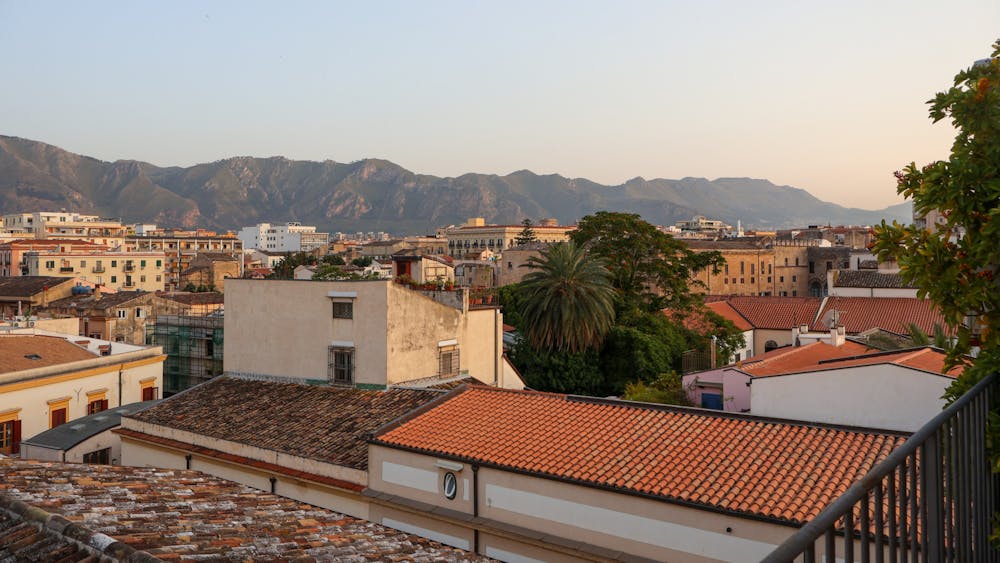
Reaching the top, a new view of the city emerges. Slightly south of my apartment, where I spent hours drawing different parts of the cityscape, I see farther east into the mafia–made apartment complexes on the city’s edge. He tells me about the mafia’s “Sack of Palermo” from the ‘50s to the ‘80s, during which the mafia destroyed historical buildings and replaced them with new apartment complexes to consolidate their power over the city. “My father told me that in the 50 years since he was born,” he says, “the city doubled in size.”
I noticed these complexes on my bus ride into the city from the airport a week earlier, finding beauty in the decorated balconies, flowers and vines dangling from each one. The quality of the buildings varied, though the orange hues of each provided a prettier sight than what the fascists left behind—especially against the backdrop of the glowing blue sea.
We talk for two hours, looking out at different parts of the city, sneaking around the dome and pushing up against its sides as families pass by. One family of tourists asks us to take a photo of them—the man’s fly is down, but neither of us has the heart to say anything. We feel guilty as they take a photo of us too. “What a beautiful city that I’ve never seen before!” he jokes.