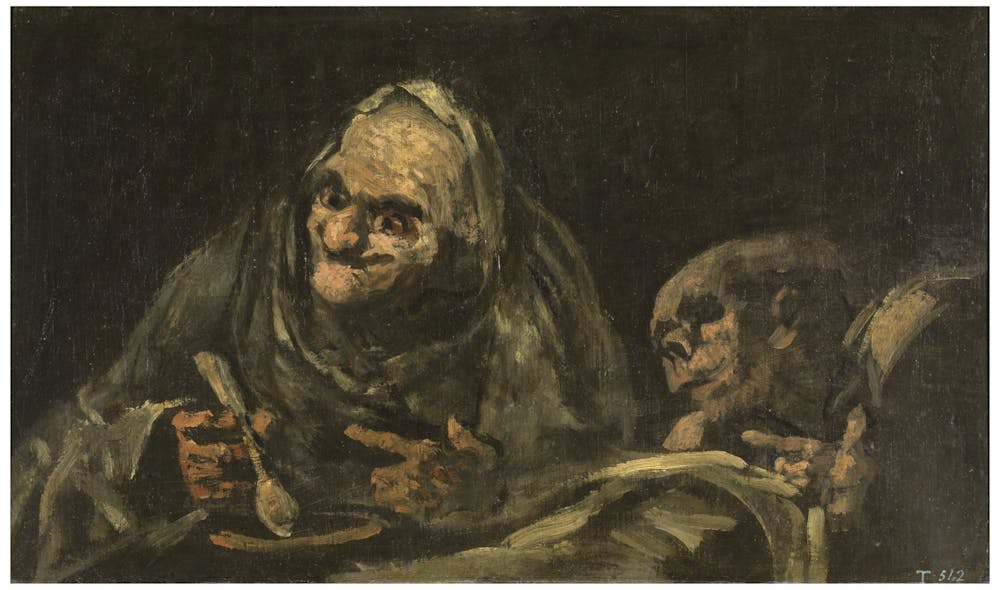
Francisco Goya’s Black Paintings sit in a dim room at the far southern end of the Museo del Prado, across the museum from the stern gaze of his likeness in bronze at the main entrance. After walking through grand halls of romantic historical paintings and light–filled salons of sculpture, entering this small, grey room feels a little like walking through a portal. Suddenly, you’re faced with walls of twisting greys and blacks, the brightest color being the crimson blood spouting from the severed head and wrist of the child in Saturn Devouring His Son.
The most widely known painting in the collection, it depicts the Roman titan Saturn consuming his infant son after hearing a prophecy that he would be overthrown by one of his male offspring. Upstairs, Peter Paul Rubens’ interpretation of this same scene hangs; in this one, Saturn is golden and muscular, his face twisted with rage as his teeth peel into the skin of his howling child. Goya splits from this idealized, all–powerful representation of the god: his Saturn is gray and emaciated. His expression is fearful, deranged, and desperate; he seems almost mortal.
The piece is perpetually surrounded by visitors. No matter what time you visit, it’s hard to have a solitary moment with it. Almost as interesting as the actual painting, however, are the reactions of those in front of it. It’s a sort of test for viewers to see where their gaze will fall: Will they look away from the gore, instead admiring the frenzied technique and strangely disproportionate limbs? Or can they stomach looking directly into the maddened, bulging eyes of Saturn as he devours his son?
I found that my own gaze varied day to day. Sometimes, I was one of the brave ones, maintaining eye contact; other days, my stomach would twist and my eyes would wander away. Some days, there would be too many competing eyes around me and I would surrender, turning instead to the paintings on either side.
The Prado became almost a second home to me when I was studying in Madrid. Any afternoon I was unburdened with homework, I would go and slide my student ID and driver’s license across the ticket desk to evade the dozens of euros I would have had to pay otherwise (I have a wad of student admission tickets waiting to go in my scrapbook as proof). The beautiful thing about a museum as monumental as the Prado is that you can first get physically lost, stumbling into rooms and hallways you’ve never seen before, and then lose yourself again admiring the new paintings you discover. But every time, no matter where I ended up, I would make sure I was in that darkened salon with Goya at least once.
Goya and his wife, Josefa Bayeu, only saw one of their seven children survive into adulthood. Only decades after becoming a father did Goya paint his scene of twisted parenthood directly onto the walls of the Quinta del Sordo, his house on the outskirts of Madrid. Literally translated as “villa of the deaf one,” the property was purchased in 1819 by the aging and hearing–impaired Goya, who sought to isolate himself from the Spanish court he had been disillusioned with for so long. Here, he painted freely, and here the scenes of the Black Paintings sprouted in oil, with the estate’s walls themselves serving as his canvas. There is debate about Goya’s mental and physical state at the time of their creation: Some attribute the twisted faces and otherworldly figures to severe mental illness or sickness–induced delusion. Whatever the cause, Goya exhibits an early kind of automatic painting, forgoing any rigid plans and changing his mind as he worked. Later art movements would expand on his initial innovations: The Impressionists would improvise to spontaneously capture light, the Surrealists to capture the subconscious.
This is the funny thing about many of Goya’s paintings: The things we feel we’re meant to be afraid of—the witches, the flying demons, the he–goats—are often more fascinating than anything else. It’s when Goya paints the human experience that he disturbs and horrifies us the most: the firing squad scene in The Third of May 1808 and the rape, decapitation, and execution in The Disasters of War. The paintings that disturb me the most are a blue–sky pastoral scene and a swimming dog, both with brighter palettes than the rest of the set: Fight With Cudgels, which features two young men about to beat each other to death with clubs, and The Dog, which depicts a sorry–looking canine almost submerged in a rising wave of sand–colored water.
Many frame the Black Paintings as evidence of Goya’s descent into madness; as products of an aging, solitary, and declining mind. But there is evidence that the artist was actually very sober in his older years, though likely a bit depressed. And he wasn’t alone in the house: Leocadia Zorrilla, recently separated from her husband, served as his housekeeper and companion. Her young daughter, Rosario Weiss Zorrilla, was his protégé. The artist might not have completed his works as lonely as one might think—he may have even painted them while trailed by his fascinated pupil.
In any case, it seems a bit of a discredit to cast these works as simple products of madness. Goya painted many horrors throughout the latter half of his career—but they were the horrors he witnessed in the world around him, not just those inside his mind. The twisted faces and distorted bodies they feature could be due to Goya’s adoption of a freer style of painting, one that departed from the rigidity of his earlier court portraits. But even if they were painted during a period of mental instability, that doesn’t detract from their power, their importance in the trajectory of art history, and their application to the human experience. There are few clearer–minded displays of fear and desperation than in the eyes of Goya’s Saturn, of hatred than in the faces of his two young men with clubs, or of tearful hopelessness than in the eyes of his drowning dog.