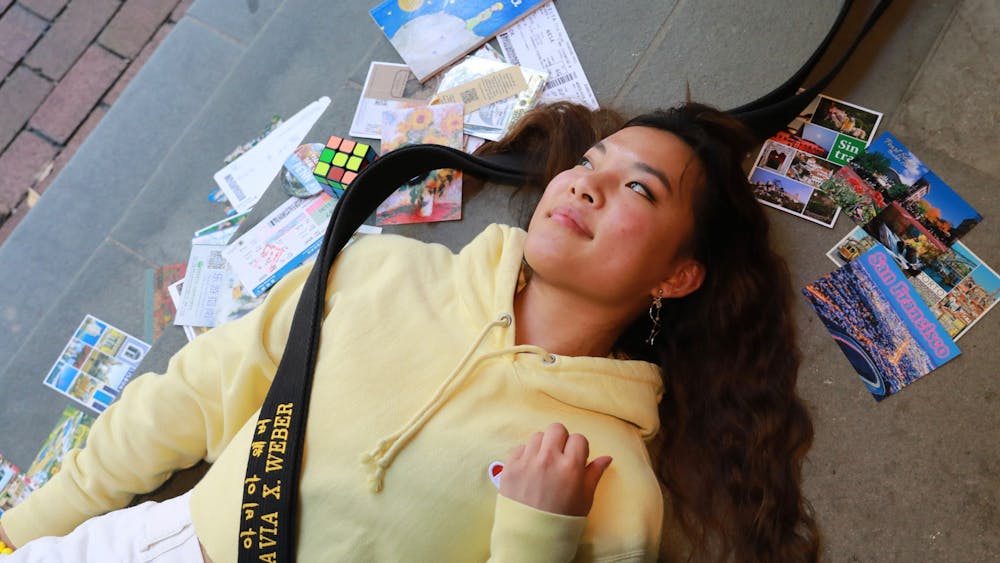
For Avia Weber (C ’26), yellow is more than just her favorite color—it’s a lifestyle. She arrives for our conversation dressed in a yellow hoodie that perfectly complements the chunky yellow beads of her bracelet. “It gives me a lot of energy,” she explains, cracking a smile nearly as bright as the color. “It’s positive optimism to start out the day.”
Originally adopted from China, Avia has had to find her own light while learning to navigate her Asian American identity. At Penn, she’s become heavily involved in both the adoptee and Chinese communities, which she leads with the same warmth she’s strived for her whole life.
Name: Avia Weber
Hometown: Hellertown, Pa.
Field of study: Major in psychology and international relations; minors in French and Francophone studies, East Asian language and civilizations (Chinese concentration), and consumer psychology
Activities: Penn Taekwondo, Impactful Mentorship at Penn for Adopted Children Club, Penn Traditions, International Relations Undergraduate Association, Penn Undergraduate Psychology Society, Chinese Language and Culture Club, Adalat Society, Zeta Tau Alpha, Theatre Arts Council
What inspired you to join so many organizations?
My biggest fear in life is regret. In senior year, my math teacher, who is my biggest mentor of all time, gave me a bracelet that says inside, “I hope you dance.” The complete quote is from a song that goes, “When you get the choice to sit it out or dance, I hope you dance.” So that’s been my motto throughout Penn and moving forward. I want to do as much as I can, expand my story, expand my narrative, expand the people that I meet. Every time you say yes, there’s so much that you can learn, do, and experience.
Which of your involvements at Penn has been the most fulfilling?
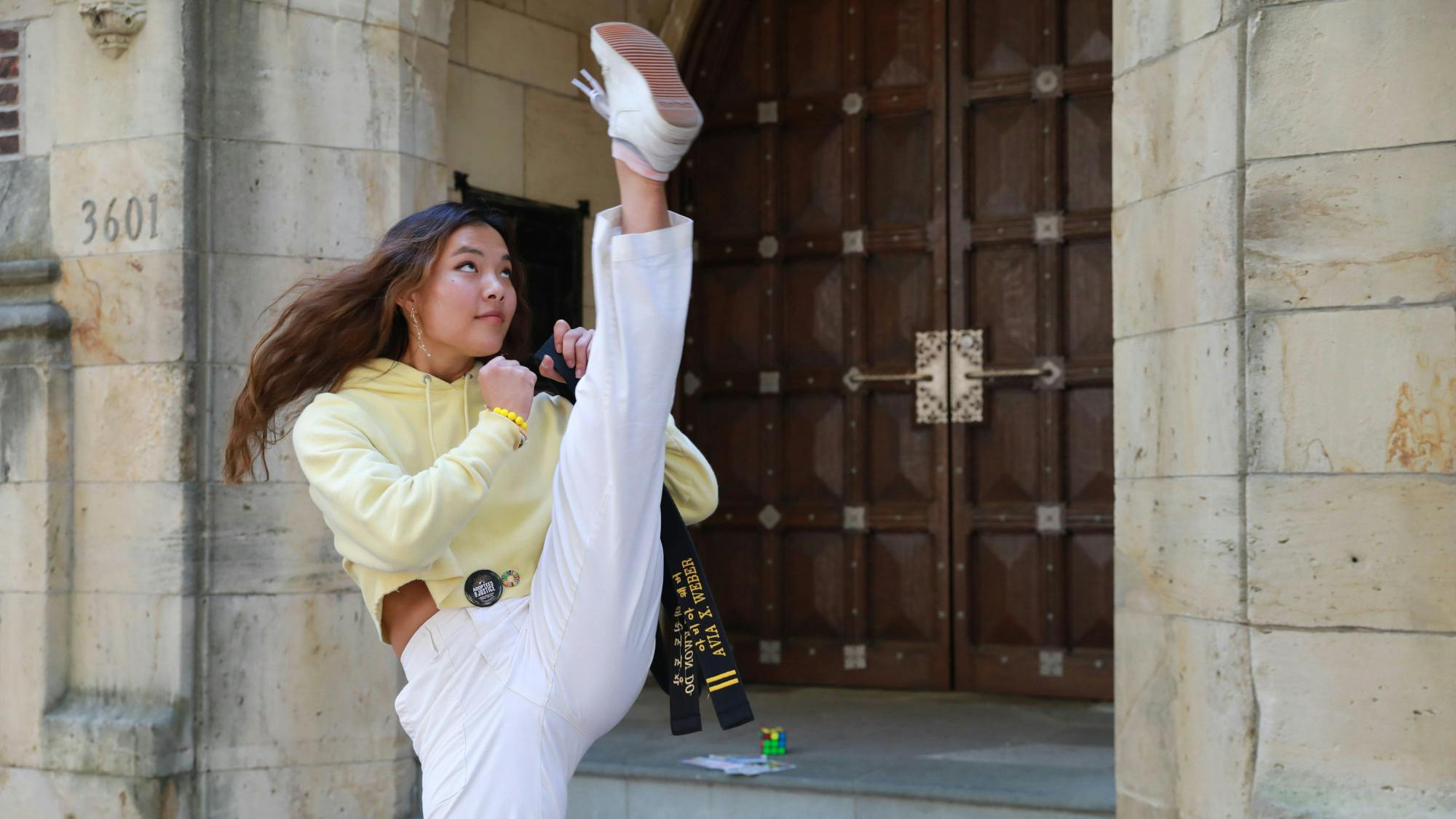
Penn Taekwondo. Although I did taekwondo throughout my childhood, I never competed in a tournament until I got to Penn. One way our team differs is we offer the opportunity to go to different tournaments at the Massachusetts Institute of Technology, Brown University, and Princeton University. The best part about competing is the confidence that you gain, because going onto the mat takes so much confidence and reassurance in your preparation. Understanding this my freshman and sophomore years helped me realize I was capable, and in my junior and senior years, I’ve worked to instill that confidence in others. Also, taekwondo has helped me see the power of community. We have this amazing phrase that goes, “A family that kicks together sticks together.” Because taekwondo is Korean and I’m Chinese, it is a place where I feel represented. It’s really surprised me that taekwondo has become one of my biggest commitments, but I’m really glad, because I can give myself and others the opportunity to find inner confidence.
How has your background as an adoptee shaped your experience at Penn?
Adoption never became a prevalent part of my identity until a lot later. I grew up in a predominantly Caucasian society, so I struggled to resonate with many Asian American experiences because I didn’t know much about the culture. For example, during the COVID–19 pandemic, there was a lot of anti–Asian hate. Although I had experienced some of this, I could not fully connect because I didn’t know the culture, the language, or the food. I felt completely lost. But since coming to Penn, I’ve started to identify more as Chinese American, and I understand the cultural nuances that adoption forces you to confront. In sophomore year, I started studying Mandarin. There are so many days where I sit in my Mandarin class and get frustrated because I can’t memorize or pronounce a character. I always think about how if adoption didn’t happen—if I was kept by my family—I would never have to go through this journey. But by meeting fellow adoptees at Penn, I got the reassurance that I wasn’t alone.
During your study abroad in Shanghai last year, you got to connect with fellow adoptees. What did this opportunity mean to you?
While I was building an incredible network of adoptees at Penn, I learned about some who were going back to their birth country. I knew that this was something I definitely wanted to do, so I spent a semester at Fudan University in Shanghai. I went in without any expectations, because I didn’t really want to be disappointed. Obviously, there’s the inkling that sits in the back of your head that goes, “Will I find my birth parents?” I did not, and that’s okay, but what I did find were a lot of opportunities to meet people, learn about U.S.–Chinese relations, and figure out where I stand as a Chinese American adoptee. It was so lovely. There is a great cohort of Chinese adoptees who go back there every year for work or study abroad. They gave me the support I needed, because even though I was back in my birthplace, it somehow felt so foreign. Especially if you’re in another country, there are so many ways to meet new people who inform your approach and perspectives on the world.
In addition to Mandarin, you speak several other languages. What are these languages, and what’s something people might not know about multilingualism?
I’ve been taking French since seventh grade. Then, during my freshman year at Penn, I audited accelerated elementary Spanish. It was really interesting to see the overlaps between Spanish and French. That same year, I also took part in the German House program. I felt so bamboozled because I was the only beginner, and they spoke nothing but German. Still, I learned so much about the culture, and it was wonderful. This past year, I took Russian for two weeks. I had to drop it because I was at a credit limit, and they wouldn’t increase it. But it’s fine; I’m going to try running it back in the spring.
All that’s to say, I just love learning from people and their stories—everything that builds who they are. So being able to say “thank you” in their language is so important. It’s community communication. And there’s a personal side of this too. Learning a language is so humbling. I think everyone at Penn needs to be humbled—I know it happens to us all 1,000 times a day, but the level at which you get humbled in a language class teaches you so much grit and perseverance. Being able to drag myself to Chinese class every single day, even on days when I don’t know anything on the vocab list, has helped me become comfortable with being wrong and not knowing anything.
Your interest in international relations is clear. But why psychology?
I’m really fascinated with using my international relations background to go into something regarding U.S.—Chinese relations. So regarding psychology, I think it’s important in building an understanding from a personal level about how our global system marginalizes a lot of people. Diplomatic spaces really need individual human recognition. That often gets overlooked because everything is done at such a global level. In a sense, a lot of citizens feel a lack of agency in what goes on in their own country. Having informed, personalized approaches to policymaking can help people gain back their sense of agency. They can feel that what they do has an effect on society at large.
At the same time, psychology helps me understand how our opinions on government and international relations are shaped. We’re a very social species. We learn from others. So when you talk to someone about what you think of a certain topic at an international level, you now influence their behavior, and it creates a huge, widespread effect. With everything that’s going on in the world, we’re constantly inundated with endless breaking news notifications from outlets like The New York Times. It feels really defeating when we have so much hope that is squandered by the amount of conflict that exists in the world. At this point, how do I, as an individual, move forward? By studying international relations and psychology, I’m hopeful for both the system and the individual.
Given your wide range of involvements, where do you see yourself post–grad?
Honestly, I have no idea, which is really daunting and overwhelming at times. But that’s the beauty of having so many interests—you’re always going to have a spontaneous lifestyle. I love traveling, and I think having an international impact on the individual level is really important. So whether that’s through going into global diplomacy or working with an international humanitarian organization, I know whatever I end up doing is going to be impact–based. Hopefully, I can explore the world and meet more people who will continue to expand my perspectives.
Lightning Round:
Favorite yellow object: My yellow Crocs, Jibbitz included
Favorite class you’ve taken at Penn: Penn Global Seminar in Paris
Best first date in Philly: A long frolic from 40th Street to Old City
Guilty pleasure: Bingeing Netflix, but more specifically Modern Family
Favorite book: The Little Prince (Le Petit Prince)—wherever I go, I like to collect the book in that specific native language
There are two types of people at Penn … people who stop and see the squirrels and people who speed walk to get to their next destination.
And you are? The person that stops and says, “A squirrel!”
This interview has been edited and condensed for clarity.
Do you know that one senior who brings a smile to everyone’s face or always has the craziest stories? It is time to give them the recognition they deserve. Ego of the Week seeks to showcase seniors not for their grades or any other academic construct, but for who they are as a person and the joy they bring to the people around them! Nominate your favorite Penn seniors for Ego of the Week!