For most, the end of freshman year is defined by the existential despair of final exams, the wistful feeling of knowing your first year is almost over, and maybe even some last–minute romantic debauchery. I, however, spent the final weeks of my college salad days obsessing over the greatest rap beef of my lifetime: Drake v. Kendrick Lamar. I had one too many data structures to study and a couple of friends to say goodbye to (no romantic prospects, unfortunately), but the thrill of infidelity, hidden children, and double agents enticed me more than anything else.
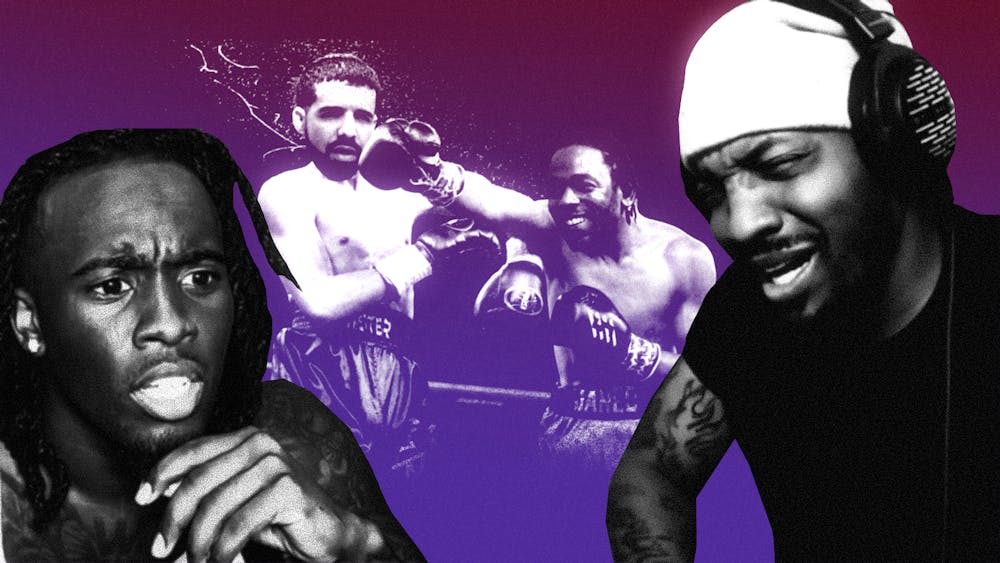
Alas, no one around me shared the same rabid fervor. “I swear we have a CIS 1600 final at 9 a.m. tomorrow,” a friend quipped after I interrupted his study session by rambling, unsolicited, about how Drake demolished the van from the cover of Lamar’s good kid, m.A.A.d city. So naturally, I turned to the Internet to seek out discourse on this topic. I was shocked to find that those at the helm of this debate weren't traditional music critics, but streamers and “reactors”—among them Kai Cenat, RDC, and ZIAS! (perhaps better known as the Hood Research Department).
The impact of these characters on the music scene has beenrecognized by both Lamar and Drake themselves. Drake, for instance, heralded the drop of his diss track “Family Matters” by texting Cenat “stay on stream” while the streamer was live (Drake would later block Cenat after he crowned Lamar the winner of the beef). Meanwhile, Lamar’s label removed all copyright claims against reaction videos made about his diss tracks. These videos have since gone on to accumulate tens of millions of views. This genius move weaponized the reach and power of content creators who were dying to chime in on the beef. Because Kendrick’s crew had effectively greenlit their participation in the conflict, reactors were more inclined to side with him: Every stream, clip, and replay of his songs were not only safe from takedowns but actively profitable for those covering them. Lamar’s victory was just built on more than simple lyrical superiority—his grasp on viral strategy was key to his success. In an ironic turn of events, his win hinged on the power of everyday content creators rather than the highbrow critics whose praise propelled him to a 2016 Pulitzer win.
This shift highlights a clear, if discomforting, reality: Traditional music journalism is on the decline. Music magazine Pitchfork, long touted as “the most trusted voice in music,” capped its decade long downturn by announcing its merger with men’s magazine GQ and cancelingits annual Pitchfork Music Festival in 2024. Other newspapers, such as the Los Angeles Times, have recently cut down on their arts coverage, completely axing their music editor and reporterroles. It’s easy to see why—in a scene shaped by the algorithms of TikTok and Spotify, gone are the days where we need basement–dwellers to tell us whether or not we should buy the new OutKast CD. The music taste of the modern listener (who is young, restless, and terminally online) is no longer shaped by some contrived, “objective” scale, but by neural networks whose extensive calculations curate the soundtrack for their next doomscroll.
So how have streamers in gaming chairs found success where entire editorial staffs have failed? Their greatest strength seems to be the immediacy of their responses. Traditional music journalism, with its thoughtful long–form content, often fails to connect with audiences in an age of instant gratification. Today's listeners want live conversations about music that echo their existing opinions, not critical pieces that might actually challenge their assumptions. Drake fans flocked to creators like DJ Akademiks and PlaqueBoyMax for trashing Lamar’s disses, while fans of Lamar flocked to Anthony Fantano for slightly more nuanced chortles at Drake’s ridiculous bars.
To listen to music with the modern content creator is to have a cheerleader by your side, someone whose every laugh, wince, or head–nod reinforces your own reaction in real time. The result is a new form of parasocial relationship that not only shapes rap beefs but radically alters the way we discover new music. Whereas Pitchfork once offered authoritative verdicts on new music, today's reactors act as simple emotional mirrors. It’s a mirror that I found myself staring at for one too many hours during the tail end of my freshman year; after every diss dropped, I looked immediately for reactions on Twitch and YouTube, eagerly awaiting the guffawing and screeching that filled the pauses between every sharp bar.
The Drake and Kendrick beef was the first shot in a revolution that seems poised to remake music discourse as we known it. While audiences once sought the objective, authoritative voice of a professional critic to help them make sense of the chaos, what we are left with today is an emotional mirror held up by a new class of digital cheerleaders. At the conclusion of the drama, I found myself conflicted. Is this a new age of music criticism, or have we traded careful analysis for louder echoes of our own voices?