Mobile Images, an exhibition on Mavis Pusey at the Institute of Contemporary Art co–organized with the Studio Museum in Harlem, is an insightful exploration of the world through the lens of geometric forms and abstractions. It was curated by Hallie Ringle, Daniel and Brett Sundheim Chief Curator of the ICA, alongside Kiki Teshome, curatorial assistant at the Studio Museum in Harlem.
The exhibition is a fluid encounter with many different aspects of Pusey’s oeuvre. Geometric abstraction permeates the entirety of her creative output, from paintings to prints and clothing. Through these common threads, Pusey distinguished the geometric forms in every contour, every glimmer of life, and every expression of her creativity. The abrupt, angular silhouettes that emerge repeatedly throughout her works become a kind of visual language, consistent throughout the varied media she explored.
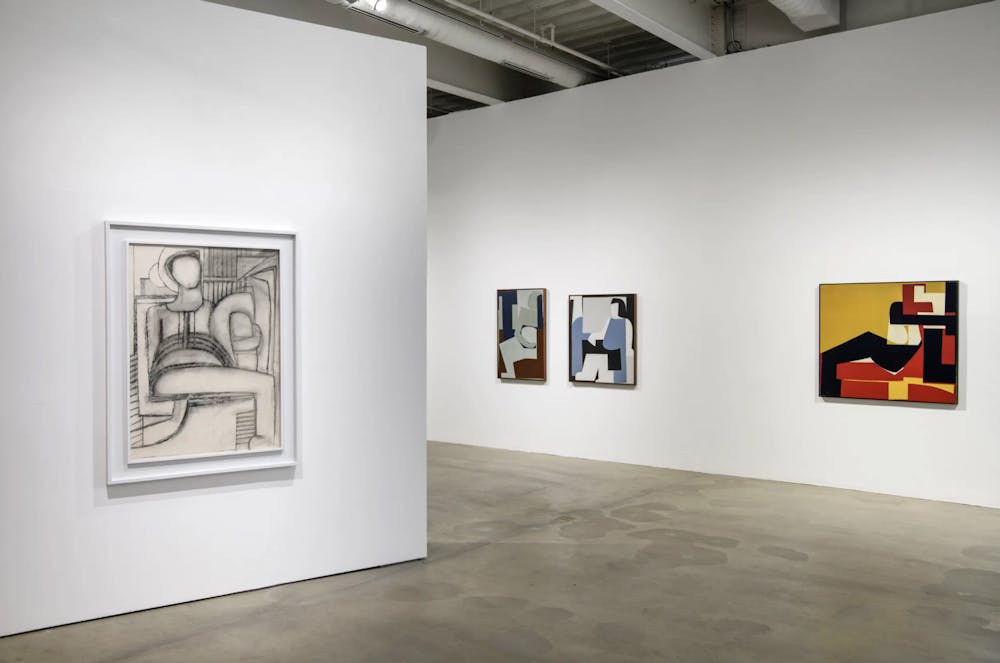
The first section of the exhibition, “Tailored Abstraction,” delves into Pusey's reflections on the human body and other forms. Here, we witness the evolution of her style in the medium of painting, moving from familiar, rounded shapes and figures to more pronounced, pointed depictions of the body. The later paintings are more in line with her wider style and embody her philosophy of abstraction over figuration.
What’s particularly captivating about this part of the exhibition is the way Pusey plays with the geometry of the human figure. For example, in the painting Solitude (1963, completed 1990), the viewer comes to focus less on the suggested subject and more on the surprisingly vivid interplay of roundness and angularity that it exudes through its mixture of squares, cylinders, and circles.
During her time at the Art Students’ League in Philadelphia, Pusey discovered “new ways of thinking about form, structure, and composition,” which proved fundamental to her eventual embrace of abstraction. This influence is especially evident in works like Solitude.
Despite her major artistic contributions, Pusey has been largely overlooked in the U.S. and hasn’t had a solo exhibition before this one. Her postmortem return to Philadelphia is particularly significant as a commemoration of the connection she had with the city.
Right by Solitude is Resting Figure, which has an equally multifaceted and luminous presence. Pronounced white circles and squares form the human figure, simultaneously flexible and rigid at the legs, which is framed by dark red and blue rectangular blocks on either side that evoke a sense of isolation and fragmentation. This work reflects her attempts to mediate between figuration, which traces the body, and abstraction, which fuses recognizable forms with novel, fragmented elements.
I was also drawn to her subtler works depicting natural subjects, such as Sensuous Movement of Seaweed and Rocks. Its subdued, faint colors allow the shapes to emerge with unprecedented clarity. This shift toward botanical imagery departs from her usual themes and perhaps reflect her Jamaican heritage, with the painting's visual language being rooted in the island’s rich natural environment. The painting helps integrate natural landscapes into Pusey’s language of geometric abstraction.
The exhibition's second section, “Rhythmic Tension,” showcases her experiments in printmaking and fashion. Pusey began her studies as an artist at New York’s Traphagen School of Fashion, but did not finish her degree due to financial constraints. Pusey even launched her fashion brand, Maviesey Co., in New York City, which produced a wide range of clothes. The exhibition displays a number of her sketches for button–up dresses, coats, and tailored suits. This facet of her work seems to be somewhat underexplored, but I found it to be a powerful addition to her oeuvre, revealing Pusey’s early interest in emphasizing geometric forms.
Another highlight of the exhibition is the concise but memorable record of her undertakings in printmaking. Pusey ran a printmaking workshop during her time in Philadelphia, and the archival display shows a preserved poster advertising it. An interesting piece using this technique is her series Untitled (Builders) 1 (1974), depicting the Hudson River and a nearby bridge. She adapted photographs into small prints, capturing the process of construction and deconstruction taking place in the city. The towering metal lines of the bridge frame the image of the construction workers beneath it, their figures tilted to mirror the bridge’s structure. The print medium is perfect for capturing the ephemerality and mistiness of this scene, a sense that grows on you the longer you look at it.
The third and final part of the exhibition is called “Restless Renewal.” It includes a captivating and multifaceted series, Broken Construction. The painting Broken Construction at Dusk (1976) stood out to me in particular—it beautifully encapsulates the tension between a careful, almost enchanting observation of metropolitan life and the simultaneous fragility that it carries within its movement.
In Within Manhattan (1977), the largest painting in the exhibition, emerging buildings rise and give way to the old ones. The canvas becomes a reflection on the city’s unstoppable movement, a movement captured in elements like the red bricks that make up the majority of the canvas, or the steel of a single ladder. The painting showcases New York City’s restlessness with a kind of tender clarity, its loudness and precision coming together in a natural, raw melody. She paints the urban space like a living thing, a landscape that falls, rises and stumbles.
Near Within Manhattan, a display of watercolors offers softer and more abstract compositions. Inspired in part by Wassily Kandinsky’s scattered, free–floating forms, these works flow across the paper with less angularity, more elongation, and a quiet durability. Untitled and scattered across the wall, the watercolors further emphasize the geometric rigor characteristic of Pusey’s style.
Re–gentrification (or Regeneration) (1986) is another work that commands immediate attention. Its colors flow organically, merging and overlapping across the canvas. The many images within the painting dissolve into the cityscape in streaks of white and yellow, punctuated by tiny eruptions of gray that perhaps stand for streetlamps as agents of urban transformation.
While I don’t necessarily interpret these works as depicting endless renewal, as the exhibition subtitle suggests, I see them as a sustained inquiry into the breathing, living nature of the city Pusey found herself unable to turn away from.
Mavis Pusey’s desire to create a new aesthetic of abstraction through inquiry, exploration, and patient observation is fully realized in Mobile Images. Whether capturing a place as it evolves, the beauty of the human body as it blurs into abstraction, or the cycles of growth and decay in modern life, Pusey is a master of unassumingly portraying the endless birth and destruction of the world around her.
Mobile Images will be on at the Institute of Contemporary Art until Dec. 7, 2025. You can visit it for free from Wednesday to Sunday from 12 to 6 p.m. at 118 S. 36th St.