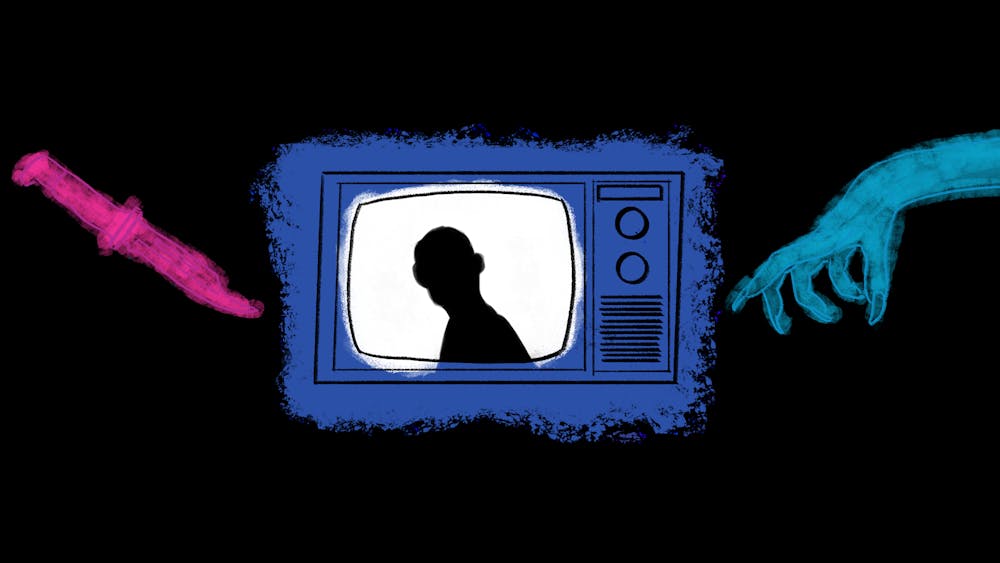
As the weather starts to get marginally cooler, it’s never too early to start preparing for Halloween. Here are ten of Street’s favorite horror flicks to take the guesswork out of celebrating spooky season.
Scream (Wes Craven, 1996)
You want a gory slasher, you want Courteney Cox in an endless cycle of neon suits, you want crazy homoerotic tension between a young F.P. (Skeet Ulrich) from Riverdale and Shaggy (Matthew Lillard) from Scooby–Doo. Add to that a healthy dose of self–referential charm that literally created the meta horror genre, and you’ve got Wes Craven’s Scream. Starring Neve Campbell as Sidney Prescott, a high schooler still reeling from her mother’s murder, the film follows a series of mysterious slaughters in her little town of Woodsboro, Calif. The franchise shows us in no uncertain terms that the figure behind the mask isn’t always the hysterical madman we’re inclined to blame—sometimes it’s a boyfriend, a best friend, or even a brother. Scream is more pop–culture classic at this point than true horror, but its warnings are clear: Trust no one, and don’t answer the phone.
—Liana Seale, Film & TV editor
Nope (Jordan Peele, 2022)
In my opinion, Nope is Jordan Peele’s best project. From deadpan humor to bone–chilling thrills, this film packages its excellence in an entertaining ride. Nope follows horse trainer OJ Haywood (Daniel Kaluuya) and fame–seeking sister Emerald Haywood (Keke Palmer) who begin to notice mysterious things in the sky, offering them an unexpected opportunity and a “bad miracle.” The two market themselves as direct descendants of the unnamed horse jockey in Eadweard Muybridge’s Horse in Motion, working as the “only Black–owned horse trainers in Hollywood.” Like all of Peele’s films, the themes of exploitation aren’t subtle, though this horror–Western goes above and beyond in its self–conscious deconstruction of the film industry. With a phenomenal supporting cast and blink–and–you’ll–miss–it references to iconic flicks like Close Encounters of the Third Kind, Neon Genesis Evangelion, Jaws, and even Akira, this genre–blending spectacle raises the bar for original horror and is a must–watch for all my fellow Letterboxd users.
—Chenyao Liu, Film & TV beat writer
Titane (Julia Ducournau, 2021)
This is a recommended first–date watch if you want to trauma bond over car sex and daddy issues. Titane is part body horror, part girlhood nightmare, part wish–fulfillment fantasy of finding someone who really holds you, and it works on every level. If you’ve ever turned pain into a performance or sexualized your trauma to feel in control, this one is for you. Titane is a story about becoming monstrous because the world only understands spectacle, and finding someone who stays anyway. Love without expectation is the most horrifying and holy thing of all. Agathe Rousselle delivers a staggering debut performance, all physicality and suppressed emotion; she barely speaks, and yet you feel everything. Julia Ducournau (who also made Raw and is our Lord and savior) became the second woman ever to win the Palme d’Or at the Cannes Film Festival for this because she gets it. This is one of the best films of the 21st century, and more people need to be freaks about it.
—Kate Cho, Style editor
The Wailing (Na Hong–Jin, 2016)
If you’ve ever had a Catholic panic attack in your Korean grandma’s house, this one’s for you. The Wailing is slow–burn religious horror that escalates into a full–blown theological psychosis spiral. Ghosts? Maybe. Demons? Definitely. A shaman who dances so hard he throws up? Absolutely. But the actual horror is watching a father try—and fail—to protect his daughter in a world where truth is slippery and God is looking away. Set in a foggy mountain village, it starts out like a grimy small–town cop drama and ends somewhere between The Exorcist and a Book of Revelation fever dream. It’s about xenophobia, generational guilt, and what happens when religion becomes performance instead of protection. Also, it’s about a cop who absolutely cannot do his job.
As someone who grew up Korean Catholic, to me, this movie feels like spiritual warfare on screen. Every guilt trip, every quiet fear that you misread a sign from God—it’s all here, festering, and festooned in rotting carcasses.
—Kate Cho, Style editor
Jessie, “The Whining” (Season 2, Episode 1)
What do The Shining, Twilight, and Frankenstein all have in common? Beyond just being great works of art, they are, perhaps more importantly, references in Rich Correll’s masterpiece “The Whining” from Disney’s hit series Jessie. This episode was my first exposure to the horror genre, the one that gave me countless childhood nightmares, and it remains a perfect combination of Disney’s cookie–cutter sitcom style with the terrifying thrill of the genre.
After the Ross children hear a gruesome story of a deranged nanny who petrified children on the 13th floor, they begin to suspect that their nanny Jessie (Debby Ryan) might repeat history as she hunts down her own big journalist scoop. Filled with homages to The Shining, including scary identical twins and a hallway spewing with “blood,” this episode strikes the right balance of childhood nostalgia sprinkled with just enough spookiness that makes you want to leave the lights on after watching.
—Jackson Ford, Street multimedia editor
House (Nobuhiko Ôbayashi, 1977)
I spent Halloween my senior year of high school dressed as a hippie watching movies with my film–bro friend. We did a double feature as we usually did—I picked The Shining out of FOMO of never having seen the quintessential horror film and Film Bro picked House to flex his artistic muscles. Despite the fame of The Shining, House was my perfect horror movie that night. Horror is often synonymous with the ugly, but House manages to find beauty in the uncanny. It is scary in the way that Edward Munsch’s The Scream is scary—representing horror but offering enough distance to allow space for observing fear rather than being encompassed by it fully.
—Norah Rami, editor–in–chief
Barbarian (Zach Cregger, 2022)
Zach Cregger’s Barbarian is what happens when you book an Airbnb, and the worst–case scenario isn’t bedbugs or weak WiFi, but a labyrinth of pure nightmare fuel lurking below the surface. The setup is gorgeously ordinary: A woman arrives at a rental and finds a stranger already staying there, but every moment after is a lesson in escalating dread and bad decisions made under fluorescent lighting. This is a film that genuinely gnaws on your fear of strangers, safe spaces, and what waits in the dark, sprinting from social awkwardness into the kind of horror that makes you want to burn down the house and never look back. Barbarian’s jumpscares are earned, its tension is suffocating, and the reveal is both sickening and brilliant. It is truly a cautionary tale for anyone who has ever scrolled past a one–star rental review and thought, “How bad could it be?”
—Arina Axinia, Social Media editor
Black Swan (Darren Aronofsky, 2010)
Black Swan is a tragic psychological horror film that traces a burnt–out ballerina’s visceral descent into madness. Unlike traditional horror movies filled with macabre monsters or aggravating friend groups lacking self–preservation instincts, Black Swan uses relatable themes of mommy issues, misogyny, and corrosive perfectionism to “scare” its viewers into an existential spiral. If you find yourself rewatching Gilmore Girls and resonating—perhaps a bit too much—with Rory’s gifted–kid burnout syndrome, Black Swan offers a chance to delve deeper into the psychological fragmentation that accompanies self–destructive ambition. Through Natalie Portman’s phenomenal performance as Nina Sayers, we see the movie wrestle with conflicting ideals of femininity and men’s expectations for women to embody both the innocent White Swan and sensual Black Swan. A perverse coming of age, the movie challenges the reductive archetypes projected onto women while warning us against the self–sacrifice required to achieve patriarchal standards of perfection.
—Chloe Norman, Features editor
The Blair Witch Project (Eduardo Sánchez and Daniel Myrick, 1999)
It doesn’t take much to make a cult classic. I hand you a mic, a camcorder, and a few no–names to fumble compass readings and panic–snot all over the lens—it’s enough to birth one of the most superstitious (or at least, persuasive) films of all time. Three blubbering film students walk into the woods to chase a campfire story, argue themselves into delirium, none come back. I get serious FOMO thinking of its release in theaters, which briefly convinced every twentysomething in the ’90s of two things: First, that this is real and second, that it’s actually possible to get lost in Maryland. I’m not so sure we’ll ever pull that off again, but shaky cam has ballooned into its own industrial complex. Hell, Street could take a retreat to the Poconos with a digicam and a box of Franzia and come back with our own found footage masterpiece.
—Sophia Mirabal, Music editor
American Horror Story: Coven (Ryan Murphy, 2013)
I have always wanted to be part of a coven, but this one is led by Jessica Lange and Sarah Paulson and includes recruits such as Emma Roberts and Evan Peters. And wait for it—not only do they team up with Angela Bassett as Marie LaVeau, a voodoo priestess, but Stevie Nicks also appears as a coven alumna with a beautiful cameo. I will never hear “Rhiannon” or “Seven Wonders” the same. This season is set in New Orleans, and Murphy creates a girl world adorned in black lace, dressed in Balenciaga and Givenchy. American Horror Story’s inspiration of American folklore to create thrill while threading modern Americana into the tapestry of its stories is the kind of masterful world building that makes this show worth watching.
—Anissa T. Ly, Ego editor