
Contains spoilers for both The Long Walk and The Hunger Games series (if people somehow haven’t read or seen the latter)
For some reason, time loop movies have been on my mind lately. I recently watched Groundhog Day for the first time, and I saw Palm Springs just a few days later. I read Before I Fall as an impressionable middle schooler and lately, nostalgic flashes of its film adaptation have been bubbling up out of my subconscious. Time loop movies are meta–repetitive, and with such an easy formula to exploit, they risk subjecting viewers to the same psychological torture as their characters if not given a unique spin.
When I walked out of The Long Walk, I may have been the only person in the Fashion District AMC thinking about time loop movies. But what if instead of a resetting daily cycle, the loop was an endless, unforgiving stretch of highway? What if, instead of nothing you do or say really mattering because it’ll all start over when you wake up again the next (same) day, every decision and every step etches itself into your knees, your heart, your mind? What if instead of an alternate life, or a pocket between life and death, your lifespan was crunched down to just a few days, sure to end when your legs give out and the bullet hits your head? Do you still choose to protect the people around you? Do you still choose hope when your own mortality looms ahead of you in the rapidly approaching distance?
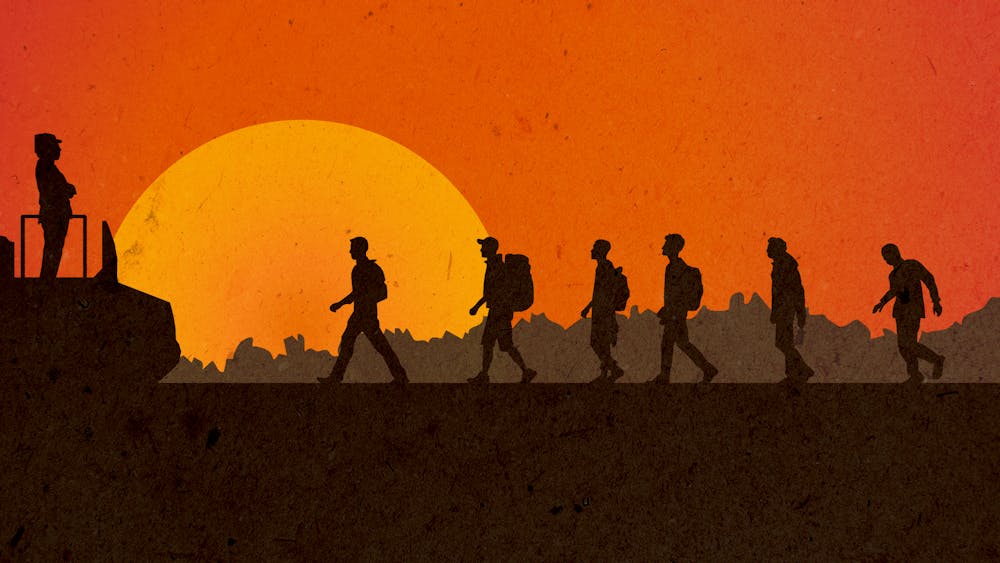
The Long Walk is based on a novel written by Stephen King under the pseudonym Richard Bachman in 1979. In it, King paints a picture of a post–war, broken–down America: a totalitarian police state where clockwork carbines flash by on military thighs and everything we know has been reduced to an ugly wasteland. Every year, all the young men in the country are eligible to put their names down in a lottery to participate in The Long Walk: a brutal, deceptively simple marathon presided over by the authoritarian, sadistic Major (Mark Hamill). There are only a few rules. Begin walking along Route One from Fort Kent, Maine, right on the Canadian border. Maintain a pace of four miles per hour; changed to three in the film. Slip below that speed once, and the silent armed guards issue you a warning and a brief respite until the next; three warnings and you “get your ticket.”
Which is, of course, a sanitized way of saying you get shot in the head and left on the road.
The novel was largely, if unconsciously, inspired by Stephen King’s experience watching the Vietnam draft, and it’s easy to understand why the metaphor holds up. Film critic Darren Mooney astutely writes: “This is, after all, a story published in the late seventies but written much earlier about a draft that conscripts a generation of young men into a pointless forward march with no end in sight, all on the promise of some abstract reward at the end of it but the more likely inevitability of a bullet waiting for them, as a disaffected nation looks on.”
What’s especially interesting about director Francis Lawrence’s film adaptation is its timelessness. The boys’ vocabulary could be from the 1970s or 2020s or anywhere else; their clothes, the atmosphere of the rural, run–down setting, and the guards’ uniforms and guns are all intentionally unassociated with any particular decade. That's not to mention the threat of a dystopian country where democracy has broken down, which feels especially applicable at the time of the film’s release.
While the original text could never have been inspired by Suzanne Collins’s 2008 novel The Hunger Games, The Long Walk shares its director with Catching Fire and both parts of Mockingjay, the adaptations of Collin's second and third books in the Hunger Games series. Lawrence, known for building sweeping, dark worlds that put our own under scrutiny—namely, in THG, the wealth inequality between the Capitol and the outer districts and the bizarrely juxtaposed spectacles of high fashion and violence against children—now tells a dystopian tale through a far more intimate lens, making us feel more like we’re on the Walk with the boys than observing as disconnected spectators.
But it might be surprising to see how much Lawrence thrives inside the cinematic walls of his enclosed world. Gone is the broader worldbuilding, the glamorization of the spectators, the self–aware critiques of an outside world hungry for entertainment. The Hunger Games is fantastically horrifying, and does all of this very well. But The Long Walk does something different. Save for one slightly on the nose but ultimately acceptable flashback that reveals some of main character Ray Garraty’s (Cooper Hoffman) backstory, the entire film takes place on the road with the boys. As I frantically texted my friends on the subway ride back from the theater, “i don’t think you understand how rare it is for a Hunger Games–esque violence porn genre style film to sustain itself almost entirely on dialogue.” I also can’t remember the last time a traditional horror movie made me cry! This many times!
Hoffman and co–star David Jonsson, who plays Ray’s best friend on the Walk, Pete McVries, absolutely carry the film, and their close bond becomes the emotional throughline of an objectively repetitive plot structure—boy gets warning, then ticket, repeat. The two form the core of a makeshift friend group—all actors chosen for their ability over their name appeal—who call themselves “The Musketeers” and resolve to look out for each other in the face of their individual ticking clocks. They crack jokes, they spur each other on when facing self–destructive despair or leg cramps or a particularly steep hill, and they talk about, it seems, everything. This is how Lawrence gives us shockingly excellent pacing and comprehensive worldbuilding without shifting his cameras away from rural Maine; with nothing to do but walk and talk about why they’re walking, that’s what the boys do. Even when they’re not sure why they started. Even when they’re not sure why they’re still going.
This intersection of gutting dialogue and Oscar–worthy acting creates a raw, authentic intimacy between all of the boys whose emotional resonance lingers even as each one drops out of the scene. Despite all the Darwinian logic and competitive expectations, once they’ve made their community, they won’t let one of their own needlessly suffer. It’s apparent when Ray gives away his rationed food to Hank Olson; when Ray almost runs off the road into his mother’s arms and Pete is the only one who can pull him back from the edge; when Hank Olson (Ben Wang) cries out for Art Baker (Tut Nyuot) in his dying moments and Art runs to his side; when Ray and Pete promise Art that whoever wins will deliver Art’s cross necklace to his grandma, giving Art the reassurance that he can meet his end in peace.
And then, of course, there’s Pete and Ray, with whom neither King nor Lawrence is afraid to draw the homoerotic out of the homosocial; The Long Walk was gay in the ’70s, and it’s gay now. Their friendship is not overtly romantic, but it can certainly be read that way, and there’s a fully–baked understanding of romantic signaling in their intimacy that feels rare—especially when a lot of queer media sticks to either side on the spectrum of in–your–face to shady gaybaiting. Drawing on other Stephen King film adaptations about boys who grow into men and choose community over isolation—Stand By Me, The Shawshank Redemption, It—Hoffman’s and Jonsson’s performances are a nod to the sometimes fluid intersections of love and friendship within the male coming–of–age experience, painted for the audience through life–saving embraces, conversations laced with natural chemistry, and glances that linger slightly too long.
For all the gore in TLW, Lawrence further humanizes the boys by avoiding the glorification and sensationalization of violence that is common in this genre. Mooney continues: “One of the bigger issues with the Hunger Games franchise has been the tension between the horror of what is happening on screen and the simple fact that gladiatorial combat is inherently fun to watch.” The same can be said about Squid Game and the Saw franchise—there’s a disconnect between how we should feel about the societal circumstances of the story and the can’t–look–away intrigue of the blood, gore, and creative deaths.
The framing of the Hunger Games themselves is more illuminating than outright heartbreaking, because injustice is baked into their design. The children from the top districts have been training their whole lives for the games; when they go after Katniss, they become “villains” rather than victims of a universally destructive system, and we naturally feel less sympathy for their deaths. In contrast, the drafting of 12–year–old Rue feels disproportionate to the other 23, making her death the most devastating moment of the film. When watching this and the Saw sequels and Squid Game, you have to constantly avoid the filmmakers’ moral traps to remind yourself that it’s all tragic, it’s all horrible; no one deserves to suffer grotesque violence just because they don’t approach life–or–death situations with the same humility and compassion as the heroes.
The Long Walk, on the other hand, feeds both its participants and its audience a strangled, optimistic fantasy of equal opportunity, drawing parallels to the fraught ideal of the American Dream. Technically, anyone can win, since all you have to do is outwalk everyone else. The deaths are all equally hard to watch, and every single one is shown—bluntly, matter–of–factly, lingering behind the main shot even after the audience wants to turn away. They’re not satisfying or fun or justified—one boy has a seizure and is left to convulse until his time is up, another boy is shot with his pants down while suffering from fatally loose bowels—and the one disagreeable “villain” character (Charlie Plummer’s Gary Barkovitch) is made genuinely sympathetic well before he takes his bullet. The deaths are more understated and visceral than in other movies that incorporate gruesome violence; it almost feels like we’re watching them happen in real life.
Where The Hunger Games gave us hope in the form of resistance, The Long Walk gives us resistance in the form of hope. Everything about the former film is self–aware and ironic: Katniss and Peeta use their romance as a PR stratagem to manipulate their “supporters” before finally threatening a double suicide that forces the Capitol to let them both win. This ploy puts a target on their backs, but is the first step of their eventual successful revolution.
Regarding the latter, however, Lawrence and screenwriter JT Mollner changed King’s controversial ending—originally ambiguous in its implications of winner Ray’s broken psyche and imploding grief—to a more clear–cut revenge narrative. Although Pete wins in the film and murders the Major, a righteous action that’s incited by the intense friendship between Pete and Ray—and their equally intense goodbye, underscored by the perverse cheers of onlookers—the film still doesn’t feel like it’s been crescendoing up to the start of a revolution. In fact, we can almost guarantee that a new Major will slot into the now–open position, and that Pete is more broken than ever now that he’s left alone. The point of the film is not the ending, but the genuine pockets of hope between the bleak horrors. The love and friendship and brotherhood stick with you past the credits, and you remember every boy of the core cast for how they lived, not for the way they died.
Which brings me back, finally, to time loop movies, and why they feel like a more apt category for this film than a social satire. Conversations about autonomy are tackled both explicitly and implicitly in the film, a reminder of how sticky it is to define freedom and free will. Garraty forces the other boys to question how much of the “decision” to enter the Walk was really theirs when it’s the only way out of a ubiquitously shitty lifestyle. Within a world where freedom of speech is heavily restricted (It’s super fun to write about this in 2025!), the Walk is the only place where they’re allowed to dissent, to pump their fists and yell “Fuck the Major!” even while their bodies are threatened into constant forward motion. Just as a time loop traps its characters in a shrunken, warped reality, the Walk becomes a way to live a twisted version of life where you’ve made real friends and left an impact on those around you … which is strangely preferable to living and dying in squalid, dystopian anonymity.
And much like characters in a classic time loop, the boys on the Walk shift their perspectives over the course of the film, slowly gaining a persistent hopeful outlook, an appreciation for being alive, a more mature acceptance of death, and a stronger love for one another. Despite the fact that direct competition is not what fuels the elimination process—since they get knocked out one by one from sheer exhaustion instead of fighting one other to the death—it would still be easy for the boys to succumb to their despair and turn on one another. If nothing really matters in the end, why should you care about what happens to the people around you? The Long Walk answers that caring is the only way to get through uncertainty and tragedy.
“There [is] still so far to walk,” the end of King’s novel reminds us, as we watch Ray spiral into madness. 46 years later, Jonsson's Pete walks off alone into the distance, his best friend dead behind him. There is no value in living this life alone; there’s no life to live without the people you love. So let’s walk a while longer, side by side, and do our best to take care of each other along the way.