You’d be hard–pressed to find someone who’s never heard of The Office. Over the course of its nine–season run, the workplace sitcom cemented itself as a quintessential “comfort show,” and has since become one of the most beloved shows of our time. It’s for good reason—with characters who walk a fine line between ridiculous and recognizable, zingers that get stuck in your head long beyond when you want them to, and jokes that make you laugh even when you probably shouldn’t, it’s not the type of show you easily forget. But emotional resonance aside, its immense success reflects the time in which it aired —a time before streaming was universal and before social media fried all of our attention spans. So what does it look like to revisit the Dunder Mifflin universe twenty years later? This is the question that Greg Daniels and Michael Koman both ask and answer with their new The Office spin–off series The Paper.
With a devoted fanbase, a long–lasting impact on the cringe comedy genre, and a plethora of less–successful rip–offs, a canon spin–off of The Office seems like a surefire recipe for success. But the reviews are in, and while it’s doing well overall, some viewers certainly seem to have their reservations. Ranging from “roaringly funny” to “grievously unfunny with nothing of interest to say,” critical opinions are starkly divided on the new series. And while critics are raising a valid concern—that this first season feels awkward and timid at times—it should be acknowledged that The Paper faces an entirely different set of challenges than its predecessor did. Overly harsh criticisms of its premiere season fail to acknowledge the intense difficulty of navigating a comedic landscape that has become less forgiving and more demanding over the past twenty years.
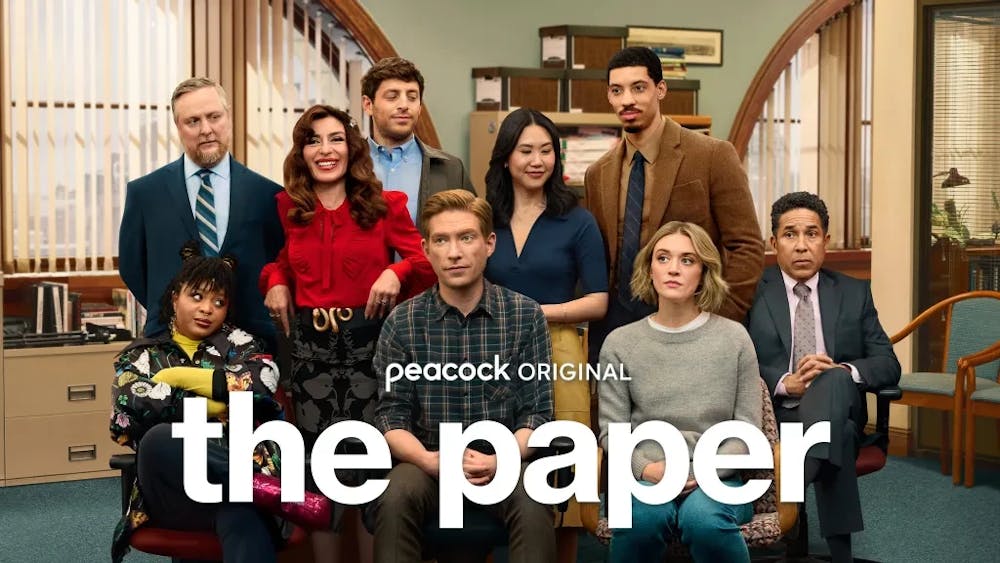
The Paper follows the relentlessly optimistic Ned Sampson (Domhnall Gleeson) on his first day of work as editor–in–chief at the Toledo Truth Teller, convinced he’s going to save the paper from its slow slide into tabloid hell … until he meets current managing editor Esmeralda Grand (Sabrina Impacciatore), who is dragging it there on a leash. Their dynamic epitomizes unstoppable force meets immovable object, going from steadfast rivals to reluctant co–conspirators over the course of the first season.
Surrounding them are a group of reporters with lots of enthusiasm but almost no experience, apart from Mare Pritti (Chelsea Frei), who quickly becomes Ned’s right–hand woman as his only competent staffer. The others—commitment–averse Nicole (Ramona Young) and her way–too–committed admirer Detrick (Melvin Gregg), as well as skeptical Adelola (Gbemisola Ikumelo), awkward father of four Adam (Alex Edelman), senile Barry (Duane Shepard Sr.), and volatile Travis (Eric Rahill)—form what can almost be called a news team.
The show seems to be following a formula we know and love—a weird boss, incompetent employees, a few awkward but adorable budding romances—but The Office didn’t owe its comedic magic to a formula. It came from its creativity, its audacity, its tendency to err on the side of “too much” rather than “not enough.” And in a much more sensitive political climate, it’s just that much harder for The Paper to take the same risks.
Where The Office had entire episodes poking fun at questions of race and sexual harassment back in the aughts, The Paper would be scrapped before it made it to print if it attempted the same thing today. As such, the writers adapt to modern standards by punching up instead of down. Rather than making fun of returner Oscar Martinez (Oscar Nuñez) for his gayness, The Paper opts to make fun of the company that houses the TTT for pinkwashing—the problematic phenomenon of corporations or governments profiting off of their public support for the LGBTQ+ community. The jokes still touch on politically charged topics, but are decidedly PC in their execution.
Unfortunately, it’s easier to cringe–laugh at the blatant homophobia of Michael Scott; corporate strategist Ken (Tim Key)’s mild ignorance earns only a chuckle. This isn’t to say it’s impossible to be funny without punching down; another episode about the ridiculous products that the beauty industry tries to peddle earns laughs without targeting those who fall victim to their propaganda—the industry itself is the butt of the joke, not the people who buy into it. It’s still offensive, but to a different audience.
But many of The Paper’s best moments have nothing to do with offense and everything to do with absurdity. Esmeralda is a strength throughout, and her jokes typically have her as the punchline—just without taking down everyone around her as collateral damage. She isn’t the new Michael Scott, and she isn’t trying to be; her actions rely very little on how much others like her, giving her a volatile edge in a markedly different way.
It’s this distinction that makes The Paper worth watching as its own show. An interview with the cast—Frei, Gregg, and Young—reveals that originality was a central focus in developing their characters. Rather than modeling Detrick after any particular Office character, Gregg says that he “just completely erased any memory of them … to try to emulate that would be a disservice to myself and to those characters.” Young adds that during the audition process, they “didn’t even get any sort of character description or real names or real scenes. So when we auditioned, we really had to put in our own original interpretations.” This speaks to The Paper’s commitment to forging its own identity—an admirable decision when it would be so easy to lean into the legacy of The Office and lean on fan service for views and praise.
While The Paper has solid potential despite its first season hiccups, I worry for its future in a world where audiences have become far too accustomed to instant gratification. With countless options at our fingertips, it’s far easier to move onto the next big thing than it is to be patient with shows that are just starting out.
For every comparison made to The Office, there needs to be an acknowledgement that our darling Dunder Mifflinites didn’t necessarily find their groove until a few seasons in. Neither did the folks at the Pawnee Parks & Rec Department, or the gang at Paddy’s Pub. What allowed these shows to blossom into the cult classics they are today was a combination of patience and time—audiences that were more willing to give the shows they watched a chance to work out their kinks. It’s unrealistic to expect The Paper’s characters to be as endearing as those of The Office right off the bat; we can’t love them until we know them, and we don’t know them after only one season.
Luckily, we won’t have to say goodbye to the reporters of the Truth Teller just yet. The Paper has already been renewed for a second season, so we can rest easy knowing that these characters will have another chance to win us over. With future seasons to look forward to, it’s very possible that The Paper will set a new precedent for the contemporary workplace sitcom—one that adapts to the current decade instead of sustaining itself on nostalgia bait.