Four decades ago, before everyone had Instagram profiles and every website looked identical, people had laggy, amateur, eye–bleeding personal websites. In the 1990s, the onset of the dot–com boom marked a turning point in internet history. For the first time, access to the web was no longer limited to academics and researchers. Free website hosting services like GeoCities, Angelfire, and Tripod supported an era of unique user–generated content, helping build online communities through vast networks of personal websites. For a brief time, anyone could own their own corner of the internet and shape it in their own image.
This period of early internet history has been dubbed the “amateur web,” and in retrospect, it was beautiful. It was a time before professional website design, an era characterized by bright colors, poor–quality GIFs, and rudimentary code. People formed online communities (“neighborhoods”), linked their websites together in webrings, and blogged about anything and everything their hearts desire. In an era of endless website templates and vibe coding, the early internet feels uniquely ensouled—and its DIY ethos holds lessons for the web designers of today.
The amateur web was a beautiful but ephemeral period of internet history. You could spend hours perusing websites about anything in the world, displayed on unique pages constructed out of passion, curiosity, and raw talent. Regular people were teaching themselves the newly invented languages of HTML and CSS as they populated their websites with animations, funky text, and background music. It was an Enlightenment of sorts; a period of learning, creativity, and community fueled by random people Frankenstein–ing together lines of code and inspiring others to do the same.
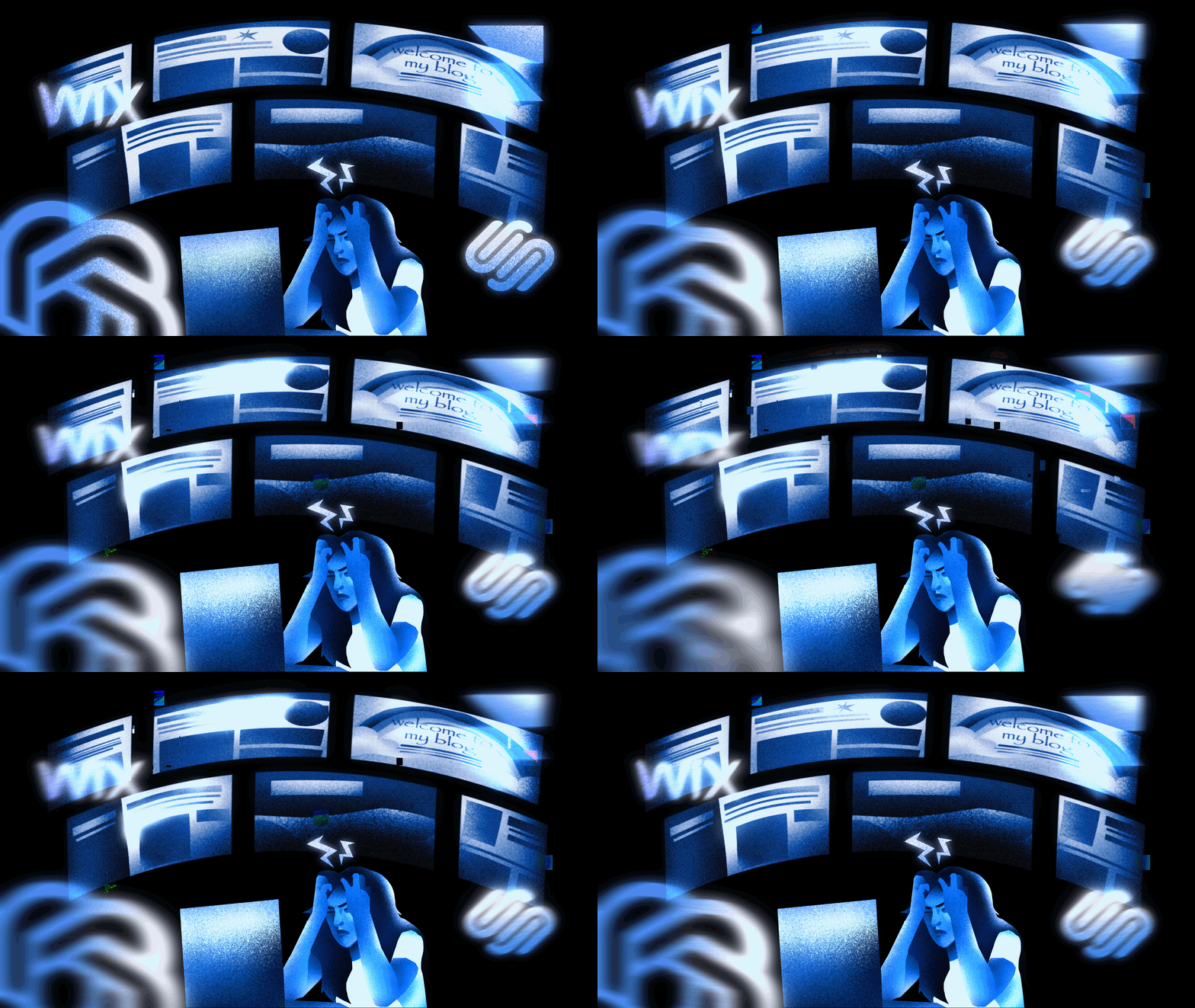
But with the pivot to professional website hosting and the rise of mass social media platforms in the 2000s, amateur personal websites have more and more become a thing of the past. Website builders like Wix and Squarespace have taken over the design space, popularizing a plug–and–play approach to web design that allows users to easily create professional websites, devoid of personality or risk, without writing a single line of code. It’s easy to understand why internet users have abandoned the endearing eyesores and extravagance of the early internet, particularly as websites began serving wider audiences. But nearly every website made from one of these cookie–cutter templates is the same—navbar on top, clean edges, and minimalist graphics created to upset no one and please even fewer.
This isn’t to say that creative web design no longer exists. While I may have missed the dot–com boom (the only downside to being Gen Z!), I’ve still been able to experience the joys of teaching myself basic HTML and CSS to customize my profiles on DeviantArt and Tumblr. But for the vast majority of internet users, customizability and creativity is limited to the couple hundred pixels that make up their Instagram profile picture. They’re no longer inspired to express themselves creatively, limiting their self–expression to the confines set by Meta.
But if internet users are creating less today, it’s in large part because they can offshore that labor to generative artificial intelligence. Just as it has infected every other part of culture and the arts, AI has become ubiquitous in the world of web design. Nearly every website builder now features a built–in AI assistant, ready to construct a website in seconds based on a user’s prompts. Generic chatbots like ChatGPT and Claude have remarkable capabilities as well, generating passable code for complete websites in mere seconds. There’s a word for this kind of easy, almost conversational model of software development—“vibe coding.”
It’s undeniable that website builders and chatbots have expedited the process of online designing. In many ways, making a website has never been more accessible and efficient. But as web development moves further and further away from direct interaction with HTML and CSS, we as builders and designers get dumber. AI tools create distance between users and the fundamental principles of website building. While ChatGPT might be able to spit out a near–perfect rendition of your vision, even it has limitations. Without the vernacular to communicate what modifications to the navbar you need or explain that you want a hamburger menu in smaller window dimensions, you’re going to struggle to actually create a website as you envisioned it. Without knowledge of the languages at hand, you may fail to realize that your vibe–coded website is using insane amounts of Random Access Memory because your chatbot produced the clunkiest possible code.
The increasing trendiness of AI indicates a real sea change among young web designers and creatives. From hackathons centering vibe coding as the primary means of development to Y Combinator–backed startups proudly offering unreal salaries to professional vibe coders, AI has seeped into and degraded the culture around creation in tech spaces. With every other novice designer promoting their latest ChatGPT–coded web app on LinkedIn, it’s clear that the rise in AI doesn’t provide new designers a pathway into tech. Instead, it only serves to diminish the talent of those who are already in the bubble.
AI flattens the digital world into an infinite field of cookie–cutter websites, chock–full of minimalist sans–serif typography, soft gradients, and static grid layouts. It’s also lobotomizing new creatives by narrowing the scope of their creativity and diminshing the quality of their websites. What was once a playground for amateurs to learn as they create, to develop their design sense and their code fluency, has now become an increasingly homogenized and broken online world.
If the amateur web was a time of Enlightenment, accessible to everyone from academics to bored preteens, the rise of vibe coding threatens to create a new digital Dark Age. We aren’t at risk of losing aesthetic diversity and whimsy entirely. But we should fear losing the creative risk–taking that made the web feel alive to begin with.