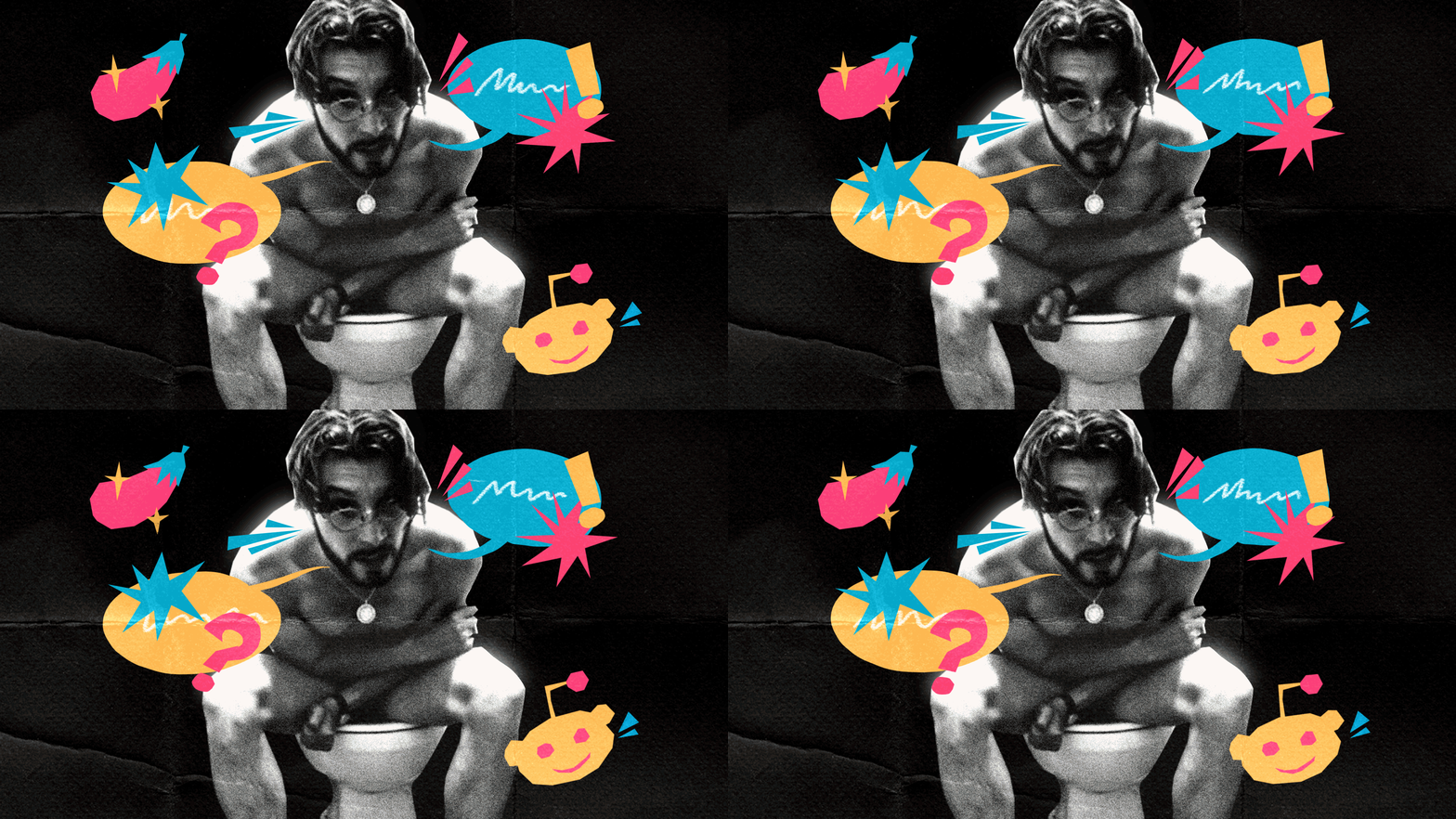
Canadian rapper–songwriter–influencer bbno$ seems to have haunted the feeds of scrollers everywhere for nearly six years. Since his 2019 hit single “Lalala” with Y2K, he's built a massive following through both his music and his strong online presence. Although this article is an album review, I will first discuss his digital persona, as the main avenue of promotion for his latest album, bbno$, has been his prolific posting.
bbno$’s internet persona takes a page out of the late 2010s Reddit landscape. One can see this through his accounts on X (the platform formerly known as Twitter), and TikTok, which primarily consist of shitposts and references to various internet subcultures. Personally, I find them quite unfunny—but if you think that a faux “67” forehead tattoo is comical, I won’t yuck your yum. Approximately 8.2 million TikTok users find some value in his content, so you aren’t alone. Another feature of his content is grandstanding against the use of artificial intelligence in art and advocating for commissioning artists instead. This is certainly a commendable cause, but it reads as incredibly performative, simply because of how often he posts about it. On another note, it might be worth congratulating bbno$ for straying from masculine gender expression in his cosplays of Mira from KPop Demon Hunters, Hatsune Miku, and Pomni from The Amazing Digital Circus. But this seemingly genuine drag persona does not quite come across in his latest album. His sense of humor (unfortunately) does, leading to an album that isn’t quite meme–rap nor pop–rap, but ear–defeaningly cringy at times.
The album’s opener, “bag TF up,” is the best–case scenario for a bbno$ song. It’s admittedly quite catchy, and although it’s repetitive, this repetitiveness might be the song’s saving grace, as bbno$ is only able to fit in one exceptionally corny bar: “Put my nick in her cage, she a ghost rider.” The production is tight and clean, and the sample meshes with the song quite well. But subsequent tracks take a significant drop in quality, beginning with “bing bong.” Here, bbno$ is at his most formulaic: a tasteless interpolation or sample for a chorus (in this case, “Gucci, Gucci” by KREAYSHAWN), meme–rap worthy lines (here, a reference to 2021’s “bing bong” meme), and fairly standard bars (“Now I’m flexing up on my ex”). bbno$ does deserve some credit for forward–thinking lyrics such as “protect the dolls” and “no Bored Ape shit,” but the messaging does get a bit diluted by standard rap lyrics like “I don't wife thots.” The drab production is nothing to write home about and only accentuates the wince–worthy lyrics.
bbno$’s inability to stick to a theme makes otherwise funny references cringy and otherwise standard hypermasculine lyrics inauthentic. His sometimes progressive statements—“I’m trying to eradicate the negative stigma around antidepressants”—become diluted by his reliance on run–of–the–mill bars, making the song feel half–phoned–in and half–prewritten. Perhaps this wouldn’t be an issue if his delivery wasn't so boring and monotonous. To his credit, he does make half an attempt at switching up his emphasis and rhythm across the album, but the lack of energy in his delivery makes every bar sound the same.
This is not to say that bbno$’s writing style is completely irredeemable, though. I found myself thinking of Ski Mask the Slump God quite often while listening to the album, as his bars mirror bbno$’s abundance of wacky references and samples. For instance, bbno$ spits “Sandy on my dick–dick–dick–dick–dick, she call me Patrick” on “ADD,” which reminds me of that time Ski Mask rapped over “Stadium Rave” from Spongebob Squarepants on “Duragflowz”. But this isn’t really a fair comparison, as Ski Mask does a much better job of rapping like he means it. Alongside his captivating variety of flows and energetic delivery, Ski Mask’s bars manage to be both funny and authentic. All in all, bbno$’s lyrics are self–contradictory in tone, eliciting plenty of eye–rolls during my listen.
Subsequent tracks stick to the bbno$ formula: uninteresting verses interspersed with annoyingly repetitive choruses that were clearly designed to be TikTok audios, all poisoned by an empty mix and production that feels lazy. I’m almost tempted to call bbno$ a copycat, as it seems that the attempted TikTok audio–choruses are eerily similar in both theme and lyrics to past songs. The clearest example of this is the chorus of “it boy,” which is a sad imitation of “IT GIRL” by Aaliyah’s Interlude. However, it’s more likely that bbno$ is very heavily influenced by the broad zeitgeist of TikTok songs, to the point that his music seems to lack any other personality.
The album’s singles “it boy” and “check” fall into this TikTok audio category. “gigolo,” meanwhile, actually manages to be an earworm with its tasteless yet undoubtedly catchy hook, courtesy of Hatsune Miku (bbno$ expertly exploits my soft spot for vocaloid vocals). The lyrics on this track are also somewhat more bearable, as his usual hyperbolic descriptions of his sexual prowess actually meshes with the track’s theme.
The tastelessness continues on tracks like “estrella” and “come to brazil,” which bastardize aspects of Spanish and Brazilian music to create yet another unholy chimera of upbeat club music that bbno$ can talk over. bbno$’s chorus writing and sample choice remain abhorrent with “yezzir” and “rich sexy ugly,” and Ironmouse’s singing on the chorus of “1–800” was impossible to listen to without wincing (God, VTuber music). The next tracks are nothing to write home about—by this point in the album, I had developed a selective deafness for bbno$’s emotionless bars, only eye–rolling now and then at the occasional corny reference. “pump it” isn’t as horrible to listen to, but only because of the shameless inspiration bbno$ draws from ye’s “The New Workout Plan.”
“main squeeze,” however, is a diamond in the rough on this album, as it features bbno$ at his most emotional (which still isn’t that emotional) coupled with some unimaginative yet well–produced beats. His lyrics also take a major shift in tone, allowing him to fully dedicate the song to his titular “squeeze.” It’s a pleasant reprieve before bbno$ launches back into his horrid chorus writing and annoying instrumentals on the next few tracks. The closing track, “finally up,” is another (relative) highlight of the album, featuring an interesting beat, bbno$’s best delivery on a track thus far, and some pretty funny lines: “We all gonna eat like it's morning after Ramadan.” Although, the Fortnite reference in the chorus didn’t sit well with me on the first listen.
To conclude, this is not an enjoyable (or even listenable) album. bbno$’s deliveries need work, and he needs to develop an ear for choruses that don’t just sound good in theory but also in practice. The lyrics on this album fall flat—while individual taste in humor may influence how they’re received, some of these bars are just unfunny. Still, there is a certain irony to this album: several tracks have become popular TikTok audios, suggesting that bbno$’s audio–farming venture was in fact successful. In the end, he got the last laugh.