When Kenan Rabah opened Majdal Bakery in 2024, his father, living in Majdal Shams, Syria, began to plant only za’atar in his garden. After it’s harvested, Rabah’s mother and grandmother dry it and mix it with sumac, sesame, and olive oil. Every time Rabah visits home, he makes sure to bring a little back with him to use at his bakery in Philly.
“We put za’atar on everything back home. Every region has their own take on za’atar. Ours is very simple, very clean,” he says. “I use it in most of my recipes. It’s a special touch.”
Special touches seem to be the forte at Majdal, a cozy space just steps off of South Street. Walking in, you’re first greeted with the bakery’s signature sage green, the vocals of Fairuz, and a luscious medley of spicy, sweet, and grainy smells. Sourdough loaves and baguettes line the shelves above the coffee maker. In the central glass display case, each available pastry is lined up in an immaculate and drool–worthy array. You’re left to ponder which of your taste buds you’ll follow: Will you go savory with the mini nigella garlic baguette or the chicken sumac fatayer? Or satisfy your sweet tooth with the baklava or pistachio tiramisu?
Though much of the menu consists of traditional recipes straight from his childhood in Majdal Shams, Rabah also incorporates his expertise from culinary school and his experience as head baker at Lost Bread Co.
“During my years at culinary school, I fell in love with bread baking. Like sourdough, it kind of merged those two worlds together—the savory cooking and the magic of baking,” he says. This is especially evident in his safeha, which is traditionally a flatbread. However, he uses the sourdough method, which involves fermenting dough with special yeast and local heirloom grains to create a hearty, aerated base for his toppings.
I choose the malfouf, which arrives warm from the oven on a cheery, green–and–white–checkered tissue paper. It’s a blend of spiced beef and tender roasted cabbage, finished with a swirl of tangy yogurt sauce and a scattering of pine nuts that melts in your mouth. And the flatbread is far from being in the background; it provides the perfect chewy texture to complement the rich flavors on top. The malfouf is inspired by a recipe Rabah grew up eating: cabbage rolls stuffed with beef and rice and served with yogurt.
“All the products, if they’re not a traditional pastry, they’re inspired by a traditional pastry or a memory I have,” he explains. “I also don’t want to limit myself. There’s a part of me that’s like, ‘I moved here for a reason.’ … So I introduce things as well into my baking.”
Working with local vendors and supporting local agriculture is central to Rabah’s recipes. Lost Bread Co. mills its own flour, and he continues to source local grains and flour for his baking. The menu also changes seasonally, mixing local produce with classic flavors.
Some items, however, are continuous residents. The potato fatayer, a flatbread with a spicy potato–and–onion filling, is one of the bakery’s most well–loved pieces. It oozes carby comfort and is perfectly brightened by the accompanying sour cream–and–herb sauce. Another favorite is the cinnamon–cardamom bun with pistachio cream cheese frosting. It’s dainty but absolutely decadent, and its sweetness is balanced by spice and nuttiness.
A cup of hot, gingery–sweet tea sits next to all of this. Majdal’s drink menu offers a myriad of flavors, from coffee to seasonal lemonade and iced rose sharab, but the hot spice tea is the perfect autumnal drink. Flavored with cinnamon, nutmeg, and other spices, it warms you from the inside out. The tea is usually served during or directly after a woman’s pregnancy, and Rabah remembers it being served on family visits.
“We have harsh winters where I’m from, so we always have a pot of spice tea on the stove,” he says. “When I came here, I started doing that regularly, and when I opened the bakery, my partner was like, ‘You should serve the spice tea!’ I was like, ‘No one’s gonna buy the spice tea!’ And it became literally our bestseller.” Customers now have the option to have it hot or iced.
Out of everything he makes, though, his favorite is the talami: a sweet flatbread of enriched dough, turmeric, ginger, anise, and lots of olive oil.
“The fun part is that we let it ferment, and we press the little dough rolls in these wood molds, and then we bake them. So it’s a nice, flat, decorative flatbread,” Rabah explains. “It’s sort of labor–intensive, so when we do it back home, the whole family would gather and we would make thousands of them, and then we each would take a few and freeze them.”
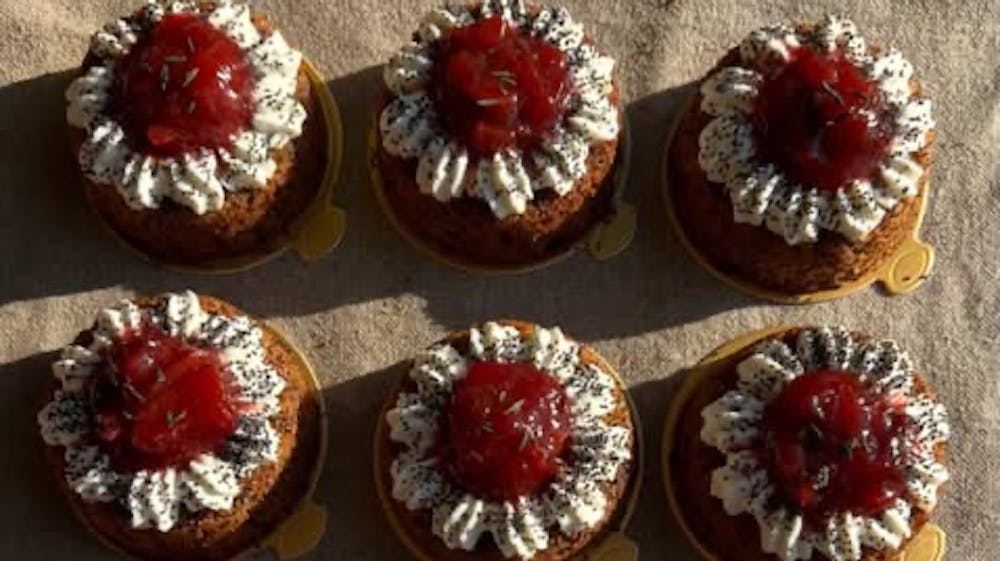
They’re eaten at breakfast with coffee, served plain or filled with butter and seasonal jam. This week, it’s a delicately sweet preserve of muscadine grapes, anise, and lemon, and it might be my favorite thing I try. The flavors are subtle yet full, and you can taste the care that went into selecting each ingredient.
Majdal Bakery’s mission goes beyond just serving good food and drink, though; it’s a way to communicate history and culture. Rabah’s hometown, Majdal Shams, has been occupied by Israel since 1967.
“I lived in a place where I didn’t have a nationality. I didn’t have an Israeli nationality, I didn’t have a Syrian nationality. It was always undefined,” he says. On his passport, it simply says “undefined.” When he came to Philly in 2015, he was confronted with the expectation to explain himself and his origins in a way he hadn’t needed to before.
“When I tell people where I’m from and I tell them the story, a lot of the reaction is they’ll feel bad for me, like ‘Are you good? Are you safe?’” Rabah says. “I felt like I needed to change that narrative, to show the other side of it, the beautiful, the amazing food, the hospitality, this really good culture of generosity.”
His chosen method? Food, of course. “For everyone, I feel like they have their language that they speak. For me, I feel like I shine more with baking and with cooking, so I feel like that’s where my role is,” he says. “I hope I’m doing something.”
He certainly is—with ingredients from across the Atlantic and from nearby farms, Majdal Bakery is tantalizing taste buds and connecting cultures at the same time.
TL;DR: Majdal Bakery serves up traditional Syrian pastries to satisfy every craving.
Location: 618 S. Fifth St.
Price: $
Hours: 8 a.m.–4 p.m. Wednesday–Sunday