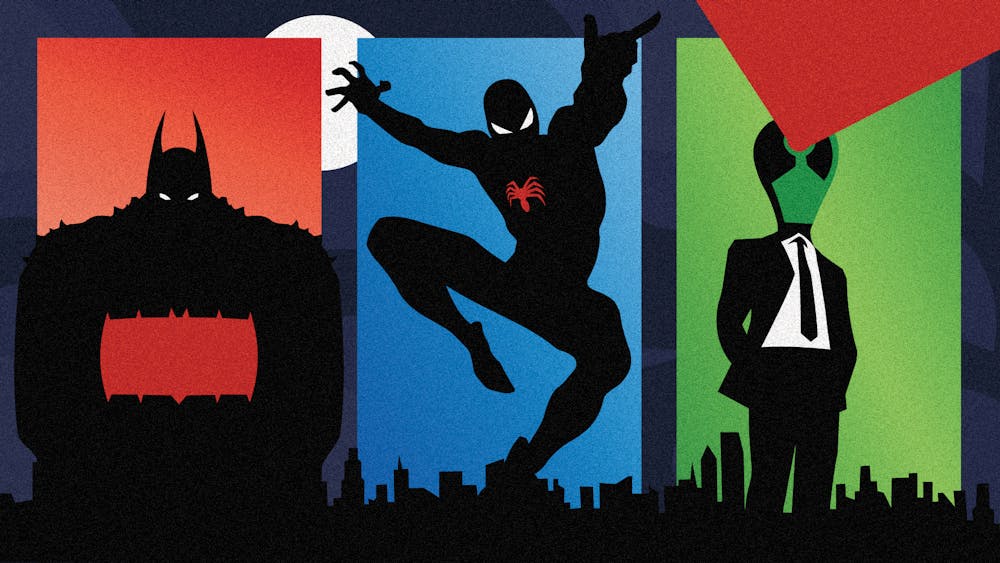
Superheroes used to save the world. Now they’re just trying to survive it. That’s the central theme of the two biggest comic book hits of the last year, Marvel’s Ultimate line and DC’s Absolute universe. These runs exploded in popularity, offering storylines that were easy to jump into and required no prior knowledge of complicated canons and decades of sprawling superhero history. At face value, to any executive, the key to modern–day comic book success seems to be accessibility. But what really makes these books land so well is the way they capture our real–world disillusionment with systems built before our lifetime in stories where fan–favorite heroes wrestle with stolen time, corrupt institutions, and violent extremism. Instead of escape, they offer readers catharsis—forcing us to reckon with the fact that the world we live in was built by forces we cannot change, but can try our best to fix.
There’s no denying that accessibility was the initial hook. Marvel’s Ultimate and DC’s Absolute universes offer readers a clean slate. For comic newbies, it’s liberating. A shared universe quickly becomes a confusing place, and the longer one exists, the more complicated it becomes. DC and Marvel have been trapped between “continuity snarls” and “brand synergy” for years. New (and even experienced) readers struggle to keep up with decades of intertwined lore, and die–hard fans have been forced to watch their favorite characters turn on a dime every time a new movie comes out. The Ultimate and Absolute lines slice through that, giving us reintroductions to Spider–Man, Batman, and others while maintaining the essence of their characters.
In Ultimate Spider–Man, Peter Parker isn’t a teenager pushed into heroism. He’s a grown man whose life has already been shaped—or more accurately, constrained—by forces beyond his control. The main villain of that universe—the Maker—deliberately rewrote history to ensure superheroes never emerged. This Parker’s journey is one of self–discovery and personal reclamation, as he fights to take back the life he was always meant to live.
Unlike Marvel’s Ultimate line where superheroes never existed, DC’s Absolute universe turns the familiar upside down. The cosmic tyrant Darkseid—a god searching for the ability to conquer the universe—has managed to corrupt the moral core of this world, poisoning the ideals of truth and justice. In Absolute Batman, Bruce Wayne isn’t an untouchable billionaire playboy, but a Gen Z, working–class civil engineer, building his own tools from scavenged scraps. In this version of Gotham, the police are privatized, corruption is institutional, and Gotham’s elites have all the power to keep Wayne and his friends powerless. His struggle isn’t just against cartoon villains, but a system that picks those who matter and those who don’t.
Both of these series allow readers to jump into new, self–contained stories without needing years of background reading. But accessibility for new readers isn’t the only factor relevant to understanding these series' popularity. After all, Marvel and DC have tried reboots before—take DC’s infamous New 52 relaunch in 2011, which abandoned popular legacy heroes like Cassandra Cain and Superboy, erased crucial character development and relationships, and told disconnected and directionless stories. What separates Marvel’s Ultimate and DC’s Absolute lines from that unpopular reboot is the intention behind them. Instead of simplifying stories, they recontextualize them. They strip away the comfort of our favorite heroes’ legacies to make their words feel unmoored, precarious, and painfully modern.
More than anything, both universes feel like they were written in response to the COVID–19 pandemic—not just abstractly, but as a catalogue of concrete failures. The literal re–writing of history in Marvel’s Ultimate line brings to mind the theft of time and opportunity that comes from chronic illness, depression, or even just years spent in lockdown. The heroes in DC’s Absolute line are put up against corporations abusing migrant workers, private police forces patrolling the streets, and normal people who are radicalized into committing hate crimes. Absolute Batman literally wages a one–man war against a crowd of white supremacists who decide to target a homeless encampment. Throwing subtlety out the window, Marvel’s Ultimate and DC’s Absolute runs speak directly to a generation that has lived through collective grief, systemic failure, and disillusionment in the institutions meant to protect us.
Those themes are most vivid in Absolute Martian Manhunter. The series follows John Jones, an apathetic FBI agent whose life turns upside down when he’s possessed by a being of pure empathy, the Martian Manhunter. Jones and the Martian Manhunter’s enemy, the White Martian, don’t control humanity with brute force but with ideas—radicalizing ordinary citizens into hate mobs that target immigrants, the homeless, and anyone deemed “other.” It’s a direct reflection of our own reality, where disinformation campaigns, hate speech, and digital echo chambers have normalized cruelty. When Jones tries to project empathy into the minds of those people, his battle feels less like a superpowered fight and more like the struggle of trying to reach those lost to conspiracies and hate. The conflicts in DC’s Absolute line aren’t just physical, but moral, questioning whether compassion can survive in a society so easily pulled toward apathy.
Both worlds feel haunted by the same kind of modern exhaustion. In the Ultimate world, the theft of history mirrors our sense of lost time after the pandemic. In the Absolute universe, the erosion of goodness reflects our growing cultural fatigue—the creeping sense that empathy, fairness, and community are ideas that are rarely rewarded. It’s not hard to see the parallels with our own world, where headlines blur together and normal life relies on quietly accepting a stack of injustices. Choices I didn’t make and systems I never agreed to have shaped my life without my consent—but I still have to live within their consequences.
Traditional superhero stories are about transcending above the ordinary. Ultimate and Absolute are about enduring. There are no clean victories, and the heroes don’t have perfect morals. Their messy realism channels readers’ collective exhaustion from the last few years to promote the idea that doing something is still worth it.
Though I love the new takes from these runs, they still depend on the classics—and that is their secret weapon. When a reader opens Ultimate Spider–Man or Absolute Batman, they're hit with a lifetime’s worth of feelings about who Parker or Wayne “should” be: the awkward kid who learns responsibility or the billionaire who can outspend any problem. Those memories aren’t baggage to be discarded but the raw material these books work with. A thirty–something Parker reclaiming a stolen life resonates because we remember the teenager he used to be. A working–class Wayne building jury–rigged gadgets lands well precisely because we know how comfortably privileged Batman usually is. These characters become not fictionalized ideals, but people who we can sympathize with and relate to.
The comics don’t waste time telling us the same old myths—they twist them and let those familiar seams teach us something new. Nostalgia here isn’t comfort, it’s tension.These universes weaponize our memories, interrogating why we admired these characters in the first place, and ask whether those reasons still hold up when the world around them changes. What happens when the ideals we grew up with no longer fit the world we live in?
Though Marvel announced at NYCC that the Ultimate universe will wrap up by next April, these two runs have still redefined what comic books can be. They’re not escapist fantasies about overcoming our human limitations, but reflections of our fractured, anxious world through the colorful mythos of superheroes. The catharsis isn’t in saving the day, but in seeing our fear, anger, and confusion embodied through heroes who keep trying anyway. It matters because it reframes heroism itself. The worlds we live in may be rigged, but trying again is still an act of resistance.