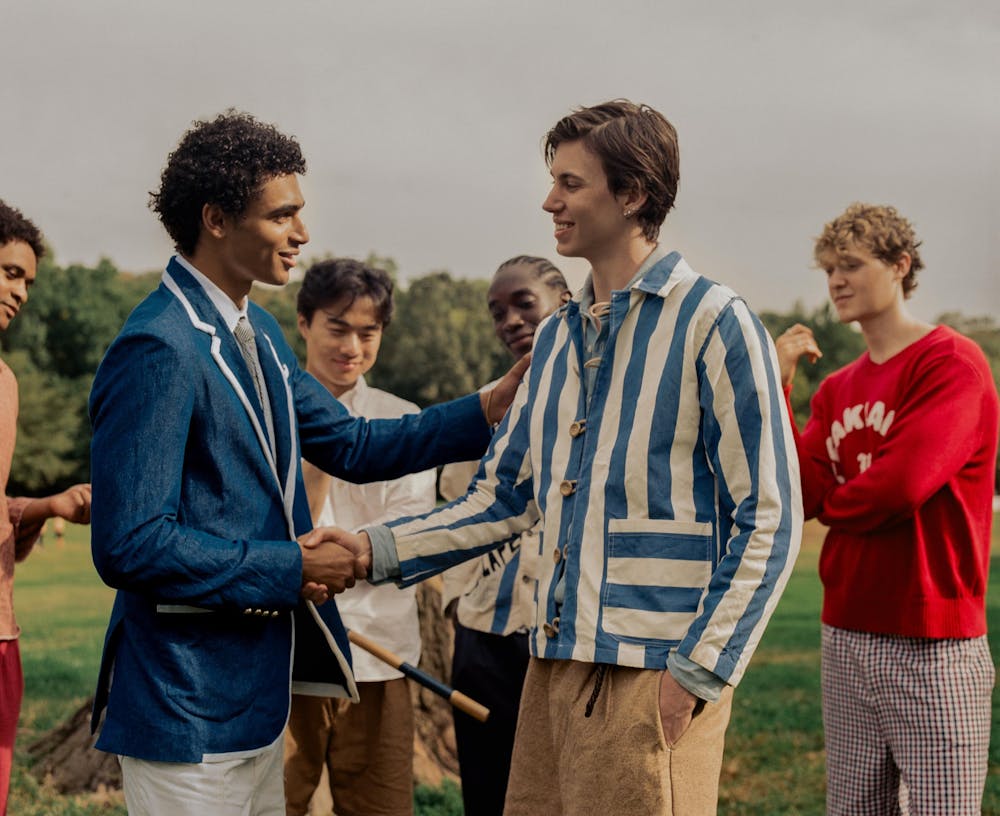
There’s a problem with preppy fashion right now. It’s trending, but toothless—it’s been flattened into Pinterest moodboards, varsity fonts on TikTok hoodies, and nostalgic uniforms worn by people who’ve never touched a lacrosse stick. But at New York Men’s Day this season, Peak Lapel’s Lawn Games collection made a strong case for the genre’s survival, if not its reinvention. Designed by Parsons School of Design seniors Jack Milkes and Ben Stedman, Lawn Games (Spring/Summer 2026) is what happens when two students steeped in Ivy League iconography decide to both honor and rewrite the rules.
Peak Lapel’s Spring/Summer 2026 collection, Lawn Games, builds itself around a “student’s time in–between”: the kind of summer that exists just before real adulthood begins. The collection captures the brief window when polos still fit like they used to, blazers are more costumes than career wear, and identity is shaped as much by sport and leisure as by study or ambition.
Milkes and Stedman draw inspiration from Take Ivy, the 1965 Japanese photo chronicle of American collegiate dress that became the holy text for preppy revivalists everywhere. But where Take Ivy documented preppy fashion, Lawn Games reinterprets it. Their stated goal—to celebrate the “rituals of youth in motion”—feels less about reproducing heritage pieces with archival precision and more about capturing the aesthetic rhythm of a world where the uniform meant something, making the style feel strange, boyish, and modern again.
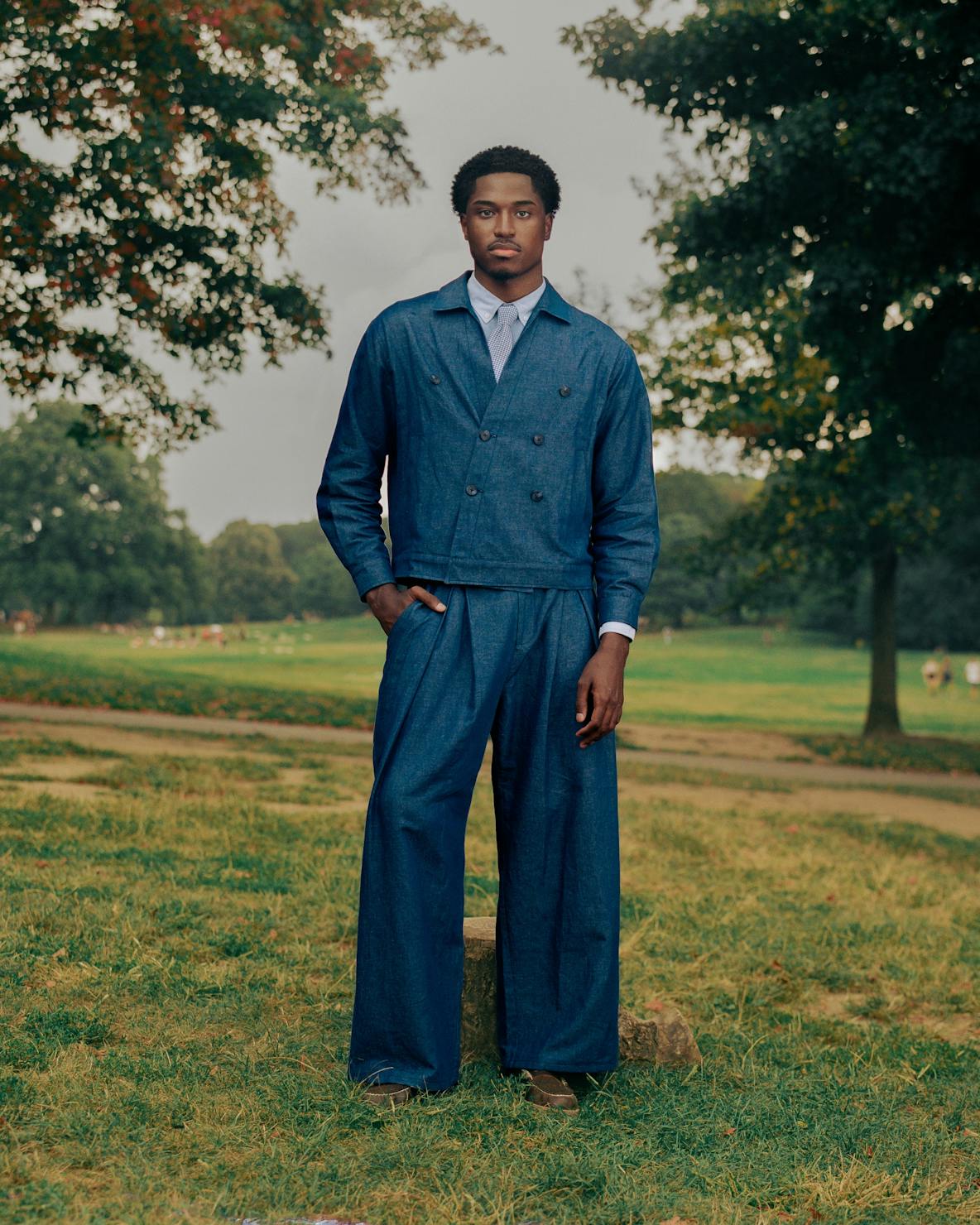
This is the anti–interview suit. The kind of thing a kid from The Dalton School would wear to his dad’s boardroom just to annoy him. The jacket is rendered in soft chambray, stripped of padding or lining, and cut with a subtle boxiness that feels closer to a housecoat than a boardroom essential. There’s no forced cinch, no tailored sharpness—just soft volume, lightly structured lapels, and a deliberate refusal to assert authority.
The trousers mirror that same refusal to perform. They’re wide–legged, deeply pleated, and deliberately long, breaking into soft puddles over the shoes. There’s a nod to 1940s collegiate drape cuts—specifically the roomy, exaggerated tailoring popularized at historically Black colleges and universities and later adopted into jazz and zoot suit culture. But here, that reference has been stripped of flash and excess.
That’s where the idea of “Japanese Americana” actually lands. Designers like Engineered Garments founder Daiki Suzuki and brands like Beams or OrSlow have long taken American heritage silhouettes—like workwear, military suiting, and Ivy tailoring—and reinterpreted them with different proportions, softer fabrics, and quiet detailing. This suit does something similar. It’s the American prep uniform, re–engineered with ease.
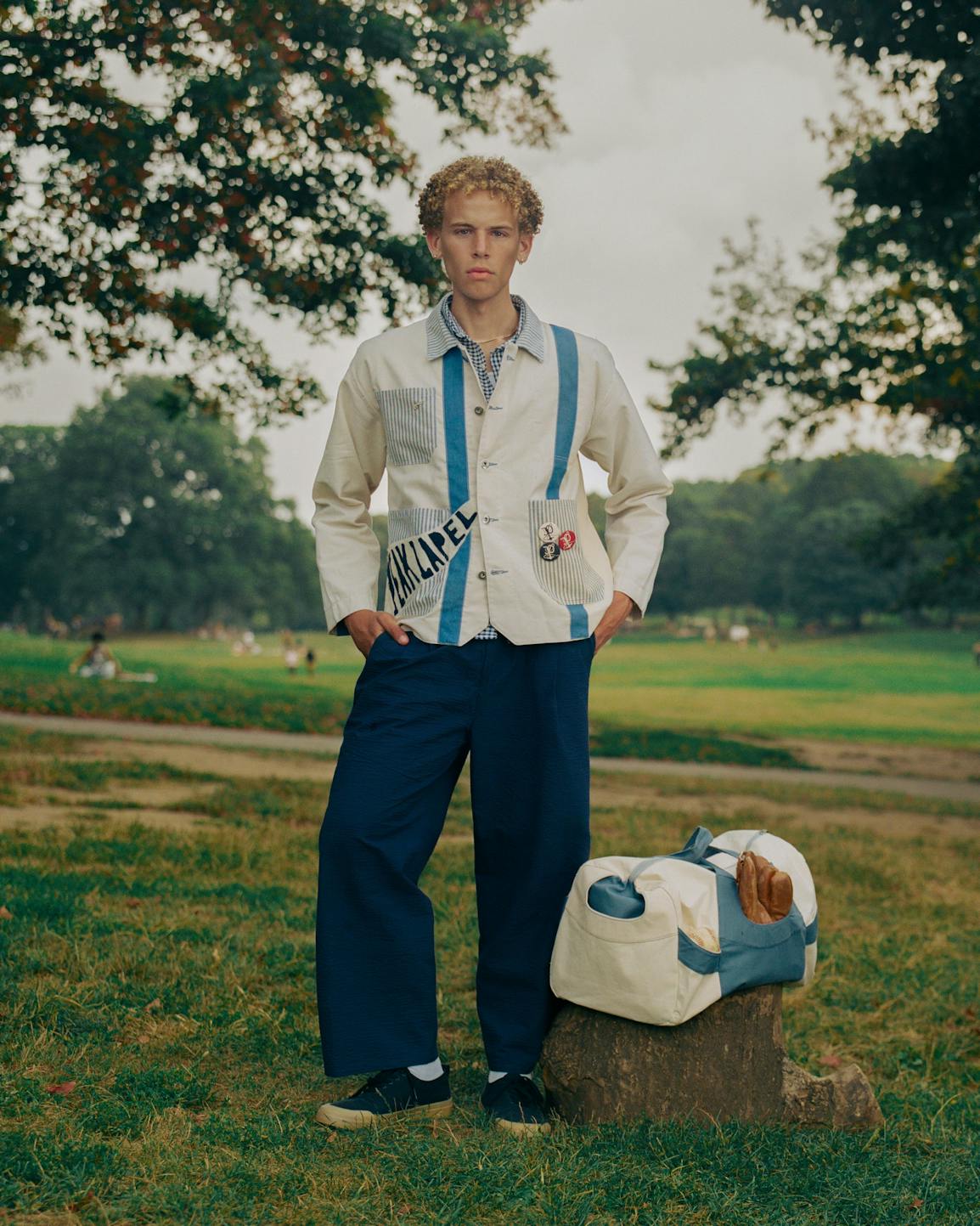
At first glance, this look is a simple work jacket and trousers combo. The jacket’s silhouette is borrowed from the French chore coat tradition: flat collar, patch pockets, button front. But the classic shape is visually sliced and stitched into a collage of blue varsity stripes, slanted type, and cheeky patches. The brand name itself is stenciled diagonally in all caps across the front like an athletic banner or a tongue–in–cheek house crest. The trousers underneath are high–volume and softly structured, cut from what appears to be a navy cotton drill, with just enough weight to hold their shape without going stiff. Cropped just above the ankle and styled with crew socks and black sneakers, the proportions are pure playground Americana—like Take Ivy filtered through New England gym classes and downtown gallery assistants. The entire outfit is coded like a uniform, but designed to wrinkle, scuff, and misbehave.
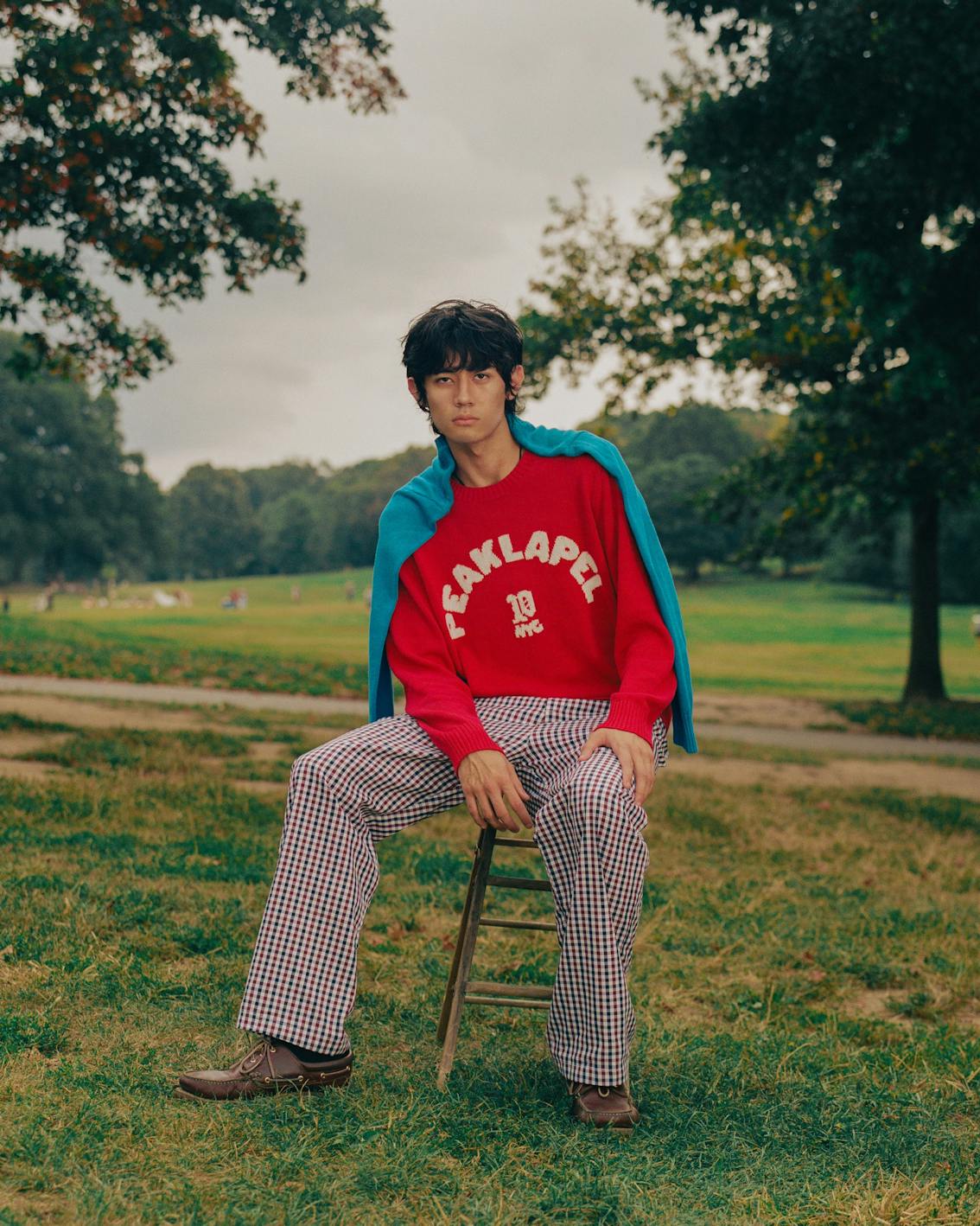
Gingham is a pattern that sits right at the awkward overlap between old–money summer and mid–century picnic table, and that tension is exactly the point. Worn here with classic duck boots and a deadpan expression, it’s an outfit that dares you to call it ridiculous. It’s a print loaded with cultural baggage: associated with childhood, domesticity, and Easter Sundays. Here, it’s recontextualized as a bottom, not a button–down, cut long enough to break over the shoes with a soft drape.
The varsity–style “PEAK LAPEL 19 NYC” print mimics the language of college–branded merch, but with no real institution behind it. There’s no fake crest, no invented Latin motto—just a name and a city, rendered in collegiate font. It’s prep as brand identity, not as affiliation. Think less team spirit and more self–aware merch drop. The font nods to Russell Athletic sweatshirts from the ‘80s and ‘90s, the kind you’d find in thrift bins or boarding school dorm closets. The lettering is likely felted or screen–printed, but importantly, it’s not distressed. It hasn’t been aged or faded. It’s faux nostalgia, made new.
This is Peak Lapel’s sense of humor at its clearest: if Ralph Lauren is the fantasy, this is the school play version, made by someone who knows every line and isn’t afraid to ad–lib.
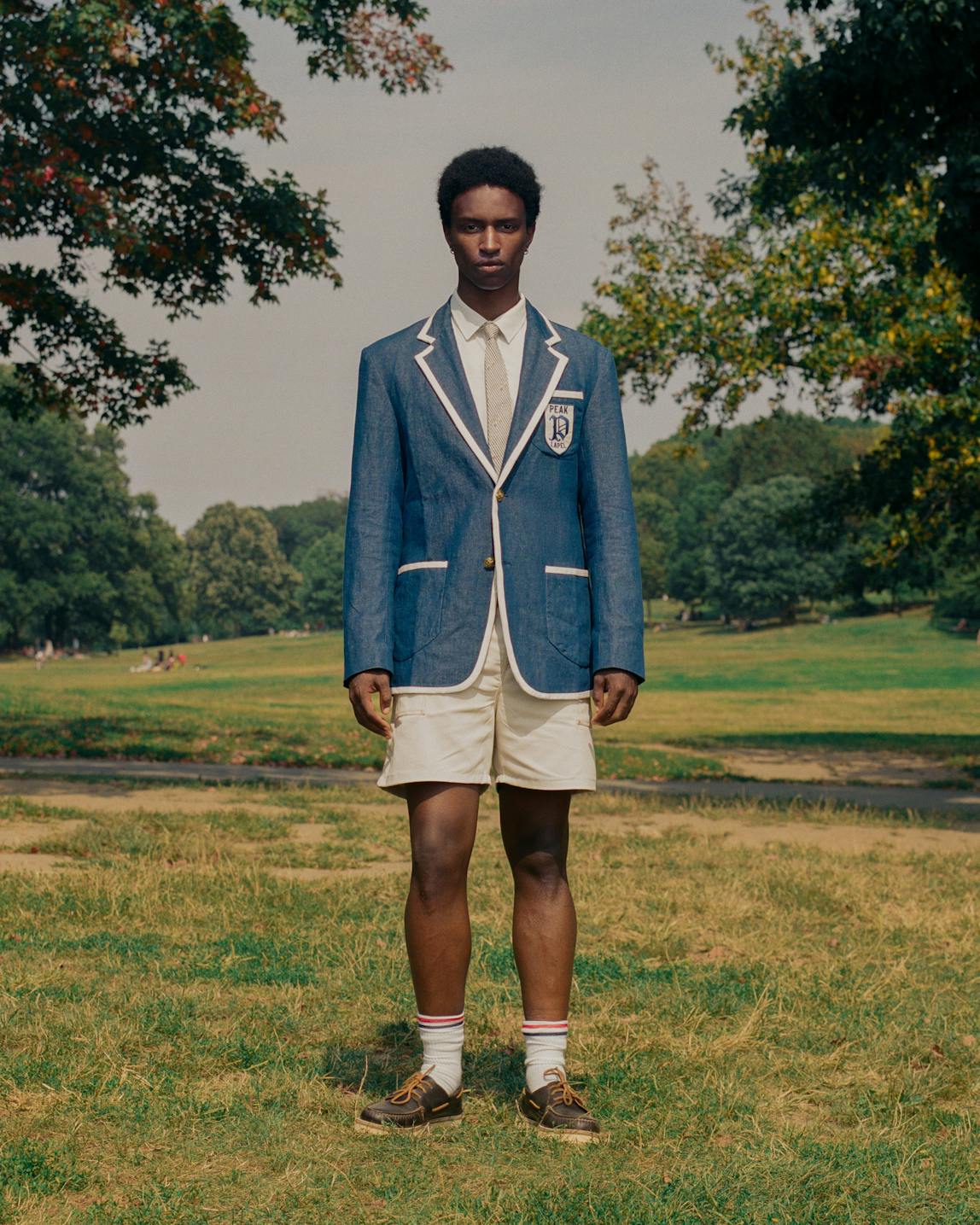
This look is the cleanest and most classic in the lineup—but it’s also where the construction really shows off. The chambray blazer is a fully built piece with a notched lapel, piped edges, two–button closure, and a custom school–style crest. The fabric looks like a mid–weight cotton or denim blend—light enough to move in, but stiff enough to hold the line. It hits right at the hip with no vent, which gives it that perfect prep–school rigidity.
The shorts are key to the outfit. They hit that sweet spot: not too tailored, not too casual. They’re almost like rugby shorts, but elevated. There’s an ease to them that says, “this kid probably played a sport, but not one with real stakes.” (Crew, probably. Maybe squash.) They keep the look grounded in utility, balancing out the more costume–y top half.
Then there’s the sock–and–boat–shoe combo, which is so aggressively trad it feels illegal in 2025. White ribbed athletic socks with visible striping, slouched down into classic brown leather Sperrys—it’s like the model walked out of a Vineyard Vines catalog and got cast in an A24 movie about repression.
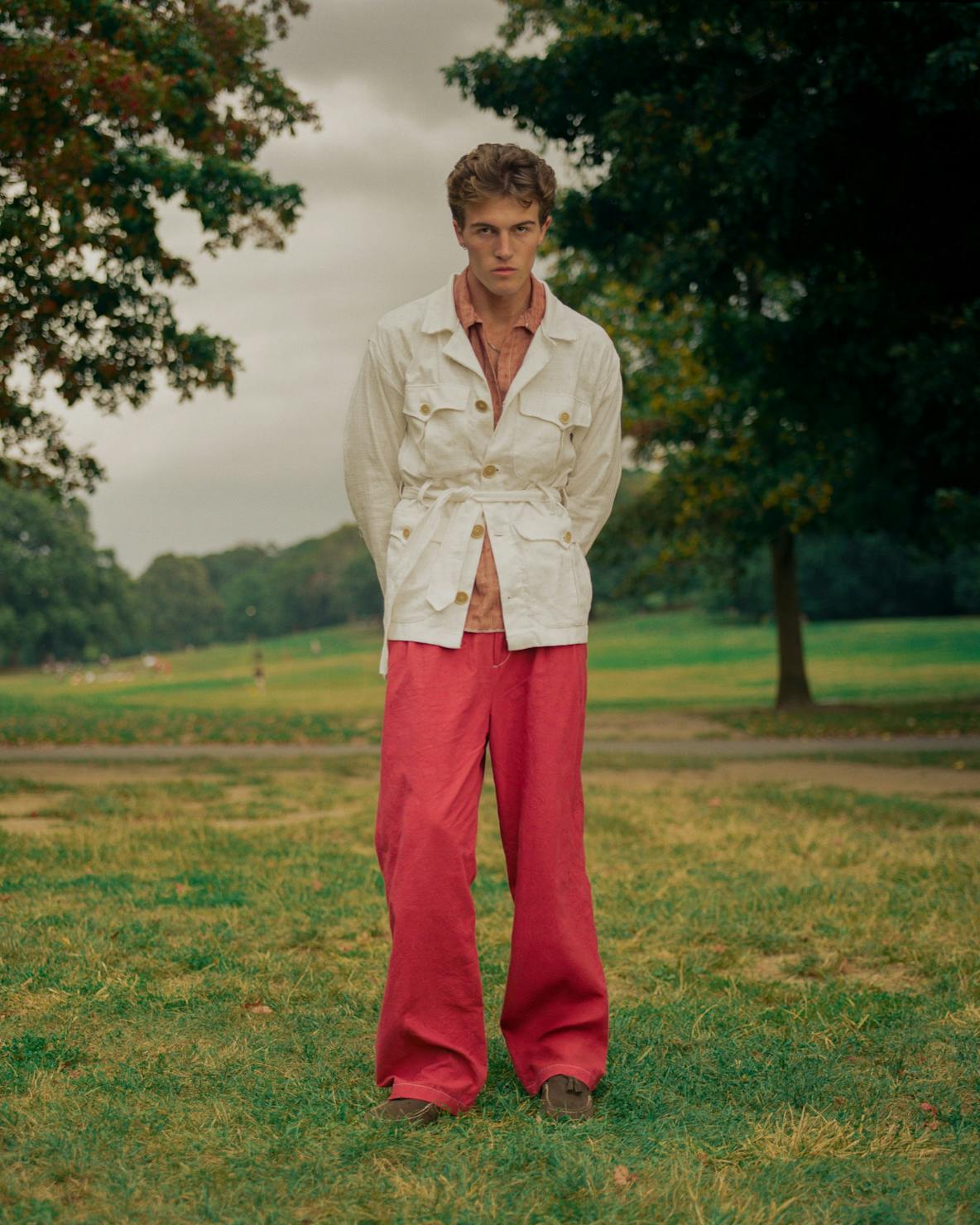
This look steps entirely outside of the traditional Ivy League visual language but still speaks fluent prep. The silhouette is built around a cream safari jacket, a garment with historical baggage: it was first developed for British officers stationed in warm climates, then later reabsorbed into civilian wardrobes as a symbol of rugged upper–class elegance. Think Yves Saint Laurent’s Saharienne, or Paul Newman in Kenya with too much time and a Leica. Here, though, Peak Lapel strips the colonialism out of the cut.
The jacket is rendered in what appears to be a washed cotton–linen blend, which softens the militaristic associations of the original design. The fabric has a drier texture, and it wrinkles naturally—nothing is overly pressed or polished. There’s no shoulder padding, no epaulets. The internal tie belt cinches just enough to give the shape structure without stiffness, turning the jacket into something closer to a robe than a uniform. It’s tailored, but not rigid. Masculine, but self–aware.
Then there are the trousers, which are arguably one of the most interesting cuts in the collection. The red tone avoids the cliché of “Nantucket red” entirely. They’re cut wide through the leg with no hard crease, falling in a long, continuous line that hits the shoe with just enough break to pool softly. The silhouette references 1970s YSL menswear, especially in how it prioritizes movement and softness over sharp tailoring. There’s volume here, but it’s intentional—it’s balanced, draped, and controlled.
We’re in a post–“#OldMoney” era, where preppy aesthetics are trending, but often misused and reduced to sweater draping and sepia filters. What once carried specific social weight—class signals, geographic lineage, access to elite institutions—has now been repackaged for the algorithm. A Ralph Lauren ad from 1992 and a frat party slideshow from 2023 can now exist side by side on someone’s for you page, indistinguishable in tone.
This collection isn’t about dressing like you belong. It’s about dressing like you know the codes of belonging and have chosen to wear them sideways. The contrast piping, varsity fonts, and club uniforms are still here, but they’re softened, slouched, and interrupted. Blazers are made from chambray, trousers are cut wider than regulation, and badges mean nothing beyond the brand’s own invented mythology.
And that’s the most compelling thing about the collection: the brand isn’t rejecting Americana—it’s translating it for a generation that knows it’s been locked out of the original version. Peak Lapel is deeply American in that way. Not red–white–and–blue Americana, but the myth of American belonging: the myth that if you put the right clothes on, maybe you’ll fit in. Or maybe that you’ll fake it well enough that letting you in becomes a formality. Lawn Games suggests that belonging now is constructed through gesture and reference, not birthright. You don’t need to row crew or go to Groton School. You just need to know what those things signify—and decide whether to wear the blazer or cut it off at the sleeve.