
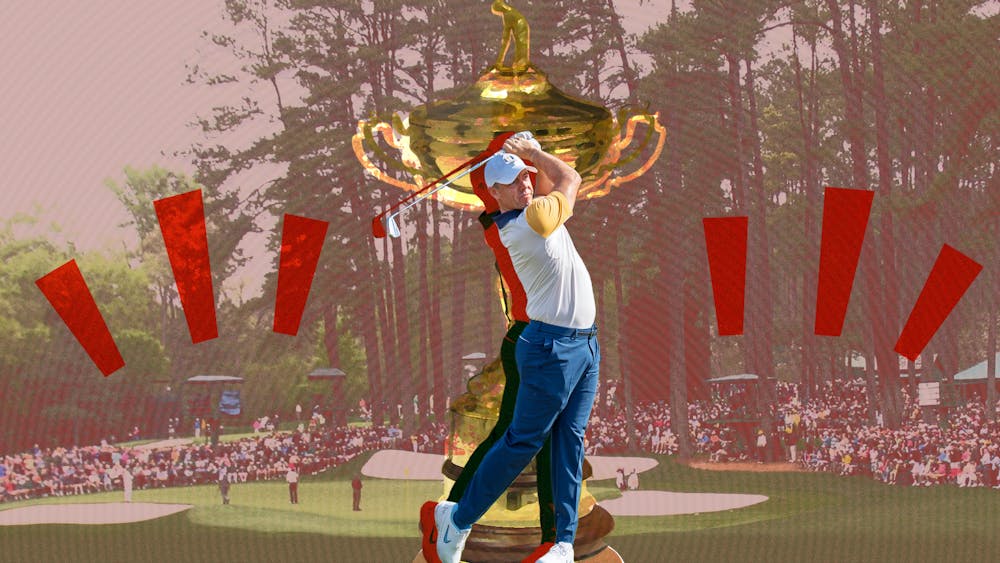
In front of New York’s Bethpage Black Golf Course is an ominous sign that reads: “The Black Course is an extremely difficult course which we only recommend for highly skilled golfers.” What’s already a daunting course, even for the best professional golfers in the world, becomes much harder when the stakes are high—and what stakes could be as high as competing not just for yourself, but also for the pride of an entire continent or country? The Ryder Cup already pushes players to the very limits of their abilities. But this year, another element exacerbated their stress: heckling fans.
The Ryder Cup is a team golf tournament between the United States and Europe that is held every two years. There are 12 golfers on each team: This year, Team Europe (led by Luke Donald) was made up of golfers such as Rory McIlroy, Ludvig Åberg, and Viktor Hovland, while Team USA (led by Keegan Bradley) included players like Scottie Scheffler, Justin Thomas, and Bryson DeChambeau. This is one of the only golf tournaments where fans can see their favorite professional players work together as a team to win for their home territories. While Team Europe took home the trophy for the second time in a row after gaining a historic lead during the tournament’s first day, it was not a smooth ride getting there.
The Ryder Cup is well–known not only for its uniquely collaborative format, but also because it encourages passionate fans to cheer on their home team, participate in chants, and dress up in patriotic outfits. While the spirit of the spectators is usually received well by players—who also play into the lively nature of the championship—fans took their passions too far this year, resulting in emotional and physical harm to both the players and their families.
During this year’s Ryder Cup, players from Team Europe were under constant fire as spectators yelled, booed, and used insensitive language. McIlroy was especially targeted by these attacks: Attendees screamed xenophobic and homophobic slurs at him and his caddie, shouted during his putting routines, and taunted him nonstop about his recent Masters win and the details of his marriage. Even McIlroy’s wife, Erica Stoll, was hit with a drink thrown by someone in the stands and fell under constant attack from the nearly 250,000 attendees throughout the duration of the championship. When McIlroy spoke with ESPN, he acknowledged the importance of managing his expectations before the tournament: "I don't mind them having a go at us. Like, that's to be expected. I mean, that's what an away Ryder Cup is.” While he acknowledged that it is up to the judgement of spectators to decide whether or not they went too far, he also encouraged the audience to step into his position as an athlete trying to go through his focus routine: "Whenever they are still doing it while you are over the ball and trying to hit your shot, that's the tough thing." Shane Lowry, another player for Team Europe who faced criticism from fans in the stands, admitted that "It was intense. It was like something I've never experienced." Despite all of the criticism that the golfers faced, it was clear that their love for the game remained strong—if anything, the criticisms of attendees motivates them to keep pushing. Lowry stated, "But this is what I live for. This is it. This is, like, honestly, the reason I get up in the morning, for stuff like this. This is what I love doing. I love being a part of this team. I really want us to win this tournament."
Part of the fun of attending a sporting event in person is getting to participate in the excitement: Celebrating the wins, bonding over the losses, and highlighting the strategies and plays of both teams.But there's a line that’s crossed when an audience's commentary is borne not out of enthusiasm, but out of disdain towards certain athletes. Heckling players to the extent that they can’t perform to the best of their ability is both unfair and unkind, regardless of what team they’re on. And while live sports can build a strong, supportive community between players and their fans, it can also destroy the morale of athletes themselves.
Mass television broadcasts allow live sports to reach homes, sports bars, and even doctor’s offices. Continued exposure to athletes, whether that be through televised matches, recorded interviews, or polished documentaries, gives spectators a feeling of real closeness to golfers. They can see up–close their facial expressions, their emotional reactions to wins and losses. In some cases, they can even gain insight into athletes’ strategies for each hole through on–course interviews. Ultimately, all of this leads spectators to form parasocial relationships with the athletes they love.
A parasocial relationship occurs when an individual develops a one–sided attachment to a celebrity or influencer, making them feel like they know the figure personally. These attachments may even lead attendees to make negative comments towards an athlete's performance—if they “know and understand” the golfer’s character, they may feel more justified in expressing harsh criticism of them, whether they're screaming at their television or screaming in the stands.
Live sports events always leave players with certain expectations to fulfill. They not only have to perform well, they have to make the tournament exciting, entertaining, and enjoyable for spectators. But the obligations between players and viewers aren't one–sided—athletes also assume that attendees will be respectful and keep energy high on the golf course, allowing them to do their thing. This year’s Ryder Cup has served as an important reminder that our favorite athletes are human, too—and that means they deserve some grace, whether they’re playing on their home turf or not.




