Come the final Thursday of November, my dining room table bears a feast of contrasts. We have your typical Thanksgiving staples: mashed potatoes, cranberry sauce, and, of course, the turkey. But seated between the stuffing and brussel sprouts is my mother’s Moro de Habichuelas, Arroz Blanco, and fried plantains. Their comforting aroma is a quiet rebellion amidst the most conventional of American holidays. But a little foreign perspective has made the celebration an open door. In my mother’s eyes, Thanksgiving is adoptive, a happy assemblage of American custom and her steadfast Dominican roots, emblematic of the open disposition that has carried her through her immigration to her life here, in this little corner of the country.
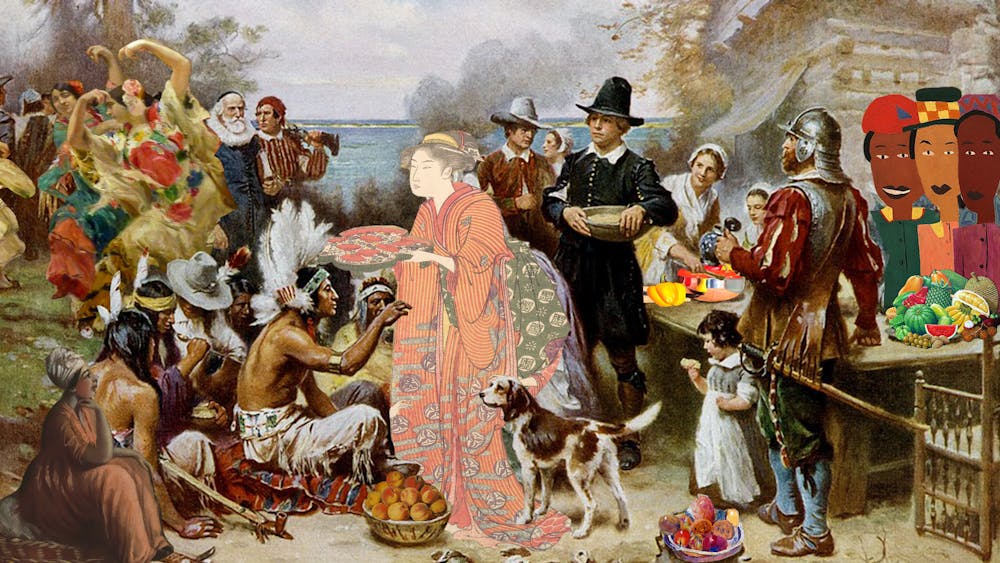
The phrase “immigrant Thanksgiving” seems almost paradoxical. Thanksgiving, after all, is steeped in the mythos of American origins: Pilgrims and Native Americans, cornucopias, and harvest feasts. To juxtapose this time–honored tradition of turkey and gravy with a perspective so unversed in this ritual, it demands nuance: what does Thanksgiving become in the eyes of our foreign born? What does it mean to celebrate in the context of a holiday whose story strains under the weight of its own fractures and current political posture? Perhaps the fusion of dishes creates a third space—separate from this storied origin and the land overseas, a past–present merging and morphing into an unrecognizable ritual. A ritual that, in its very hybridity, sits closer to the truth than the story we’re taught; maybe the meal is more “American” than we realize.
Deputy Copy Editor at The Daily Pennsylvanian Prashant Bhattarai (C ‘27) was born in Nepal, living there until age eight when his family made the move to Baltimore. Before stepping foot in the States, Prashant had never heard of Thanksgiving and was first exposed to the holiday within the confines of his elementary classroom. At once, he was gripped by mentions of the event from his peers—many were also Nepali, but they had come to the country years prior to him and were raised with a more elaborate understanding of the holiday.
“I think initially, a large part of it was just conformity,” Prashant says. “I think I wanted to do what other people were doing. A lot of my friends that I met in elementary school had come to the United States before me. Even my Nepali friends had started celebrating Thanksgiving well before me. And I was like, well, everyone’s doing it—why can’t my family do it?”
Prashant’s curiosity and urge for belonging eventually motivated him to ask that his family also participate. His parents weren’t very enthusiastic at first, given the extent to which they associated the holiday with Protestant ideals, combined with their confusion at celebrating a narrative so far removed from their own. But despite their initial qualms, they eventually warmed up to the request, adopting some—but not all—of the holiday’s traditional principles.
Now, Prashant’s Thanksgiving mornings are a flurry of excitement—the entire family gathers in the kitchen to prepare the meal. One standout dish is momos—steamed or fried dumplings that are Nepali staple. It’s a day–long process, but by the time everyone is seated around the table to eat, the effort has made the meal all the more meaningful. According to Prashant, this is the extent to which his family pulls from American ideals: reunion and harmony. These are events that he appreciates, though not in quite the same spirit of “thankfulness” so central to the holiday.
“I’m grateful for Thanksgiving in the sense that my family is able to come together and sit down together and just reconnect after a long time,” he explains, “[but] we don’t necessarily sit and think about what we’re thankful for. It’s just, ‘Let’s do something together as a family.’”
Prashant doesn’t gather with his family over dumplings to immortalize the first Thanksgiving, but to observe the holiday’s purely personal significance—a separate celebration with its differences in emphasis, form, and cuisine. For him, Thanksgiving began with his exposure to American culture through elementary school friends. His celebration is not a commemoration of history, but an appreciation for present ideals—ideals which have only grown in importance over the years.
“I’m away at college and my brother has a job,” Prashant says. “Our family—my family—is in different places.”
It’s safe to say this sentiment may resonate with many Americans, but especially students—a demographic which finds itself thrown headfirst into independent living. For the vast majority of undergraduates, college is a grand departure, and Thanksgiving, consequently, is a long–awaited homecoming. For many international students, however, it’s another thing altogether: a second fall break for some or a step into an unexplored facet of American life for others.
Despite her international status, former Street writer Natasha Yao’s (C ‘27) American roots have allowed her to celebrate the holiday to some extent, but from a uniquely foreign perspective. While Natasha was raised in Hong Kong until age 13—at which point she began attending boarding school in the UK—both her parents are U.S. born. Her father was raised in New Jersey, and her mother lived in the States as a young child before moving to Hong Kong. In consequence, her Thanksgiving was never a hallmark event.
Natasha explains that her family would celebrate Thanksgiving only if “everyone was around and everyone was free.” She also adds that the holiday isn’t very different from a typical dinner, albeit with a more American menu.
“We eat a mixture of your classic Turkey and stuff, and then we also mix Chinese food in,” she explains. “So we do a Cantonese sticky rice for our carbs instead of potatoes. But then we still have all the traditional pecan pie, pumpkin pie, that type of stuff.” But for Natasha’s family, there wasn’t much emphasis placed on holiday spirit. “It wasn’t really a big deal to me. It was just kind of like another family gathering.”
But away from home, Natasha found herself exploring this “togetherness” with other international students, who also found themselves miles away from their familiar cities, surrounded by new people and customs. If there’s any benchmark for the grace–giving and camaraderie that Thanksgiving is all about, it’s “Friendsgiving”—an inherently adoptive buffer for young adult life, and an organic reimagining of the holiday as a personal practice.
“I’ve done Friendsgiving with some friends from Hong Kong—just other international students who might not necessarily have their family around,” Natasha explains. “It’s just nice to be around people who you care about and you’re grateful for when everyone else gets to go home.”
Having celebrated the spin–off holiday for the last three years, Prashant agrees. He describes Friendsgiving as a “relaxed” form of the holiday, almost refuge–like, where all backgrounds find recognition and a cause for celebration. Something about giving grace with peers—however informal in setting and unfixed in tradition—everybody gets it. But despite the divergence from tradition, for both of them, Friendsgiving is the most “American” it gets.
“Friendsgiving is almost more American for me than when I do Thanksgiving with my family,” explains Natasha, “because we're all international students trying to replicate what everyone else does.”
Prashant agrees. “Most of my friends grew up in the U.S., so they bring the traditional American foods, and I do, too. But that’s different than what we do back home.”
But perhaps what reads as deviation—unfamiliar dishes, borrowed customs—isn’t deviation at all. Maybe it’s the very process by which tradition sustains itself. If, within our “third spaces,” we wield the unity and hospitality so central to the holiday, what exactly makes such celebrations so “not–American?”
According to Mariana Matos (C ‘27), nothing at all. Born to Venezuelan immigrants in Miami, Mariana has celebrated the holiday for at least the past decade. Her Thanksgivings are a lively reunion, with turkey on the table alongside her mother’s pan de jamón, and an array of friends invited to compensate for the little family she has in the area. But besides the food, there’s little that she feels is unconventional about the event.
“The essence of giving thanks and gathering with loved ones is something that I find resonates universally,” she explains. “I feel like it’s a holiday that you can really make your own. It centers around a shared meal with friends and family … that can be done in so many ways.”
For Mariana, the holiday’s open–ended nature is boundless—enough to warrant a vast inclusivity. 74% of immigrants, having lived in the country for a decade or less, celebrate Thanksgiving. There’s no easier holiday to adopt, to adapt, to accept. The absence of strict ritual or belief has made Thanksgiving a tradition so light in doctrine it lends itself to reinterpretation—perhaps that lightness enables freedom from certain expectations for its adapters. In other ways, this image might leave room for erasure, and it’s something to consider in conversations on the history of the holiday.
We know the story—or think we do. That saccharine elementary school tale of Pilgrims and Native Americans—a tableau of harmony that seems to faultlessly smooth over centuries of dissonance. It’s a touching narrative, no doubt. And those of us who spent our elementary years on a gymnasium stage in bonnets and capotains might remember those moments with warmth.
“My first memory of Thanksgiving was at school as a child,” says Mariana. “I remember it involved watching a movie … some arts and crafts, and then a grade lunch with our parents. … We also had a Thanksgiving play at school where I was dressed as a pilgrim.”
But the holiday’s origins continue to be reexamined; its meaning reshaped by those who critique its sanitized history and complicit role in symbolizing colonial domination. After all, what we celebrate as gratitude and unity also rests on a foundation of violence against Native American nations and peoples—land taken, lives disrupted, and a mythologized “welcome” that preceded centuries of displacement.
The attached immigrant narrative came later—an interpretive overlay arising from, though not quite aligning with, this fractured beginning. The Pilgrims themselves—flawed, desperate, alien to this land—are poised as the first arrivals in a nation defined by movement and exchange. Their migration planted the seed of a narrative that persists, endured not for it’s purity but the promise it imagined: an aspirational frame of a nation shaped by newcomers, of arrivals and exchanges, collisions and reconciliations. If the “melting pot” lives on, it’s as an ignored reality, a small glimpse of a more generous national identity, not the inherited truth we’d like to imagine.
And even the meal itself escapes scrutiny. From its earliest days, American food has been anything but singular. The regional diversity of our “traditional” spread is in large part thanks to the food brought here by foreign hands. We would have no pecan pie if not for French immigrants who, so fascinated by the hard–shelled nuts introduced to them by Native Americans, added corn syrup, eggs, and vanilla to the mix. No potatoes either—their roots are, quite literally, South American. And turkey? Domesticated in Mexico, just like the corn, squash, and pumpkin that accompany it. Even the smallest details of the meal betray this narrative: Your cranberries? Borrowed. Your stuffing? Imported.
And yet, isn’t that the beauty of it all? Something to pride ourselves on? It is an intimate mixing of culture, and the exchange speaks vastly to our nation’s extensive ethnic fusion. Today’s tables only continue this narrative. As Mariana reflects, “By incorporating Venezuelan foods while participating in an American holiday—it’s a beautiful way of connecting to both cultures.”
It’s an irony, then, that the holiday often finds itself divorced from the very migrant communities whose labor sustains our food system. Nearly 70% of farm workers in the United States are foreign–born, as are 22% of those in food processing and preparation. Meanwhile, aggressive immigration policies—raids, heightened deportation quotas, interior enforcement—present immediate shocks to this labor supply; continued mass removals could raise food prices up to 9.1% higher and reduce real GDP by as much as 7.4% by 2028.
One can’t help but notice the disparity—discourse on this “fix” to a recognizably flawed system seems to stray from the human side of the equation, not cognizant of our shared realities, and quite often, failing to prioritize the livelihoods of the affected foreign–born. Empathy seems a little far–removed from Thanksgiving spent inside of a Texas shelter, or for the migrant residents of our nation’s cities who cannot afford to put food on the table for the holiday, or for the DACA kids marching in the sweltering San Fernando Valley heat.
Perhaps we should consider empathy within such discourse and the policies they reap—on the relevance and contribution of our immigrant populations and the lives they have formed for themselves within our borders. Equally so, it would do us some good to recognize the irony in celebrating the holiday as an immigrant story even as national policy edges further from the generosity that narrative imagines.
In a country so rooted in and dependent on the immigrant experience, to which it owes so much of its labor, its vibrancy, and its very survival—we fail to loop in this sacrifice within our safe, misguided definition of the holiday. If there is any true expression of what Thanksgiving purports to capture—it exists in the immigrant Thanksgiving, a lived metaphor for the weaving of disparate lives into shared traditions, and an overlooked epitome for life, liberty, and gratitude. Maybe this “third space” is no deviation at all, but exactly what the holiday should look like.