I’m falling asleep in the back of the dark lecture hall when suddenly, plaster bodies wrapped in plastic packaging fill the screen, instantly snapping me awake.
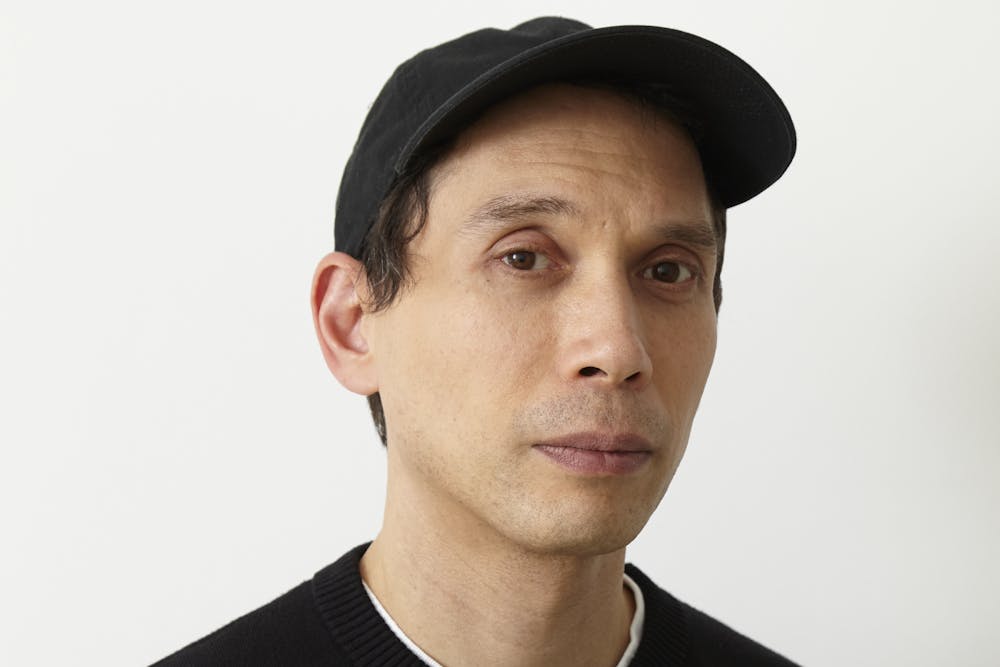
I’m attending a visiting artist lecture by Josh Kline at the Institute of Contemporary Art. The Philly–born artist's work examines many of the most pressing political issues of our time, such as climate change, democracy, and the intersection of technology and class. From life–sized 3D printed humans to intricately melting wax houses, Kline’s work is evocative, personal, and subversive; it's truly innovative in the political message it sends.
Kline opens the talk by detailing his creative process, which was influenced by his nontraditional film school background. “I don't have an iterative experimental studio practice where one thing leads to another,” he says. “I have discrete bodies of work that are novels that I work in over many years.”
One of these novels is his 2016 installation Unemployment. Set in the 2040s or 2050s (the decades by which Silicon Valley was, at the time, predicting that AI would render the middle class obsolete), 3D printed plaster sculptures of unemployed middle–class individuals lie lifelessly on the floor, wrapped in clear plastic bags and curled in a fetal position. Staring down at these glassy–eyed forms, I am struck by the exhibition's muted colors and desolate, haunting feel, the 3D printed faces at once too human and not human enough.
“When I scanned people, I had extensive conversations talking about how they will be represented,” Kline says. In Notes on Cinematography, French filmmaker Robert Bresson emphasized that the director’s role lies not in giving directions, but rather in going with the flow of reality. “Choose your models well,” Bresson writes, “so they lead you where you want to go.” I am struck by how Kline's approach to artmaking feels similarly organic. Kline views his models more as co–creators than subjects: Through extensive conversations, he learns about what they stand for and asks them to shape the project with him.
Kline would often contemplate what it means to create “tragic art.” Books and movies often make people cry, and he wondered if sculptures could do the same. He decided that he had to use imagery that regular people are intimately familiar with. In chapter two of Unemployment, shopping carts are filled with plastic bags of soda cans, glass bottles, and office equipment, staples of middle–class life. The carts are printed to look like they’re set on fire, with neon green and yellow flames enveloping them from below. “Something defining New York is that you see elderly people pushing shopping carts full of materials,” Kline says. “And it always makes me angry, thinking about what kind of society forces its elderly to scavenge for bottles and cans for pennies.”
In some way, Kline’s work captures a core impulses of contemporary art: to lay out with raw clarity the paradoxical tenets of reality, to invite the viewer to reflect on their conditions, to introduce ideas that viewers can carry into their everyday lives the next time they see a shopping cart.
Kline ends his three–part series with hope. Now that he’s identified the problem, part three begs the question: What would a utopia look like?
During the extensive conversations with his models, Kline explained the concept of Universal Basic Income: “It's the idea that the government gives everybody a set amount of money for being alive so nobody has to struggle for the bare necessities of life.” He was surprised to find that his models were deeply offended by this idea. “I really need the help,” they would say, “but it'll go to people who will go home and do nothing and sit on their couch and watch television.”
In response to this sentiment, part three of Unemployment is a commercial for UBI. Kline filmed interviews where he asked, “What would you do if you won the lottery and didn’t have to work anymore?” Answers included “I’d help my neighbors,” “I’d take care of my grandparents and go back to school and become a scientist,” and “I’d become a writer and volunteer at my Church.” No one would sit around and watch television all day.
Listening to Kline’s creative process, I’m reminded of conversations I've had in my video art class. The sensationalization of suffering and violence towards the marginalized in journalism reinforces the narrative that the oppressed are weak and the oppressors are strong. This, in itself, becomes an act of disempowerment. Rudy Gerson, my video art professor, believes that artists ought to hold ourselves to a higher standard: Visceral narratives of trauma and harm induce empathy, but only enable a politics where caring about issues means we must suffer vicariously through the victims. As an art student, I’ve often wondered about this paradox. Few things feel as urgent and meaningful as raising awareness about the endless problems in the world; at the same time, it feels impossible to depict suffering without feeling, on some level, like I’m selling someone out, packaging deeply personal stories into bite–sized, consumable pieces. What does it mean to create art about suffering without exploiting the subjects of said suffering?
Kline’s work perhaps offers one resolution to this question. In another installation, Deep Fragility, cityscapes of NYC, LA, SF, and DC are slowly submerged in water. Next to the flooding cities, wax houses slowly melt into mush, and the viewer is forced to stand there, helpless, unable to do anything but watch the goop drizzling down the drain. The wax is then collected in a bucket underneath and reused for the next day’s exhibit. “I think the twenty–first century will be defined by forced migration,” Kline posits. As someone who lives in New York, he is ready to be forced to migrate inland in the coming decades.
By focusing on the inanimate rather than the human, Kline evades the question of exploitation: He refrains from depicting human suffering altogether. No sob stories of migrating refugees are aired. Instead, while watching the wax houses melt, I am forced to look inwards, to ask myself about the role of housing and potential migration in my own future. These wax sculptures serve as an analogy—through the visceral experience of the artwork, viewers must do their own work to draw connections to their own lives.
Even when Kline portrays humans, such as in Unemployment, he only depicts their stories abstractly. No details are aired of any person’s life; those are reserved for the private sphere. Kline’s path to the viewer’s heart is again through visceral experience: In the case of Unemployment, it’s the haunting feeling of walking amongst uncanny, life–sized, 3D printed humans.
At the end of the talk, a viewer asks Kline, “You mentioned earlier you used to wonder if you could make people cry in the gallery … What was the answer?”
Kline takes a deep breath, then, in a soft voice, lets out, “The answer is yes.” He scans the room before continuing, detailing the out–of–body experience he had walking around his gallery witnessing others’ raw emotional reactions.
“I don’t want to say it made me feel good?” Kline says. “But it made me feel like I had figured something out in the work.”