
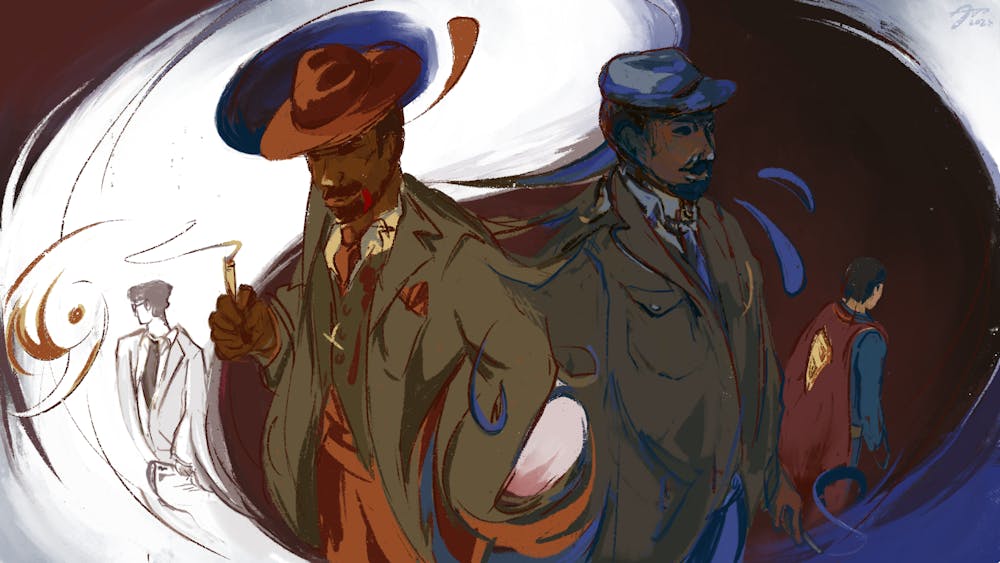
In 2025, Hollywood’s most reliable special effect wasn’t CGI—it was cloning its stars. Michael B. Jordan played twin brothers in Sinners. Robert De Niro played rival mobsters in The Alto Knights. Robert Pattinson played a man and his copy in Mickey 17. Theo James faced off against his evil twin in The Monkey. Even Superman found himself doubled, with David Corenswet facing off against his evil clone Ultraman. Add Elle Fanning’s twin act in the newest Predator film and Dylan O’Brien’s bleak comedy Twinless, and it starts to feel less like coincidence and more like obsession.
The dual role isn’t anything new—film history is littered with mirror–image performances, from Jeremy Irons in Dead Ringers to Nicolas Cage in Adaptation. But this wave feels different. In an industry now defined by replication—sequels, spinoffs, and reboots—Hollywood has turned doubling into a broader metaphor. Every star is playing themselves twice because the industry as a whole keeps doing the same.
It was all about “imagining those dynamics and incorporating that into the body double that I was acting opposite, and premeditating those choices because once I do one, I have to go on the other side and play the other brother,” Michael B. Jordan told People. “I’m already going against a performance that I already did before … There was a technical aspect and an emotional level of building these characters that was challenging but very rewarding.” He added that his dialect coach helped him distinguish how they stood, how they walked—“they held their trauma in different places”—and said that the process was essential to feeling “confident and prepared.”
De Niro, by contrast, treated his doubling in The Alto Knights as instinct. “F*** it, I’m going to do it,” he told Entertainment Weekly. He plays Frank Costello and Vito Genovese, two men circling each other across the mid–century mob world. His presence as two faces of aging authority turns the film into a kind of mirror confrontation between legacy and replacement.
That tension runs through many of this year’s projects. Mickey 17 literalizes it: Pattinson’s clone wakes up to find his predecessor still alive, and both are forced to confront which one deserves to continue living. The conceit turns existential panic into physical dialogue. The Monkey, adapted from a Stephen King story, turns the twin trope into horror—one brother good, the other corrupted, both bound by guilt.
Each of these stories treats identity not as a mystery but as a resource—something to split, package, and re–sell. The same star twice in one frame becomes both a symbol and a symptom of how the industry operates. Movies used to depend on transformation: an actor disappearing into a role. Now the draw is repetition. The spectacle isn’t change—it’s sameness multiplied.
That’s what makes this trend feel so specific to now. The same year studios flirt with AI–generated extras and algorithmic scripts, their biggest names are proving they can still outdo their own doubles. Jordan and Pattinson aren’t just performing range—they’re proving existence. The dual role turns human imperfection into the last real special effect.
The technology behind these scenes—motion–tracking, facial replacement, digital compositing—used to be a selling point. Movies like The Parent Trap or The Social Network flaunted the trick. Today it’s so common that audiences barely register it. What used to signal innovation now signals effort: a reminder that the actor is physically there, playing both sides, not generated by software. The irony is that the most digitally–intensive performances this year are the ones proving they’re human.
Earlier generations used doubling to express what characters kept hidden: alter egos, temptations, inner demons. In 2025, it’s about something simpler and sharper—staying visible. The fear isn’t exposure anymore, it’s erasure. Actors are no longer hiding from their reflections, but clinging to them, fighting to prove that there’s still a difference between the person and the projection. In an era when digital stand–ins and AI likenesses can recreate performances in–depth, these stars are fighting their own replacements. The screen becomes a battleground where presence itself is the point. Each double role is less about psychology than preservation, dramatizing the anxiety that art—and the people who make it—could be copied out of existence.
That’s why so many stories this year revolve around split selves. Severance treats identity as corporate property, splitting workers into halves that share a body but don’t know each other. Twinless turns it into farce, a joke about grief that never ends because memory keeps replaying the same face. Even Mickey 17 and The Monkey share that fixation on endurance—how long one version can survive when the other refuses to disappear. Every variation centers on the same question: what happens when the image outlives the person? What’s left to perform once performance itself becomes infinite?
The double role answers by turning anxiety into authorship. In a world where anything can be faked, what still matters is watching someone actually do it. Playing both sides of a scene isn’t just a trick—it’s work you can feel, something no algorithm can mimic. The act becomes the message: presence as proof, effort as authenticity.
When it works, the effect is startling. Jordan’s brothers share a frame and you feel the collision of two real performances. De Niro’s two mob bosses turn every scene into a quiet duel between versions of himself that the industry has spent fifty years mythologizing. In Predator: Badlands, Elle Fanning’s twin performance isn’t about trickery at all—it’s about watching an actor build two distinct survival instincts with the same android programming. These moments remind audiences that acting is still a physical craft, not a template.
Hollywood has always repeated itself, but in 2025 that repetition finally means something. The doubled actor isn’t a gimmick; it’s a confession. The industry keeps cloning its stories, its characters, its stars, and the result is an image of a system watching itself in the mirror, trying to find what’s still alive inside the copy. The movie star hasn’t vanished—it’s multiplied. Now, it's fighting to prove it was real all along.