
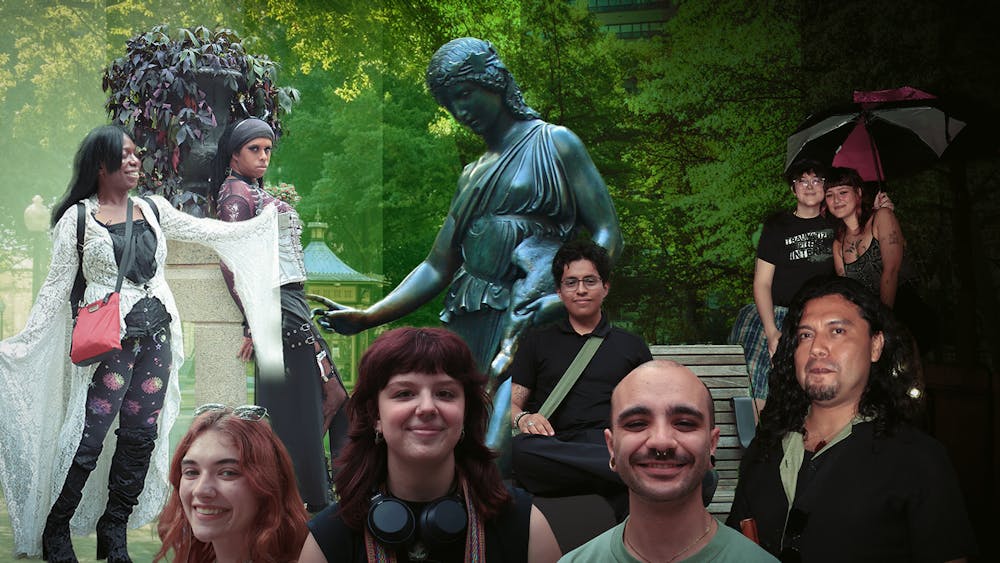
Night has fallen now in the square, and I’m sitting in the rain. I’m joined by a friend for safety and for company.
It feels awkward now trying to approach people as the park population grows scarce. One couple shoos me away, the only pair to deny me an interview today. It’s a bit chilly, but I’m dedicated to interviewing three more people.
Teenage girls are celebrating their friend’s sixteenth birthday and taking photos in the park—the second group today. Couples leave their Saturday night dinner dates. A few guys share a joint.
These are the stories of Spencer, Vic, and Crow—the final interviewees of my 12 p.m. to 12 a.m. investigation into Rittenhouse Square.
______________________________________________________________________________________________________________
SPENCER AND VIC
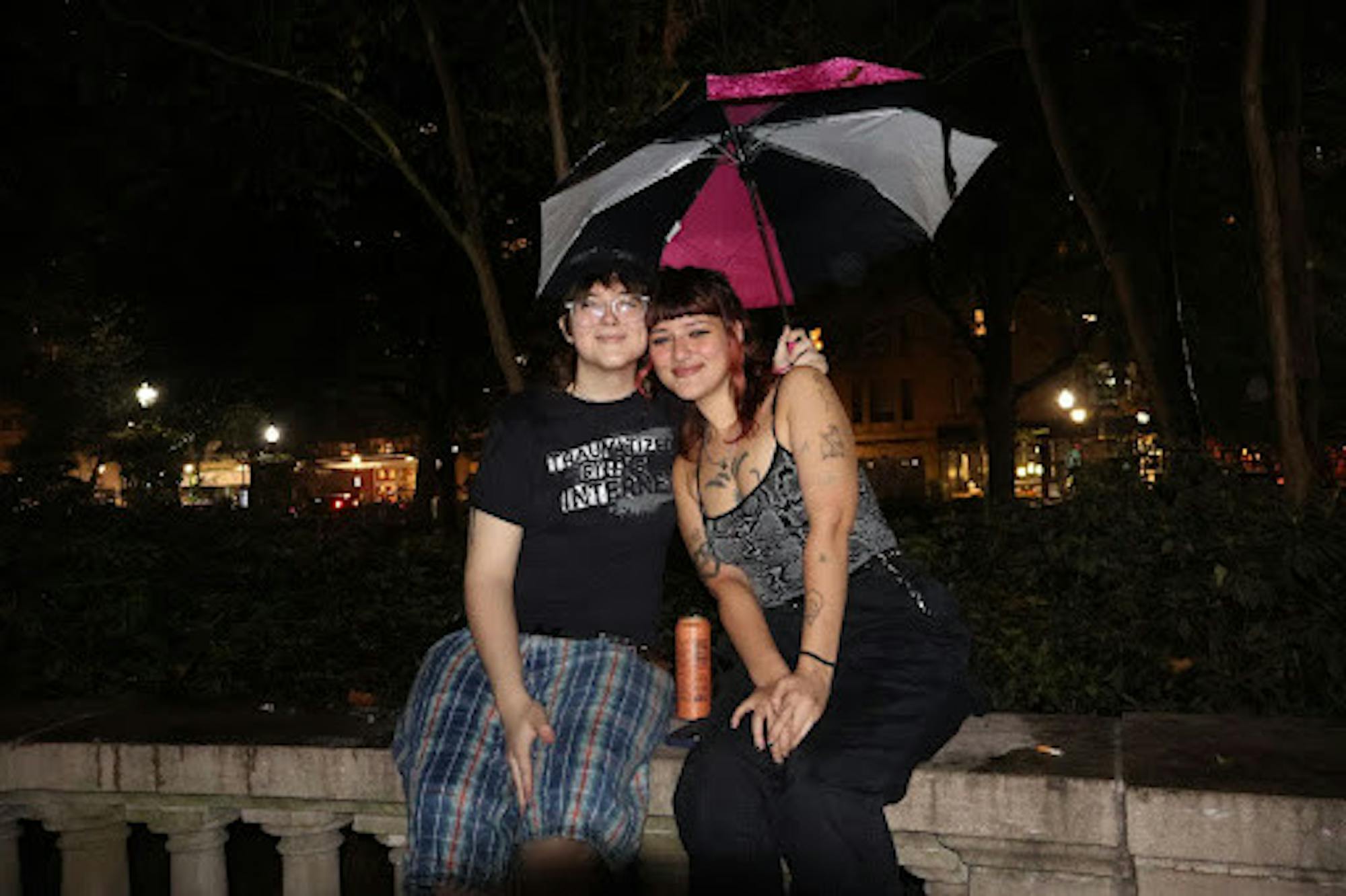
I find Spencer and Vic sitting in the same spot as Sophia was, light rain falling on their heads. I offer them my spare umbrella as we talk.
The two were on South Street earlier that day, and had been together since the morning. Vic, sitting on the left, lives nearby, about five blocks away. Spencer lives in West Philly near her job at Knockbox Cafe, the Philly cafe voted to be the most “lesbian” in the city according to Spencer.
Vic works at the nearby Penn Medicine Rehabilitation Hospital, and has been there for about a year, having moved to the area for the job. She’s originally from Texas, but “didn’t like how conservative [it is] where [she] was growing up, so [she] ran away.” It’s been three years since then. Spencer, on the other hand, grew up in Philly, and recognized my friend from Penn Alexander School.
Vic worked in a retail pharmacy prior to her current gig, around when Ozempic was booming in popularity. “It was just constant bullshit, they didn’t pay me enough, and then the company eventually went under, so I left,” she explains. Eventually she moved to a Walmart pharmacy, but got stuck in a predominantly male retail environment. “When the gay–looking one is getting yelled at and no one jumps in, I start to find it a problem,” Vic says. They knocked her hours down to five and a half per week, because unlike most pharmacies, Walmart is a seasonal job and doesn’t want to employ people full–time in its pharmacy. So she left, and after three months of unemployment she landed her current position. “There’s like a tattoo shop there if you ever end up inebriated and in need—just don’t show up too drunk. They might kick you out. I showed up stoned and they’re okay,” she goes on.
This brings us to the topic of tattoos. Spencer is visibly covered in them, most of their tattoos being stick–and–pokes they did themself. Vic, more covered up, has a bunch as well. “I have a bunny from where I grew up,” she says, “after my dad died, I don’t know, it kind of just reminds me of him because it was around that time.” Not all are so wholesome, though. “I have a bunch of stupid ones, in nasty places,” she goes on. Pointing to one on her lower back: “this is a classic, and it’s really poorly done. It was like on the floor of an apartment, okay? Like, drunk, K hole, shittiest possible situation, literally, I should have been infected for weeks. Like, I put underwear on, like, straight over it. Didn’t even think about it. I was just partying, so I didn't really care,” she explains.
In high school, Spencer covered their legs with eyes, flowers, strawberries, and all sorts of lesbian imagery. More recently, they covered their upper torso. Spencer is an artist, and is currently interning under a mural artist who runs Hagopian Arts. The female–owned public art initiative is based in West Philly and focused on ecology, culture, and community, particularly indigenous ones. Spencer helps with these projects across the city, painting native and medicinal plants with the initiative and doing oil painting on the side.
Spencer recently got back from Berlin, where they went on a graffiti tour and left feeling more inspired than ever. Their tour guide spoke of graffiti as the work of the city's lower income population, and explained that the upper class of the city had recently begun to capitalize on it. In high school, they’d interned with Mural Arts Philadelphia and felt a similar vibe, especially because of their anti–graffiti goal. “They don’t pay their artists enough, and kind of capitalize off of Philly artists,” they explain. Hagopian Arts, they say, “[is] an independent artist, and works especially with indigenous people, I really enjoy it.”
When asked by my friend about a recent lesson they learned that had been really meaningful to them, Spencer turns back to their trip to Berlin. The history behind the street art they learned about, and the ways in which German society built itself back up after World War Two and the Cold War, left them feeling incredibly inspired. The connection between public expression and societal growth drives art in Berlin, and has begun to drive Spencer’s work in Philly.
When I leave the pair, they decide to go to Van Leeuwen for a scoop of ice cream.
______________________________________________________________________________________________________________
CROW
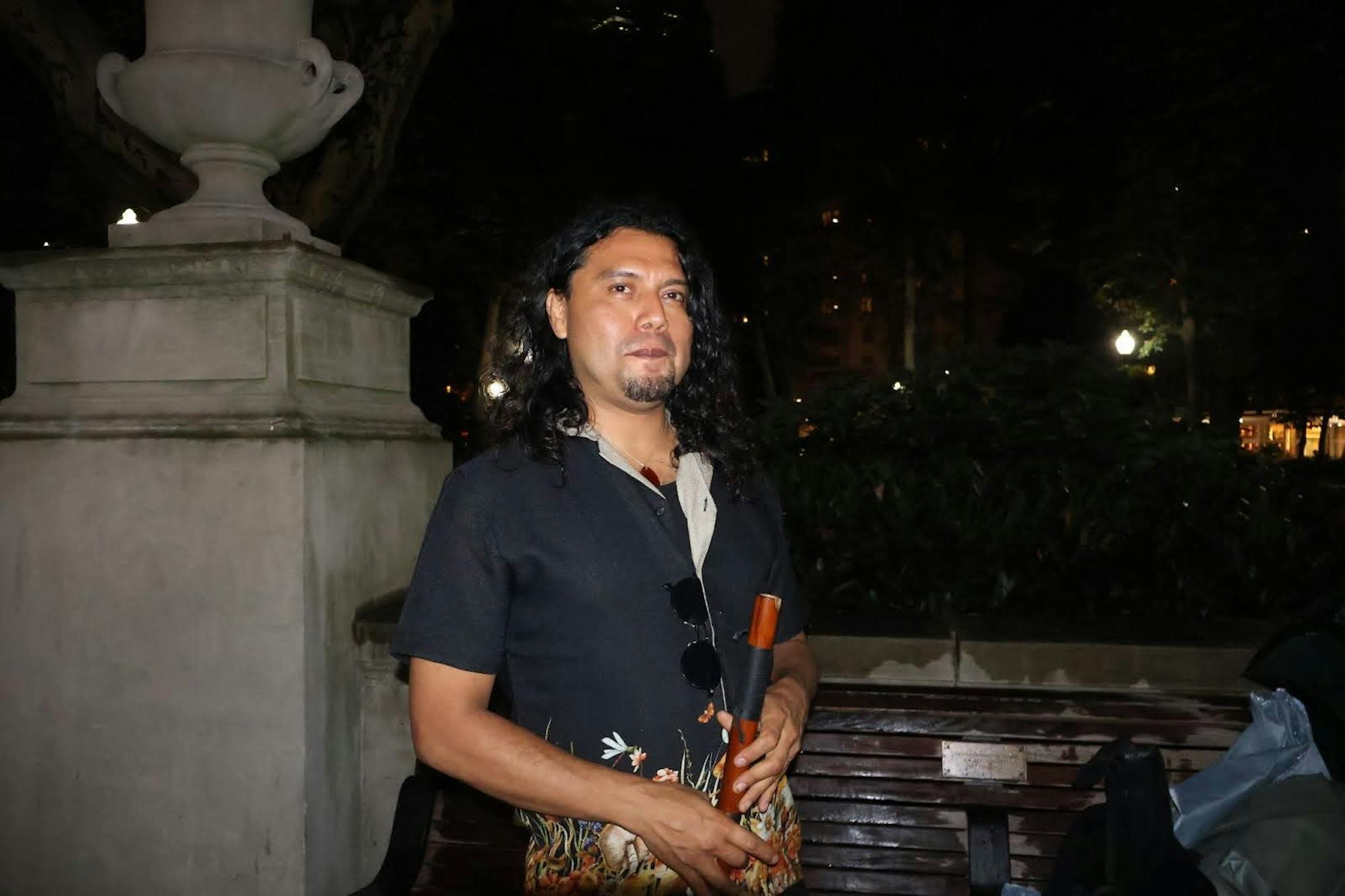
Crow talked my ear off. As our conversation went on, we sat in the rain together as he straightened out a tobacco leaf, rolled, and smoked a blunt in its entirety. The only way I could get our conversation to end was to say my phone was about to die—which it was.
He first came to play in Rittenhouse back in 2014 when he was looking for a place to play his quena, an Andean flute. The park was perfect, as he needed a space that could hold such a loud instrument. Despite his public performance, Crow never sets out a hat for money; it’s all for the love of the game. When it comes to his choice of music, Crow’s keen on sticking to songs by Black women. “Damn, I love Black women,” he shares, before listing off a plethora of Black female artists he likes to play, Keyshia Cole in particular. He shared this another three times.
Crow’s from Los Angeles, and he moved here around the same time as his first trip to the park. He tells me about this as he goes on a tangent about a massive crack he got down his quena. A buddy of his back in Los Angeles was obsessed with getting one of his own, and kept asking Crow to make him one, even buying the proper bamboo for it. They ended up going to a Creole man in Inglewood who taught Crow everything he knows about tempering the wood and making flutes.
Somewhere along the way we get to Crow’s childhood. The scene starts in Gardena County, Los Angeles, and Crow is six years old. On a day where he had a couple bills in his pocket, he went to the Roadium, a nearby open–air flea market. “The first thing I heard was music playing at a CD stand—Latino CD stands, you know how they are—and the guy was bumping Andean music,” he says, “I already had some idea of instruments because my sister was a great singer. But I couldn’t figure out what the hell that sound was.” He bought a CD for five dollars, labelled "Viento en los Andes,” thinking that was the band name. “I took it home, playing it, and my mom goes, ‘Nena, that’s music from the Andes, where’d you get that?’ I tell her, ‘The Roadium.’ She goes, ‘Wow, your cousin plays that instrument.’ I’m like, ‘Oh, that’s a quena,’ … She tells me I need to go back to Colombia. She sings me some Andean songs she knows. And I’m like, ‘Damn, okay, now I know what I need.’ So I go back to the flea market looking for the CD guy, thinking he’s a vendor so he must know someone,” he goes on.
I let him go on speaking, barely getting in a question throughout the story. “Instead, I hear someone else playing the music,” he says, “actually playing the flute—selling stones, incense, tarot cards, sage bundles, all that. And he has a basket of flutes. They were novelty grade bamboo, not tempered … He let me stand there practicing until I got a note. When I finally did, he showed me a song—super simple, very native and pentatonic.” Crow picked up Andean songs quickly from there, mostly by ear, going to see the man every weekend for a quick lesson on the tarmac. “Time flies when you’re a kid, so I don’t even know how long I went there learning,” he says.
He moved away from Philly in 2017 to New York City, going back and forth for four years until he settled back in Philly in 2021. Now, he lives here but still performs with his band every now and then in New York City. As of now, he’s been in Philly for three consecutive months. Philly’s very different from Los Angeles, as “there aren’t many town–square type places in L.A.,” he says. He found Rittenhouse when searching for good acoustics in the city. “To me, this is free performing. It’s far enough from the cars, and right in the middle I get the best acoustics. When I’m doing stuff, you all can enjoy it. I can’t enjoy it the same way. I enjoy it differently, like I’m doing something while in a dream state,” Crow explains. This spiritual and emotional connection to his quena drove much of the conversation.
When asked why he stays out playing so late, he explains that American bassist Victor Wooten “talked about [it]—being tired late at night and finding the best ideas. When you’re tired, you can hear yourself. That’s why I like playing at night, like 2 or 3 a.m. … it gets spiritual. I feel the universe responding.” The intensity of his playing frequently reaches the extreme: “I humble myself, like, ‘How the fuck am I doing this?’ I remember moments where I feel like I’m outsourcing energy, like I’m at the verge of passing out but something won’t let me stop. Even when my mouth hurts. I’m tired, but I’m in it. Now I am it. That’s where I learn the most—in the painful songs, the emotional ones,” he explains. “And Black women,” he goes on, “they’re tired, but they have such elegance. You learn a lot from them about pushing music, attacking it.”
He isn’t just into R&B, though—Crow’s a metalhead, too. “Opeth, Testament, Decapitated, Vader, Behemoth,” are some of his favorites. “I go to backyard metal shows, basement shows. I play guitar, shred, whammy bar, dive–bomb,” he says. His band isn’t metal, though. “They’re rock, kind of country–ish, cowpunk. I just love groove.”
Still, Crow is the only one playing quena in the park. It’s rare to find someone else, especially in Philly. Growing up, they were everywhere, especially at the Roadium stands where guys were “selling flutes, trinkets, artesanías, CDs.” He reflects on the technique he learned then, sad that much of it may be lost if his teacher never taught anyone else. “Some of them didn’t want to show their methods—especially flute-making,” a trade he explains was incredibly competitive. “A well–tempered flute is like $60–$80 and has to be well made. Then more makers popped up, more availability. It really was like that South Park episode with the Peruvian flute bands, fighting each other for corners, yelling ‘This is my corner, bitch!’”
Crow misses Colombia all the time, “the food especially, the music, the people, my family. And it’s almost like it’s still the 90s there. Still the 90s there. And like here, you could try to be in the 90s, but I feel like I’m in the 60s or 70s sometimes,” he says. Missing home is another reason why he plays—it lets him feel connected to his Andean roots. “And I invoke the ancestors when I play the instrument. It’s something that is thousands of years old, like well over ten. It’s one of those first things we started doing,” he explains.
The instrument has a wide range of capabilities, “It has four–octave range, and it has so much tonal potential. It has all these different tones it can achieve. And I’m almost like a scientist with this shit at this point because it’s so much,” he says. He met one other quena player in the park years ago, a man named Iron Gum. Shocked when he saw Iron Gum playing the quena, he asked him all about it, but he didn’t know the traditional music, so he didn’t push further. Crow’s love for R&B takes him beyond the traditional limits to the instrument though. When I saw him earlier that day, he was playing songs by Alicia Keys.
His sound was built on that of his teacher’s, but with people out performing and busking around him as a kid, “whatever they showed me, I took it with me.” In Rittenhouse, where he has such good acoustics, he feels a demand from the space to play a certain way. He’s always reflecting on what he can do with the space, rarely playing the same song twice. “I know it sounds crazy, but that kind of limitation is important,” he says without further explanation. Most of what he plays is what people ask him to, playing everything from traditional to jazz or R&B. “Because it’s like a new sound to people, they’ve never heard it before,” he shares. Hours earlier, I could hear him playing from across the park—I heard girls squeal at the noise, saying, “let’s go eat near the flute!”
Crow is a master at his craft and a musician in his soul. At 14, he became obsessed with the guitar, wanting “to be a badass metal guitar player.” He studied the instrument and was drawn in by the microtones, “those in between–tones … It’s not just a half step, it’s blending in, sliding in,” he says. The freedom of microtones is why he fell in love with the quena. He knew clarinet, sax, “all that,” but “the quena has more freedom with the microtones because it's just holes.”
Despite his obsession with technique, “what’s important is how special the song is to you,” he says. He emphasizes learning the artist’s work and capacity, really learning their music and diving into what they like. This lets you get an idea of what you might like because you like them. But beyond all this, he encourages me to remember: “what’s happening the most with music is your spirit. Music is spiritual, even if it says it’s not. Even if someone says, ‘I’m an atheist, I don’t believe in God,’ music is still spiritual. Even that idea—that you don’t believe in God and you are the master of whatever—that itself is spiritual. You’ve taken that route. It’s still spiritual. And that’s where all the energy is coming from.”
The art we share with the world, “it’s not coming from you—it’s coming from a different power source. And you’re gaining so much by doing it, by performing.” He discourages playing at home. “Find a place where you can be loud, where you can play, where you can be heard and complimented. This is one of those places right now, the square, where you can find all those things,” he says. Never feel like you can’t do something, or feel shame at seeing someone’s skill at something they’ve been doing forever. Thinking back to his past, he says, “damn, that guy I was then was amazing. That kid was amazing. So never doubt yourself.”
Rittenhouse isn’t his only stomping ground: he plays at City Hall a lot, sometimes by Penn’s Landing, or Reading Terminal. “But this is much better. Better vibe. The bigger spaces are the better spaces … Find those big places where you can hear the sound and appreciate it … get as far as you can,” he says. Absorbed in his own testimony, he says that he’s found a new dimension of appreciation.
Crow blew my mind. I have never been so absolutely enthralled by another individual. I’m damn near certain that he’s the best quena player on this side of the country.
______________________________________________________________________________________________________________
The rain calmed as my conversation with Crow ended. The park was quiet, with light drops of rain falling off the benches and hitting the bricks. The few unhoused men lying around the park had fallen asleep.
And I went home.