
We love to flirt with death—at least behind the barrier of the silver screen. Maybe it’s morbid curiosity, maybe it’s catharsis, maybe it’s just good storytelling, but audiences have always been obsessed with the spectacle of survival. “Death game” movies—stories where contestants compete until only one walks out alive—feel aggressively modern, but the instinct behind their success is ancient. The arenas may change, but our fixation doesn’t.
Today’s death games—from The Hunger Games to The Long Walk, Battle Royale to Squid Game—aren’t just exercises in shock value. They’re mirrors held up to society, just distorted and sensationalized. We keep returning to them not because they introduce new fears, but because they show us something disturbingly familiar.
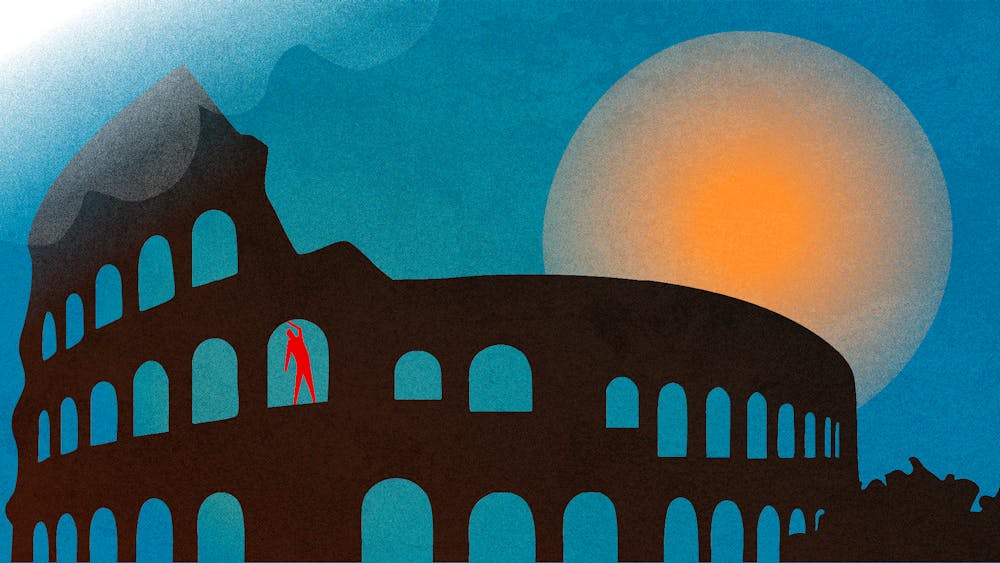
Let’s go back in time a few thousand years. Crowds once flocked to the Colosseum, where gladiators bled under the roar of thousands of attendees. That was the original death game—state–sanctioned gore dressed up as entertainment and moral lesson. Medieval Europe had public executions, civic rituals where violence was performed for the masses. Today, people pay premium prices to watch professional fighters beat each other senseless in MMA bouts. Humans are unsettlingly consistent; we crave structured violence as entertainment. There’s something cathartic, or at least clarifying, about how these spectacles distill life and death into something simple.
That simplicity is exactly why movies like The Running Man are so enticing. Set in a dystopian America where a reality show forces contestants to outrun hyper–theatrical assassins, the film focuses on a single question: Will Glen Powell survive the night? The 1987 Schwarzenegger version leaned into camp, but the new film plays its violence straighter, with an almost clinical precision. The audience inside the film cheers because the rules are clear: run, fight, or die. The audience outside the film cheers for the same reason. There’s no ambiguity. No hidden scoring system. No moral gray zone. Just a binary outcome.
The Long Walk is even more stripped down. 50 teenage boys—each representing their home state—are forced to walk until 49 fall. If they stop, they’re shot. There’s no elaborate arena, no outlandish weapons, no colorful villains. It’s monotony with a gun to your head. That minimalism is what makes it one of the best and most psychologically disturbing entries in the death game genre. The walk is arbitrary, slow, punishing, and impossible to “win” without losing pieces of yourself—a metaphor for the rat race we all find ourselves running in. In many ways, The Long Walk is the purest possible death game, because it strips away any illusions of control, any chance of corporate cheating. There’s no strategy. You don’t win by being clever. You win by enduring longer than anyone else.
In The Ballad of Songbirds and Snakes, Coriolanus Snow (Tom Blyth) observes that the power of the Hunger Games lies in the attachments that audiences form to the tributes—a hopeless, compulsive attachment. That psychological hook is what keeps the Capitol engaged—and it's what keeps us watching as well. If the rules are brutal but straightforward, we know how to invest our emotions. We know exactly what’s at stake and how to care.
It’s all wildly different from our actual lives. There’s no clean scoreboard for adulthood. Hard work doesn’t guarantee stability, luck matters more than effort, and while success feels arbitrary, failure feels personal. Did I get into Penn because of my grades, or was my admissions officer just in a good mood? There’s no rulebook, no discernible logic, so there’s no game to “win.” Death games, as horrific as they are, offer a version of life that comes in a recognizable rubric. You don’t have to guess what you’re supposed to do.
We tell ourselves that we watch The Hunger Games for the revolution, Squid Game for the critique of Korean society and capitalism, and The Running Man for Glen Powell’s stunt–work. For sure, that’s all part of the appeal. But beneath those justifications, there’s a quieter, more self–serving fantasy. We watch death games because we want to believe we would survive.
It’s easier to imagine outwitting 23 other tributes or walking until every other competitor collapses than it is to imagine successfully navigating the absurdity of the actual world we live in—a world where rent outpaces income, healthcare bankrupts families, and rigged institutions keep us from coming together. In that context, the premise of a death game becomes perversely comforting. At least in those games, the rules are written down.
These stories exaggerate our world to expose a core truth: when life feels like a daily grind without end, almost anyone would consider entering a death game. You win or you die—and if you win, that decisive victory will change your life forever. Squid Game makes the argument explicit when its contestants vote to return to the arena. They decide, collectively and consciously, that a deadly game with transparent rules is better than the opaque, crushing uncertainty of capitalism. The same logic exists in modern challenge culture. A recent Mr. Beast video asks viewers directly—Would You Risk Dying for $500,000? In the first few seconds, we get our answer: “Yes.”
Death games crystallize economic instability, rising inequality, exploitation, and despair into a system dramatic enough to confront explicitly. They give a narrative structure to the systemic insanity we live through. And, most importantly, they offer us the fleeting, delusional, but intoxicating fantasy that if we were thrown into a literal arena, we could triumph. That somewhere inside us is the protagonist who survives through grit, luck, or pure stubbornness. Such hope is irrational, but irresistible.
Death game stories pretend to show us distant dystopias we’d never tolerate. But the trick is that they only translate the reality we already live in into something more explicit. They strip away bureaucratic nonsense and moral grayness, leaving only the true forces that already govern our lives. They compress our realities into something cleaner. Something winnable. Something that makes sense. If the spectacle is cinematic enough, we can finally acknowledge the stakes—but it’s life and death in the real world, too.