As a member of Street, Hollywood’s most feared and respected publication, I recently had the honor of previewing the latest Asian American Blockbuster(™): it’s the powerful story of a young Asian American who fights their controlling family and ultimately overcomes their conservative thinking, winning the freedom to choose their own path as a result.
Sound familiar?
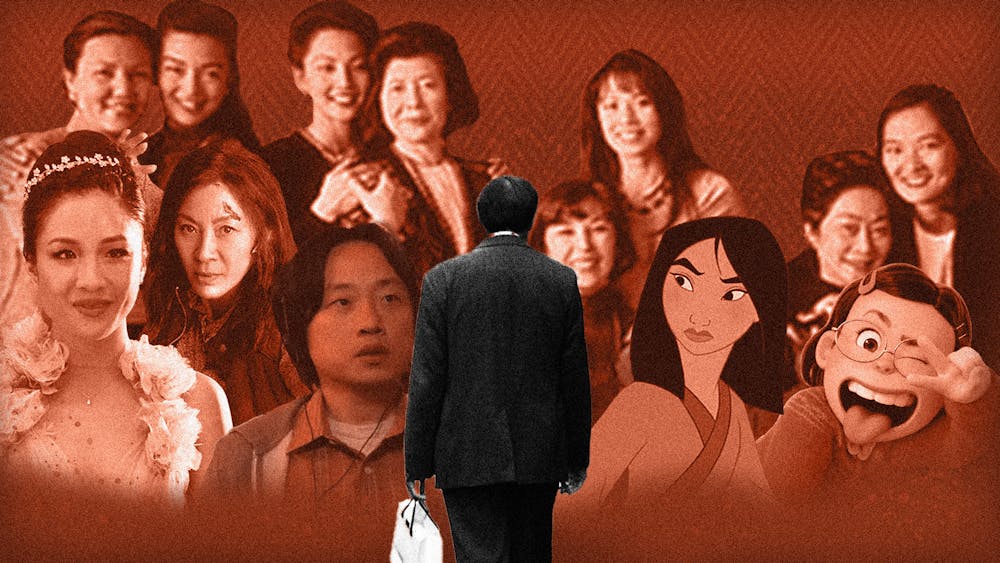
Mulan, The Joy Luck Club, Crazy Rich Asians … even at a cursory glance a pattern starts to emerge. A movie where an Asian girl turns into a giant 100–foot panda? She fights her mom. We finally get our own superhero with godly powers? He fights his dad. Everything Everywhere All At Once? More like Mommy Issues Everywhere All the Time.
It would be easy to dismiss this as stereotyping; racism as plain as buck teeth and slant eyes. Jokes about Asian parents are so banal at this point they’re in Family Guy. Yet, many recent works of Asian American media are explicitly pitched as authentic Asian perspectives. Turning Red, for example, was written and directed by Domee Shi, a Chinese–Canadian who based the movie around her own experiences growing up in Toronto. The same can be said of EEAAO, directed and written in part by Daniel Kwan; or Never Have I Ever, created by Mindy Kaling. These stories were not conjured by non–Asians in a boardroom, they are breakthroughs for Asian American representation on screen and meaningful to millions of living, breathing members of the community.
While the extent is debatable, the fact that Asian cultures tend to place greater emphasis on familial hierarchies than others is hard to dispute. The influence of communal lifestyles, belief systems like Confucianism, and firmer norms around marriage can be at odds with the individualist ethos of American society. Forget Confucius, how about the Census? Asian Americans earn more, are better represented percentage–wise in white–collar professions, and have higher educational attainment than any other racial group in the United States. Regardless of culture, it makes sense for high–achieving parents to push their children towards the same path to success they took—difficult paths which take away some freedom. Maybe these stories are simply capturing the truth?
I don’t think so. These stories portray a truth, but not the truth about us. In that sense, they are a significant improvement over older tales which held no truth at all, in which Asians were either corrupted villains or prostitutes. Looking at Black or Latino representation in the media, however, this victory starts to look Pyrrhic. Black characters are boxed into stories about urban poverty and slavery, Latino characters into tales of gang violence and menial labor. These stories are not necessarily inaccurate, but as they rack up awards and box–office dollars, they turn a story into “the” story.
The Daddy Issues Movie has become the Asian American version of The Slave Movie, the only story we are allowed to tell. It can be nuanced, realistic, compelling, written and directed by Asian Americans, but it still traps us in perpetual adolescence. We are only interesting when we are struggling with our cultural background and our parents—when we suffer. Once we break free of silly parental expectations and discover wonder–bread American freedom—in other words when we assimilate—the camera shuts off.
Asian Americans don’t grow old in movies. We don’t fight in wars, we don’t solve crimes, we don’t explore fantastic new worlds. We don’t get killed by scorned lovers, get trapped inside our own heads, get by with three kids on a budget. We don’t have one–night stands, we don’t marry unless it’s arranged, we don’t fall in love at cute coffee shops.
In short, we don’t get to be human. We get to be put in our little glass box, the Freud Gallery at the Museum of Colored People, crying about our generational trauma for 15 minutes every hour. Visitors gawking at us can feel reassured that, no matter our successes, we are profoundly miserable, repressed, and filled with hatred towards the people who love us most.
The worst part about the box? We’re directing it.
But I don’t blame Asian creators for writing stories about their parents. There’s a tendency to herd in Hollywood, which has become stronger as distribution channels become more diverse and each production becomes riskier as a result. Stories about parent–child conflict, like the aforementioned Joy Luck Club, were the first to break through, and studio heads may be reluctant to approve something which strays from a tried–and–true formula.
Putting financial considerations aside, I will never be against Asian creators drawing from their own lived experiences, daddy issues or not, to make compelling media. Consider Dead Poets Society, Romeo and Juliet, Antigone, along with thousands of other works, every era and every culture has explored parent–child tension in stories because it is fundamentally human.
In Interior Chinatown, Willis Wu, played by Jimmy Yang, is a struggling actor stuck playing “Background Asian Guy” who dreams of playing “Kung Fu Guy” one day. For decades Asian Americans on screen have been relegated to these one–note characters, whether they deliver kicks like Bruce Lee or your DoorDash order. I’m glad we’ve moved beyond those old stereotypes, but I fear that as things currently stand, all we will have changed is one day Asian American actors will dream of playing “Hates His Dad Guy” instead.
The unhinged comedy and experimentation of Beef, the suspense and thrill of Killing Eve, the chemistry and romance of Selfie—these examples show what Asian American creatives are capable of when they aren’t boxed in. The industry doesn’t tend to reward Asian American actors and writers when they try to push the envelope, but that is exactly why it is so important. Conflict doesn’t have to be between someone and their parents, it could be with a coworker, a foreign spy, a pet fish. Asian American characters don’t have to be emotionally stilted members of the upper–middle class, they can make silly jokes, love and be loved, drive a 20–year–old Camry. In short, any story can be an Asian American story because we can be every kind of person. In the hopefully near future, when someone is asked to picture the Asian American Blockbuster(™), they won’t think of a single story. Then, and only then, will we truly see ourselves represented on screen.