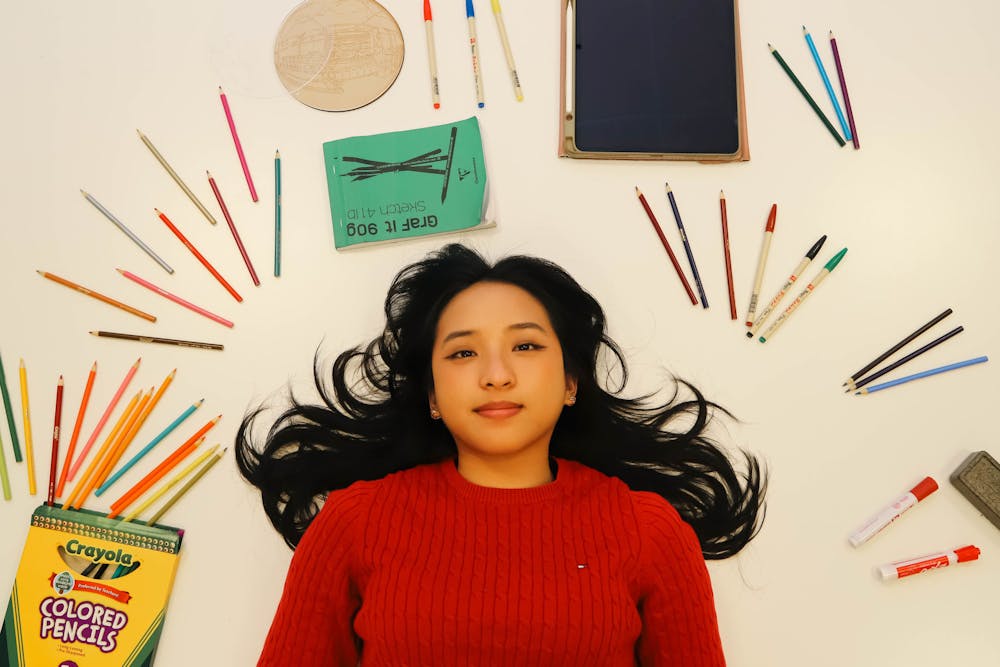
If you’ve ever scrolled past a class board graphic, clicked through Penn Student Agencies’ website, or lingered at a Penn Philippines Association post, you probably encountered Janine’s design. Across campus spaces and student communities, Janine has quietly shaped visuals that feel intuitive, thoughtful, and effortlessly engaging. She approaches visual work as something that should guide rather than announce itself, creating pieces that feel natural to the viewer. Her process is rooted in curiosity about how people see, feel, and connect, bringing a sense of clarity and intention to everything she creates.
Name: Janine Navalta
Hometown: San Francisco, California
Field of study: Major in Cognitive Science and Design
Involvement: Penn Philippines Association, Class Board, Penn Student Agencies, Penn Healthcare Review
What inspired you to pursue both design and cognitive science? How do these two disciplines inform one another in your creative process?
I’ve always been interested in art since I was a kid. Drawing and painting were always my hobbies. For a long time, though, I thought I would go into STEM or medicine because a lot of my family works in healthcare, and I was really interested in human health.
When I was applying to college, I started reflecting on what I actually spend most of my time doing in high school, and it leaned way more toward art. That’s when I decided to pursue design. Cognitive Science came a bit later. I didn’t declare it until sophomore year. I took some psychology classes, and they made me realize how connected design is to how people think, perceive, and interact with things.
Now, the two feel inseparable. Design without understanding people feels incomplete to me, and cognitive science helps me think more intentionally about how people process information.
Was there a moment in your life where you realized that design and science weren’t separate but deeply connected for you? What triggered that shift?
It really happened during college when I started learning more about UX and UI design. A big part of that process is interviewing people, asking how they use products, websites, or applications, and understanding where they feel confused or frustrated.
That research side felt very psychological. You’re gathering data, interpreting behavior, and then translating into something intuitive. That was the moment when it clicked that design isn’t just visual, it’s about cognition and human experience.
You design across very different spaces on campus. How has your creative voice evolved across these communities?
Across all organizations I’m involved in, the biggest similarity is that my work is always for students. Most of what I do falls under social media, publication design, or web design.
The differences come from who I am designing for. With the class board, I’m thinking about an entire class year. With Penn Student Agencies, it’s students who are interested in business but might not have experience yet. With Penn Healthcare Review, I’m working alongside people in STEM. Designing for different spaces has made me more adaptable and intentional. The goals are different, but I’m always thinking about clarity. Who is this for? How can design make things feel more accessible rather than overwhelming?
You’ve described yourself as someone who prefers to work behind the scenes. How does that influence your creative voice?
I’m a pretty quiet and reserved person, and I think that really shapes how I design. I don’t love being at the center of attention, but I like creating things that reach a lot of people.
Design feels like the right balance for that. When it’s working, it doesn’t draw attention to itself—it just feels natural. I think that’s why I really believe in the idea that good design is invisible. People notice when something looks bad or feels confusing, but when it works, they don’t think twice about it.
Tell me about a time when you hit a creative block. What did you do, and what did it teach you about your own process?
Sophomore year was probably my biggest creative block. I was doing social media work for PPA, and everything felt rushed. I noticed myself relying on Canva because it was fast, but it wasn’t helping me grow creatively. Eventually, I promised myself I would fully commit to learning Photoshop and Illustrator, even though it was harder. That forced me to slow down, find tutorials, and really understand the tools. Ironically, limiting myself that way helped me become more creative. It taught me that sometimes creativity comes from discipline rather than inspiration.
You’ve contributed to projects like Barrio with the Penn Philippine Association. What about that initiative spoke to you creatively and culturally?
Barrio was really meaningful to me because I grew up in a place with a strong Filipino community, and I wanted to stay connected to that part of my identity at Penn.
I was a co–scriptwriter and co–director, and I also danced and sang in the show. Writing and singing weren’t things I normally do, so it felt like a personal challenge. I liked pushing myself to try something unfamiliar while still being grounded in a cultural space that felt like home.
Penn can feel overwhelming, especially when success seems narrowly defined. How have you navigated that pressure?
It was definitely overwhelming at times, especially as a design major. You hear a lot about consulting and finance being the “stable” paths, and when you’re not doing that, it can feel like you’re behind.
Sophomore summer, I didn’t do anything. I stayed home because I was really burnt out. Junior summer, I did a GRIP program abroad in Thailand, but it wasn’t design related, and at first I felt disappointed. I had to remind myself to be grateful for the opportunity and realize that being in a place with a good work culture mattered more than checking a box.
When things feel overwhelming, what grounds you?
My family plays a huge role in that. I am a first–generation, low–income student, and learning more about my family’s history has really shaped how I see success. My parents didn’t go to college. My siblings and cousins took very different paths; some took breaks, some changed careers, some went back to school later in life. My sister stopped going to college to start a family and eventually returned to finish her degree. Seeing all of that showed me that there isn’t one “right” timeline. That perspective really reassures me when I feel like I am not moving fast enough or doing things the “right” way.
After Penn, where do you imagine your design and cognitive science interests taking you: in industry, research, or something unexpected?
I am leaning towards design, especially in spaces where the work helps people directly—healthcare, education, or public–facing organizations. Designing for a hospital, a healthcare program, or something like Khan Academy would feel meaningful to me.
At the same time, I’ve stopped rushing myself. I realized I’d rather spend my senior year maintaining relationships and making memories. I’ll have the rest of my life to apply for jobs.
What impact do you hope you leave behind in the spaces you’ve been part of?
I hope my work encourages people to try things they’re unsure about and to fully pursue what they care about. I want to leave behind a sense that it’s okay to move quietly, to take unconventional paths, and to design in ways that support people, even if it goes unnoticed.
Fun–lighting Round:
If your creative energy were the following, what would each be?
- A color: Yellow
- A place: A greenhouse
- A sound: “Wings” by So!YoON! and Phum Viphurit
What’s a guilty–pleasure cafe or snack spot in Philly you always make time for? Wawa fries and hoagies.
If you had to describe your Penn experience in a design metaphor, what would you choose? Good design is invisible.
There are two types of Penn students … Heads and tails
And you are … Tails!
This interview has been edited and condensed for clarity.