“How are you doing, Laura? Welcome, welcome in.”
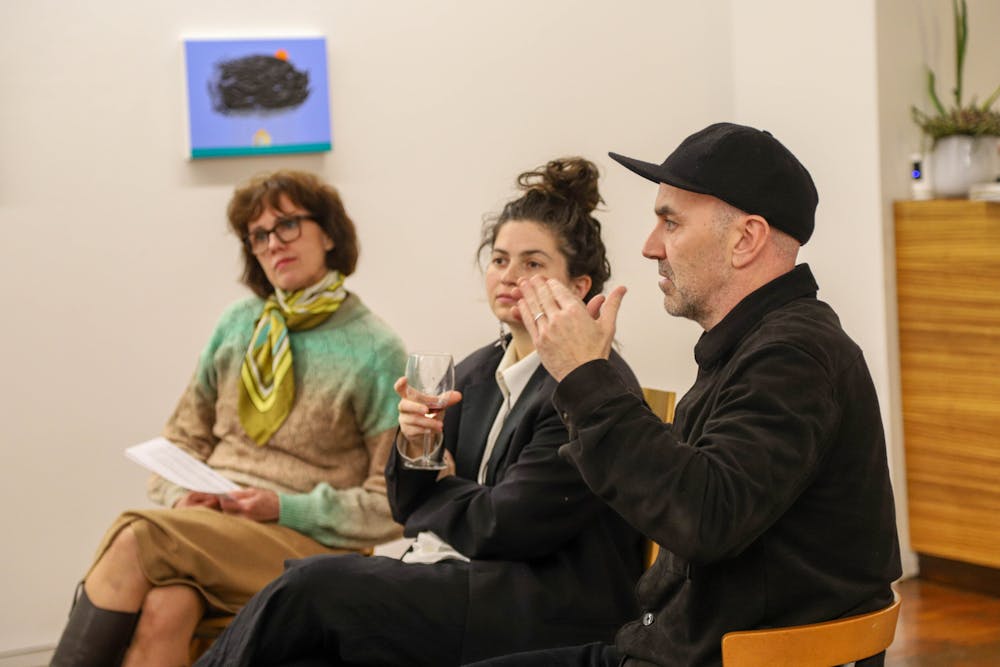
As soon as I open the wooden door, I am greeted warmly by Christine Pfister and Emily, two of the brilliant curators behind Pentimenti Gallery’s new round of exhibitions. On this chilly Friday night, I’ve just made the familiar trek to 2nd Street to attend the gallery’s opening reception. Upon entering, I am directed to the coat check. Grateful to have shedded my three layers, I head to the back of the gallery, where I am handed a breadstick and a glass of wine.
I sit down on a folded chair, ready to listen to Aitor Lajarin–Encina walk us through his newest solo exhibition, Flora, Fauna, and Furniture. Throughout 12 paintings, the same few everyday objects—chairs, plants, and crescent moons, amongst others—are arranged and rearranged into all sorts of exotic permutations. Aitor’s distinct visual style—impossibly sharp lines, two–dimensional forms, and an abundance of blues, greens, and beiges—draws upon surrealism, expressing a dreamlike, childhood world. These rearrangements ask us, “What if?”
What if wild horses lived across the river from your house? What if snakes could stand on chairs, or if goldfish could gaze at vast seas—what do these motifs say about our personal relationships? What if your living room was filled with miniature critters—what if these imaginary worlds were possible, and when in your life have you experienced the feelings they portray?
One answer is the expansive sense of wonder and untouchability associated with childhood. Star painting Flora, Fauna, and Furniture (2025), the namesake of the exhibit, features a centerpiece of a table and chair. To the left lies a turquoise, tree–shaped coat hanger; to right lies an unrealistically skinny palm tree. Littered throughout the painting, crawling over the furniture, floor, and walls are various tiny critters—an orange goldfish, a striped cat, and a wavy yellow snake, amongst others. These animals are drawn significantly smaller than life—the cat, for instance, is smaller in width than the leg of the table.
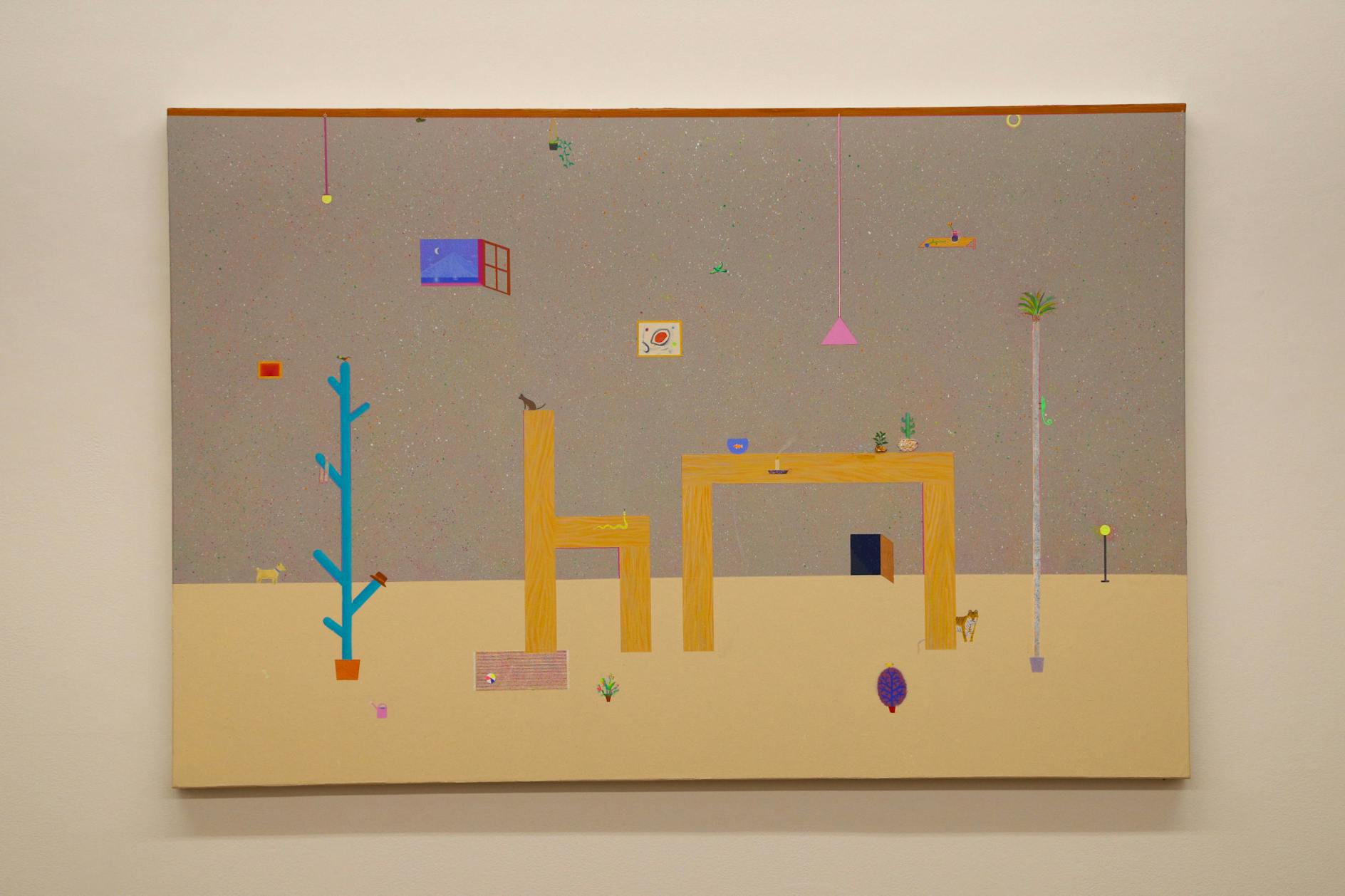
When looking at this painting, which, mind you, is a 60–by–40 inch colossus that covers an entire wall, it’s impossible not to be struck by the flat, cartoon–like imagery. The furniture centerpieces are only rendered in two dimensions; the chair is simply depicted as an angular, lowercase “h,” while the table is an upside down “u” with sharp edges. All edges are perfectly straight–down vertical or horizontal, without a single imperfection—a difficult feat to achieve with acrylic paint. Yet, both pieces are distinctly recognizable. In reducing his forms to their simplest versions, Aitor strikes at the universality of these motifs.
During his opening reception talk, Aitor explains that his interest lies in arranging “accessible and familiar” motifs into “ambiguous” combinations, then seeing how viewers respond to, make meaning out of, and access critiques of the world through his work. “One of the things I'm very interested in is the element of curiosity in the viewer,” he says.
By composing primarily out of beiges, tans, and other warm–toned neutral colors, this painting evokes a sense of safety, calling upon conceptions of a childhood home. The wall, which takes up the majority of the canvas space, is littered with windows, paintings, doors, smaller plants, and semi–uniform specks of white dots. “A window,” Aitor says, “is an opportunity to point at a space that doesn't exist in the representation that you see.” Using landscapes of deep blue—a color not seen anywhere else in the piece—the windows and doors bring to mind imagery of portals to an outer world. Together, these elements elicit a childlike wonder, a sense that anything is possible. The vast, expansive outside world portrayed by the portals almost reassure the viewer: “The world is your oyster, but you’ll always have this safe, lively home to return to after your adventures. Your colorful little friends will be waiting for you.”
“In a way, I'm not doing anything different from a child,” Aitor says, “when they bring from the imagination, and then try to put together something they have in mind that they want to share in an exciting way.”
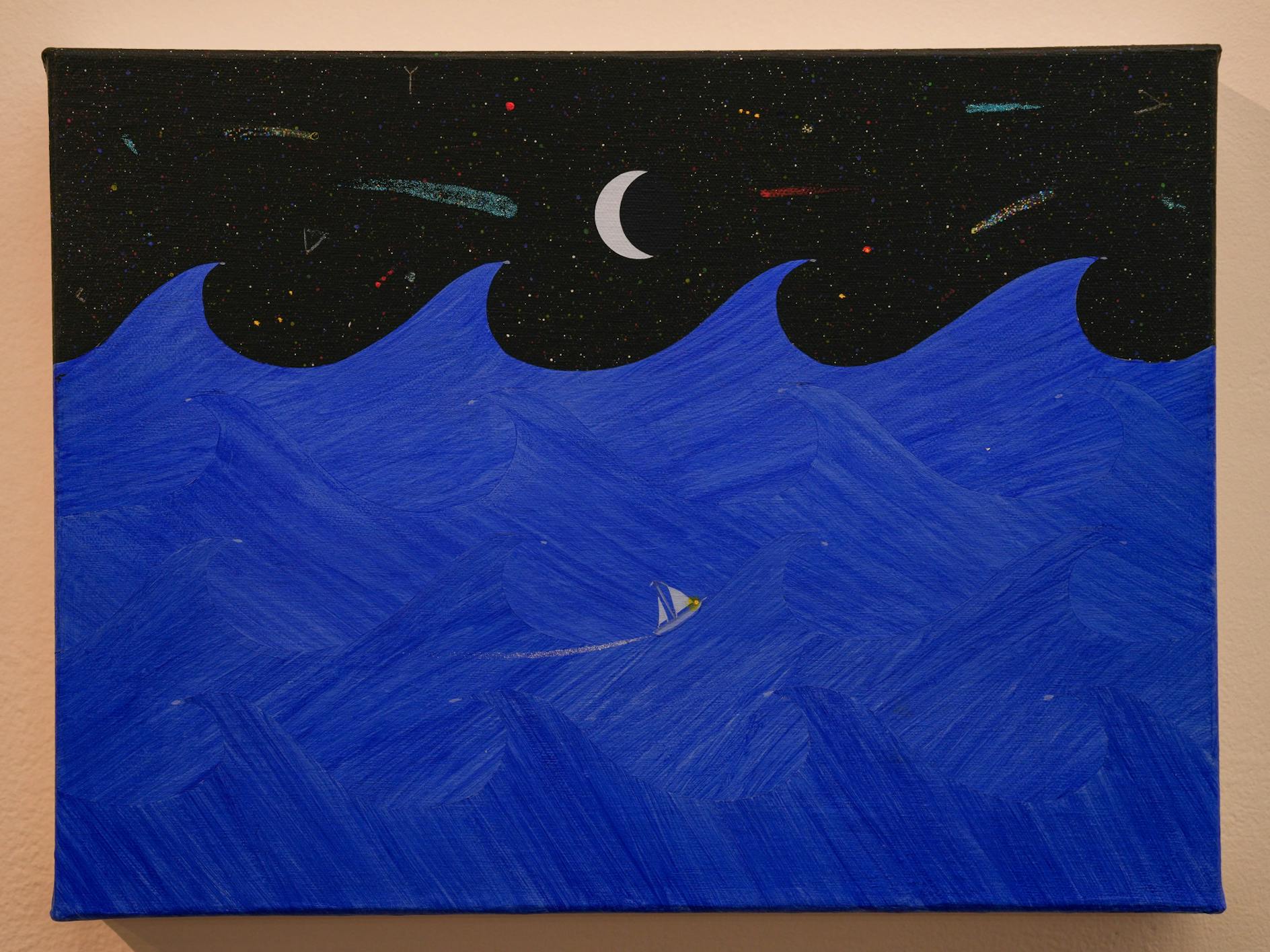
But what happens when you leave the home? Journey (2025) depicts a tiny sailboat in the middle of tall, deep blue waves. The sailboat, a primitive technology, represents a form of naivete against the dangerous, mysterious ocean. Yet, the painting carries a buoyancy. The sailboat is tailed by a flurry of white splashes that feels gleeful and cartoon–like once again, eliciting a sense of playful adventure. The waves, while larger than the sailboat, are rendered as two–dimensional forms; they’re filled in with diagonal stripes, as if colored in by a child.
The modernist movements emerged in the late nineteenth century as a radical retaliation against the academic, classical painting practice that had dominated the art world beforehand. Painters wondered, what if we weren’t interested in depicting forms as they are, but rather, bent and distorted to express the emotional state they’re carrying? Van Gogh’s famous Starry Night (1889), an early modernist painting, depicts the night sky in brilliant swirls. It looks nothing like the actual sky, but it captures the dazzling, radiant starlight and the inner search for peace against a tumultuous mind. At the Museum of Modern Art, where this painting is currently on display, a blurb reads, “Van Gogh assigned an emotional language to night and nature that took them far from their actual appearances.”
The same could be said about Journey. Aitor’s night sky is streaked with red and turquoise comets, speckled with white, blue, and neon yellow stars. The brush marks have a loose, airy, crayon–like application, as if smeared over the sky with a cloud–like applicator. Even on a dangerous sailing mission, stranded in the middle of the ocean with no land within sight, the sky reaches down and tickles your tummy, letting you know it’s watching over you.
The repetition of the crescent moon (in the window of indoor pieces, in the sky of outdoor pieces) serves as a storytelling device, placing the paintings in conversation with each other. A plot can be drawn, tracing a journey of an imaginary subject—arguably you, the viewer—as they traverse these different terrains. As such, the paintings are expansive rather than confined.
On the southeast corner of Pentimenti Gallery lies a smaller, nested room, with one special exhibit on display: we call the moon the people’s wife (2026). This 30–by–40 inch painting is a collaboration between Aitor and Vox Populi, a contemporary artist collective based in Philadelphia’s Chinatown. The painting functions as its own exhibition—Aitor painted a background, an abandoned nighttime parking lot, while ten Vox Populi artists created various objects in mediums of their choosing. The objects, which range from a sculpted traffic cone to a perpetually spinning plastic wheel, are tenderly arranged throughout Aitor’s painting.
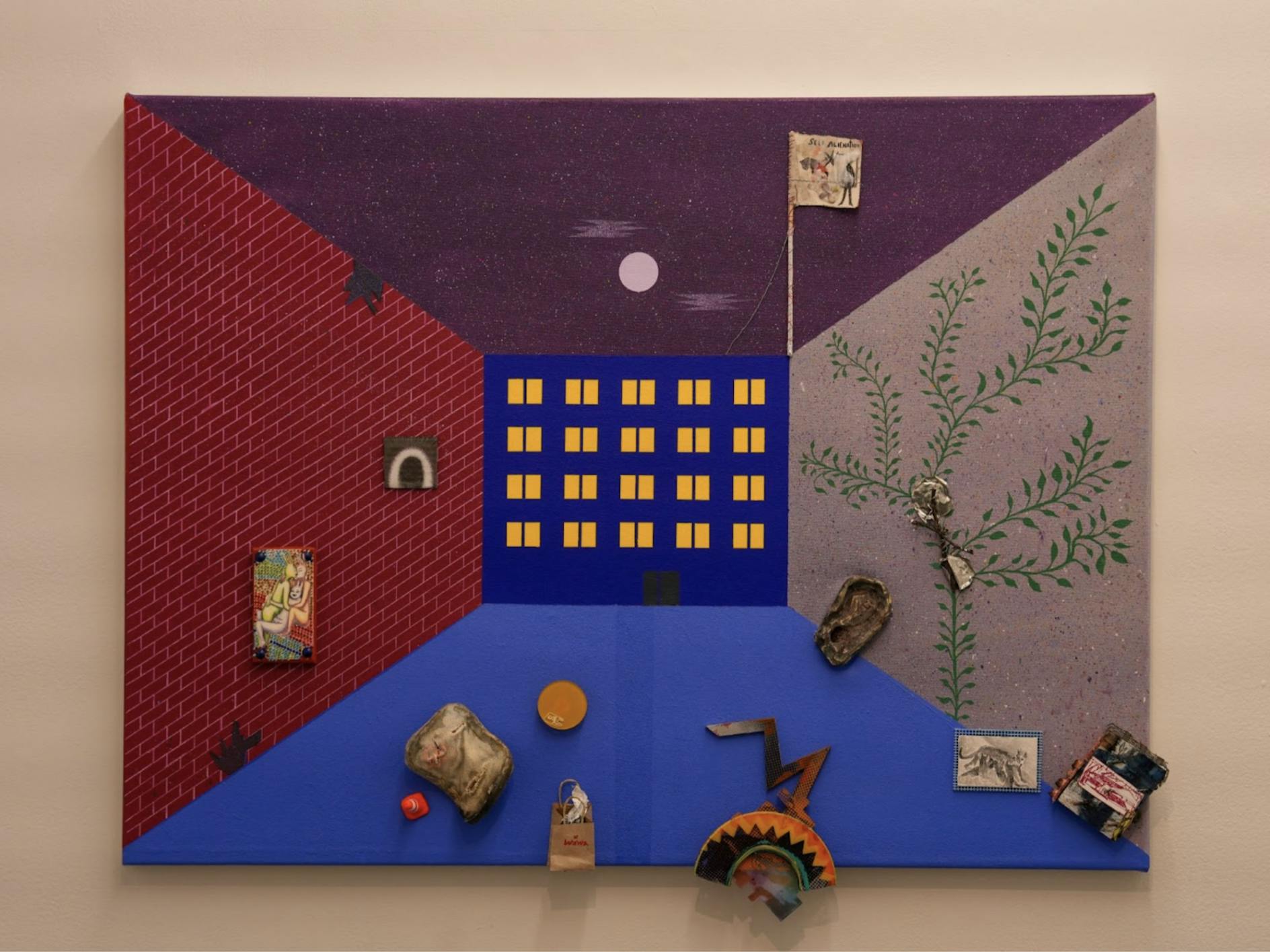
Aitor explains that he also works as a curator. While working on his Flora, Fauna, and Furniture paintings, he began thinking that these two practices—art making and art arrangement—aren’t so different. Both consist of organizing different representations and iconography within a dedicated space or frame. He decided to create hybrid pieces to explore this dichotomy. “It was going to be a good experiment to reconsider ideas of what’s a painting, what's a show,” he says, “with an understanding that maybe, it’d be a failing at both.”
Vox Populi Director Blanche Brown, who oversaw the collaboration, says it is “a work of great translations.” The piece allowed Vox members to create work within their own world and share those small worlds within a larger canvas, to an even larger world. “The show is called, ‘we call the moon the people’s wife,’ which is also a bit of shared, borrowed, ad hoc language,” she says.
China Rain, one of the Vox Populi artists, created a miniature, hand–painted flag, depicting an image of self–alienation. In the exhibit, the flag flies high above the abandoned parking lot; as the only object above eye level, it’s architecturally isolated. “I think it’s really exciting that we get to bring our personal symbology into a realm with others,” China says. For China, her flag is a snapshot of her broader research, where she investigates what it means to become distanced from who you are.
China explains that collaboration requires letting go of control. The day before, when the work was being assembled, Blanche asked if she had opinions about where she wanted her flag to be placed. “And I was like, ‘Maybe I do and maybe I don’t, but it shouldn’t matter, because I shouldn’t be able to have control all the time,’” China recounts. “‘So just do whatever you want to do.’ I just wanted it to be up to her at the end of the day, because that was, to me, part of the whole endeavor.”
Blanche echoes the sentiment. “Maybe the best thing for the ego is a boundary,” she says, “and that can be a really beautiful growth edge.”
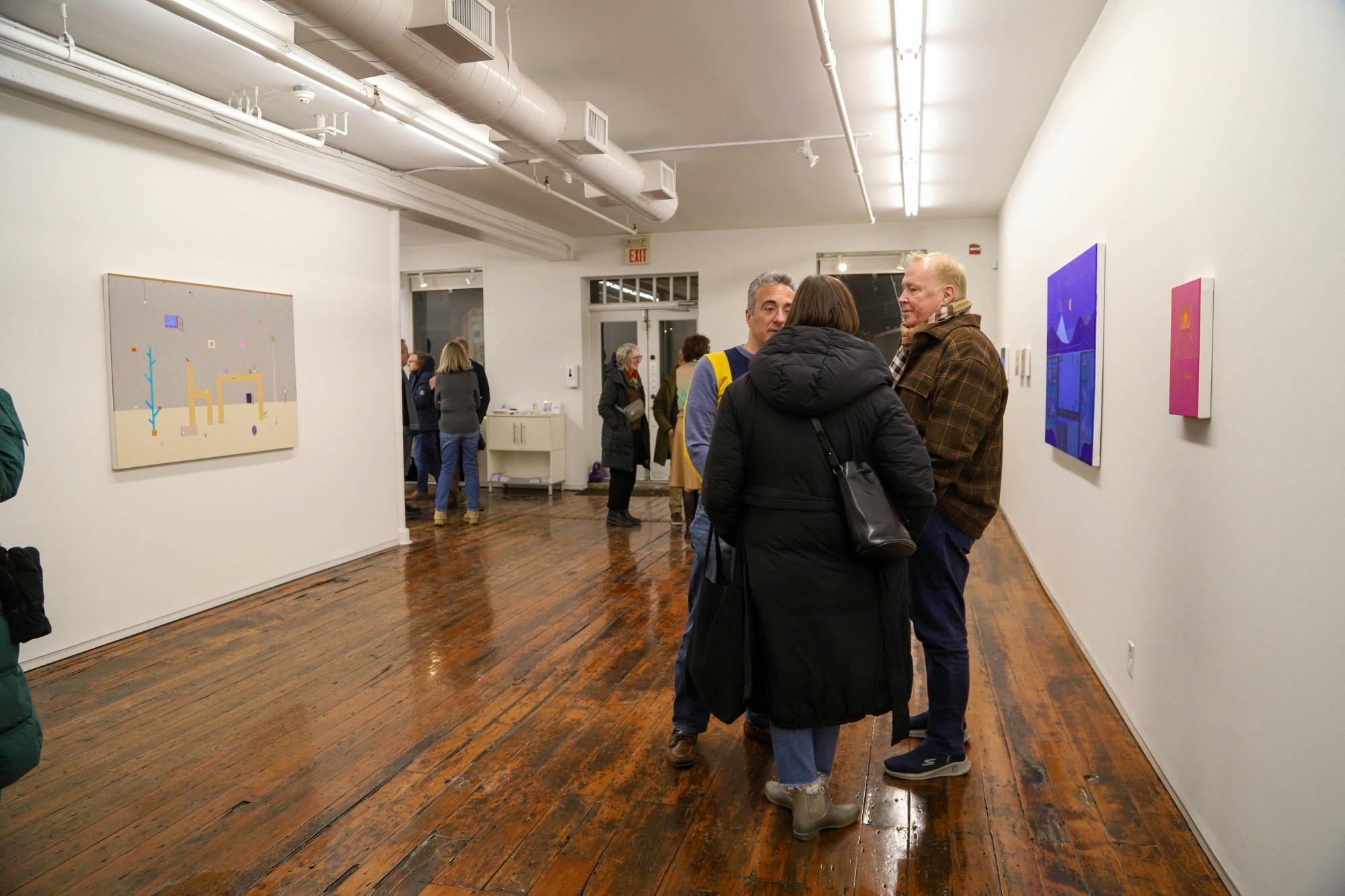
When you see artists on big screens, with dozens of square feet of wall space dedicated to their solo exhibitions, they take an untouchable, mythical semblance. At museums, brass–framed pieces are juxtaposed against hospital–white walls. The only sign of life left by the artist is a single, short statement on a hardwood plaque. It never has enough space to contain all the tangled threads of humanity that emerge from thoughtful viewership.
But opening receptions function as spaces of demystification. Artists, viewers, and curators alike milled around the little brick building that used to be a fire house, or candy shop, depending on who you ask. Catch Aitor standing beside his painting, and he answers your every question with a grin on his face. Philadelphia’s art scene is unique in its ubiquity of small, locally–owned galleries—I encourage you to trek to Old City and explore.
As a kid, I would never walk on the sidewalk in winter; I adored the crunchy, airy feeling in my boots as I left my mark in a fresh patch of snow. Walking home from Pentimenti, I do the same. I watch the smooth, snow–ice amalgamation break into large shards beneath my steps, like the floor is splitting into tectonic plates. Maybe the art world can be within us all too.
Flora, Fauna, and Furniture and we call the moon the people’s wife will be on display at Pentimenti Gallery until April 4, 2026.