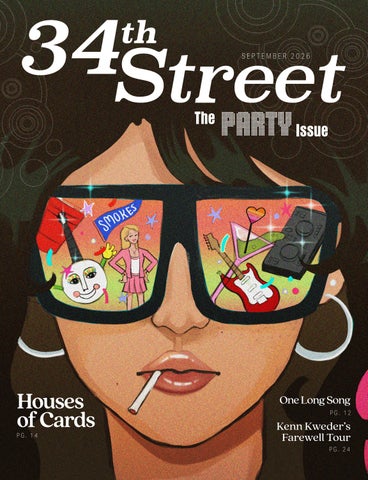
The typical routine of a Penn student likely looks like this: an endless rotation of classes, extracurriculars, social events, and mediocre dining hall meals. For Jason Xu, this was also the case—until he decided to leave Penn a quarter of the way through his sophomore year.
Now, Jason’s routine looks vastly different. In lieu of homework assignments and homecoming parties, his schedule now consists of 12–hour work days spent debugging code and meeting with other engineers out of a company office in New York. As a founding engineer of artificial intelligence startup Icon, Jason is part of a growing legion of young, ambitious students putting their education on hold in the hopes of making a big impact early on. At Penn, students who decide to leave school to enter the tech world join a broader cultural trend that questions the worth of higher education.
From Mark Zuckerberg to Bill Gates, dropping out of college has become a rite of passage for big tech founders and change makers in the entrepreneurship space. Now, amid a rapid rise in AI development, the startup world is fertile ground for new founders, particularly younger ones. Venture capital firm Andreessen Horowitz wrote in a 2025 blog post that it’s the “best time in a decade for dropouts and recent graduates to start a company.” Jared Friedman, partner at big–name startup accelerator Y Combinator, posted on X, the platform formerly known as Twitter, that “2 years ago, only 10% of the YC batch was college students or new grads. The last batch was 30%.” Most recently, Open AI CEO Sam Altman stated that he envies college dropouts because of how many opportunities they have.
Amid rising higher education costs and entry level job cuts, the return of investment on college is facing heightened scrutiny. To add to the increasingly enticing nature of leaving school, programs like the Thiel Fellowship and the 1517 Fund are offering students hundreds of thousands of dollars to drop out. The Thiel Fellowship, founded by Peter Thiel—co–founder of Palantir and PayPal—offers students $200,000 to pursue their own ventures. Similarly, the 1517 Fund doles out thousand–dollar cash grants to student founders. The only catch: You must be a dropout to qualify. The reasoning the Thiel Fellowship presents for this undergirds the questions of many business–minded students debating the value of higher education. “College can be good for learning about what’s been done before, but it can also discourage you from doing something new,” the fellowship’s website states.
Jason came across the opportunity to enter the startup world while majoring in computer and information science at Penn. There, Jason came into contact with an Ivy League dropout who had left Columbia University after his freshman year to work on his first company, Skio. Following Skio, he founded Icon, which uses AI to create advertising materials ranging from user generated content to static ads. The company currently runs a subscription–based service, offering unlimited AI–generated ad creation for $39 a month. After being offered the position, Jason accepted a role as founding engineer of Icon.
Icon, which is backed by investors like Open AI Executive Mark Chen and Eagles running back Saquon Barkley, currently earns $10 million in annual recurring revenue. Jason explains that working at the company alongside former employees of tech companies like Google and Meta means adjusting to a new kind of fast–paced, rapidly changing work.
“Understanding such a huge code base and trying to tackle it from the ground up, especially in the first few weeks of a project, you’re kind of just not really sure what to do,” Jason says. “And it really takes some time to ramp up. There’s a lot of expectations because the product obviously keeps moving even though you’re still learning, and that is obviously pretty hard to keep up [with]. But once you get past that beginning slump, it gets a lot easier.”
The image of a college dropout has changed drastically in recent years. For Gen Z specifically, the image of a dropout is no longer associated with lack of discipline or an inability to keep up with school. Rather, being a dropout—from an elite institution, particularly—carries an aspirational, almost admirable weight. The celebrity status of Gen Z dropouts is evidenced by the rise of Columbia dropout Roy Lee, whose marketing tactics for AI startup, Cluely, have turned him into a viral sensation. Today, accounts like Roy’s offer a curated window into the glamorous world of young startup founders—complete with million-dollar raves and offices where everyone gets a Van Cleef bracelet.
In Roy Lee fashion, Jason’s social media accounts offer insight into the tech world through the filter of unserious, iconoclastic Gen Z humor. His Instagram features reels of himself “trolling Elon Musk” at San Francisco speaker events, hacking into campus job boards on Workday, and pregaming a Y Combinator rave by coding. Despite the fact that he’s navigating rooms of people with years of industry experience and million–dollar companies under their belt, Jason’s still, in many ways, preoccupied with the interests of a college–aged student.
He states that one of the primary worries he had when choosing to take a leave of absence from Penn was missing out on the social aspect of college. To combat this, Jason frequently travels from New York to Philadelphia as often as he can to catch up with friends.
While maintaining that his Penn relationships are a huge concern, Jason also explains that the process of justifying his leave of absence from school to his parents as “pretty nightmarish.”
“Honestly, at the very beginning they were just like, ‘Why?’ Like, you got into such a nice school and now you’re maybe forgoing the chance of finishing the degree,” he says.
For many parents and members of older generations, the idea of forgoing higher education carries a high level of stigma. However, Jason ultimately sold his parents on his decision by explaining the beliefs driving many students’ decision to trade school for startup work—the tech industry is rapidly shifting, and university isn’t necessarily the best place to keep up.
“Industries change so quickly, right now. Sure, some people are calling the AI boom a bubble. The only thing is that there’s a lot of opportunities that come with being in a bubble that might not be there once it bursts. And I don’t see the curriculum at Penn changing as rapidly and as fast–paced as the current sector in tech. The CS job market is already really difficult, and I’m just not sure if I’d be able to get the opportunity again. What ultimately convinced my parents was that course curriculums aren’t going to change that much in the next three to five years, but the opportunities and offers that come my way might.”
The race to capitalize off of the AI boom has created a newfound Silicon Valley gold rush, one in which ambitious tech entrepreneurs are hurrying to strike while the market holds its highest level of promise. For many Gen Z students, this notion is no different. While many might have once savored college as a time to defer adult responsibilities, entrepreneurial–minded students are increasingly viewing higher education as a hindrance from being able to stake their claim in industries—tech, specifically—where timing can matter more than a diploma.
However, as Jason noted, the rapid ascent of AI tech has also raised concerns about the industry becoming a bubble. As doubts rise about the sustainability of the AI industry’s growth, a question arises about whether leaving college will truly give students a head start, or whether they will be joining a gold rush where many walk away with far less than they hoped.
Like Jason, Ace Kim (W ’26) proves that leaving school to pursue tech is a risk he is willing to take. A desire to capitalize off of a potentially fleeting window of opportunity is also what propelled Ace to take a gap year following his sophomore year at Penn to focus on his startup, SphereUs.
Ace began building SphereUS during his freshman year at the Wharton School. He describes the process of balancing startup work with school responsibilities as “super chaotic,” admitting that he ended up caring more about his professional work than his classes.
“I think balancing classes with trying to build something competitive is challenging,” Ace says. “To build something where you’re working with a lot of people and you’re doing a lot of sales calls, fundraising, all that kind of stuff, it’s super hard to manage both at the same time. And so, when we started picking up traction for a previous iteration of this company, I made the decision to basically just go all–in on this.”
Ace has chosen to go all–in on his ambitions, deciding to take a second gap year from Penn to continue scaling his company. In the time that it would’ve taken for him to complete his junior and senior year, he believes he has made SphereUS into “the world’s most powerful and comprehensive AI–powered influencer research database for influencer discovery, analytics, reporting, media kit generation, and safety review, and outreach.”
After gaining support from the Wharton Innovation Fund, Penn’s Startup Accelerator fund, and the UPenn Startup Challenge, SphereUS finished raising its first round of pre–seed funding—the earliest stage of investment used to develop an initial prototype—and is now in the middle of its seed round, where startups typically secure capital to refine their product. It has also recently partnered with Wonder, a food–hall delivery company that has raised more than $2 billion in funding. Ace explains that SphereUS will be working with Wonder to support the company’s influencer marketing efforts. Another of the startup’s major partners includes Team One, a media and advertising agency based in Los Angeles.
Now, Ace spends the bulk of his time in Tangen Hall (Penn’s entrepreneurship hub), which he has access to as a member of Penn’s Entrepreneur in Residence Program.
Although he’s still based in Philadelphia, close to campus, his schedule looks far different from a typical student’s.
“My days typically consist of sales calls, investor calls for fundraising, meetings with my engineering team, and product and design meetings,” Ace says. “And then, after all of that, it’s a night of just doing all the admin work, like responding to emails, [CRM] stuff, designing products myself, etc, etc. I guess I’m the CEO, so my job is kind of a mix of everything, but the main things I focus on are sales, product design, fundraising, and then just coordinating with the rest of the team.”
Similarly to Jason, Ace’s primary concern with dropping out wasn’t the loss of a college degree, it was not having access to college social life. He explained that the sudden shift from student life to full–time work posed an initial hurdle for him in choosing to take time away from Penn.
“I think it is a little challenging to go from a really structured student life, where you have a class schedule, and you’re just around a bunch of people. Startup work is super grind–heavy, where you have to for a lot of the day just be in meetings. There’s a lot less structured social time, I suppose.”
The experiences of Jason and Ace demonstrate that college now takes on many meanings that exist beyond academics. In fact, it might not be about academics at all. As Andrew Yang wrote in a 2016 Forbes article, “Students aren’t going to college to learn, they’re going to network.” In this way, the value of higher education is not only being questioned, it is being reinvented, transforming from a site of academic discovery to a launch pad for the cultivation of connections and social capital.
Although trading school for startup ambitions comes at the cost of various hallmarks of the college experience, some student startup founders say that choosing to stay at Penn comes with sacrifices too.
Ellis Osborn (W ’26) is a prime example of the dilemma facing student entrepreneurs. Ellis first worked for two years as co–founder of Fitcentive, a health app that promotes sleep, exercise, and other wellness goals through group challenges and a reward system. Ellis’ first venture was forged in collaboration with his father, neurosurgeon–turned health influencer Brett Osborn and software developer Chandan Boinapally.
Ellis describes being “all in” on the project, moving to San Francisco over the past summer to work on Fitcentive full time.
“If you really love what you’re doing it’s not really work, so I’d probably be in the office from 8:30 a.m. to maybe 6 p.m. some days and 3 a.m. other days,” Ellis says. “It just depends on what needs to get done.”
However, despite his passion for the project, Ellis made the difficult decision to pivot to another venture when a committee member of the Penn Blockchain Club—of which Ellis serves as president—approached him with another company idea. Now, Ellis is working as the co–founder of Saturn, a stablecoin (cryptocurrency) startup that generates around 14% yield through Bitcoin credit rather than traditional US treasuries. Saturn is currently in YZi Labs, a venture capital firm with over $10 billion in assets.
Safe to say, the responsibilities of balancing class, clubs, and running a company can be a lot to manage. Ellis currently splits his time between Philadelphia and New York, frequently commuting between his classes and company meetings. He explains that his obligations as a student have, at times, come into conflict with the work he is doing at Saturn. “It’s like, you need to go all in. And even me being in school is a big obstacle for my team, and I think about it every day.”
Although Ellis is choosing to stay at Penn to finish out his final semester, he says that, looking back, he would choose to do things differently if he had the choice.
“If I were to go back again, I would have gapped. It was a mistake not to, I think.”
Ellis’s revelation reflects a larger question on the purpose business school serves for those who have already found employment. As a heavily preprofessional space in which students are expected to secure internships, build networks, and position themselves competitively for the job market, the value of attending business school seems uncertain for those who already have careers secured.
The experiences of Ellis, Jason, and Ace reflect what many ambitious student entrepreneurs are beginning to recognize: The tech industry is teeming with possibilities, and it’s going to take a lot to keep up.
When asked about his post–graduation plans, Ellis says that he’s in Saturn “for the long game” and sees himself working in the startup space long–term.
For both Jason and Ace, returning to Penn is still up in the air, an option they’re willing to forfeit if their startup work takes them in another, more promising, direction.
“I kind of figured out for myself decently early on that my career trajectory is going to be in startups. So I’m either going to be working in startups or I’ll be working in the startup ecosystem, investing in startups or whatnot. And so I think building a startup is by far the best use of my time,” Ace says, still uncertain whether or not he’ll go back to school.
Although returning to Penn and recruiting for a job in big tech is an option he’ll keep in mind, Jason believes that his true ambitions lie in building companies of his own.
“I wanted to do founding stuff, and I think that’s one of the reasons, actually, why I really wanted to work at a startup as a founding engineer. … I’ll leave FAANG [Facebook, Amazon, Apple, Netflix, Google] in the back of my head, but that’s if I come back to Penn.”
In recent years, the tech world in particular has demonstrated an increasing ambivalence towards higher education, doubting the worth of a once fundamental college degree. “I’m not sure that college is preparing people for the jobs they need to have,” Zuckerberg said on the comedian Theo Von’s podcast. Other tech titans, such as Thiel, are purposefully institutionalizing support for drop outs through fellowships and funding. This, coupled with the rises of AI technology and flashy headlines about million–dollar Gen–Z companies, makes startup life appear even more appealing to young and hungry students. The emergence of Gen Z in the startup space signals a shift in attitudes towards college, a belief that, oftentimes, there’s more to learn than what can be taught in the classroom. As students move their attention towards speed, connections, and startups, what will it take for higher education to keep up?