Unless you’re living under a literal rock, you’ve probably noticed the extent to which artificial intelligence has taken over our daily lives. All Google searches come with a (questionable) AI summary, household appliances like dishwashers have started integrating AI, and AI–generated images are all over the internet, fooling our older relatives every day. Necessarily, as AI has entered our daily lives, it has also become increasingly prevalent in media, with major discussions over its use in scriptwriting, AI–generated “art,” and even completely AI–generated actors taking place over the last couple of years. However, the idea of AI as a theme in film and media as a whole has been a prevalent topic far longer than there has been tangible AI in the public sphere. These predictive stories, although not perhaps the deepest films ever made, confront issues we still ponder today, and are incredibly entertaining while doing so.
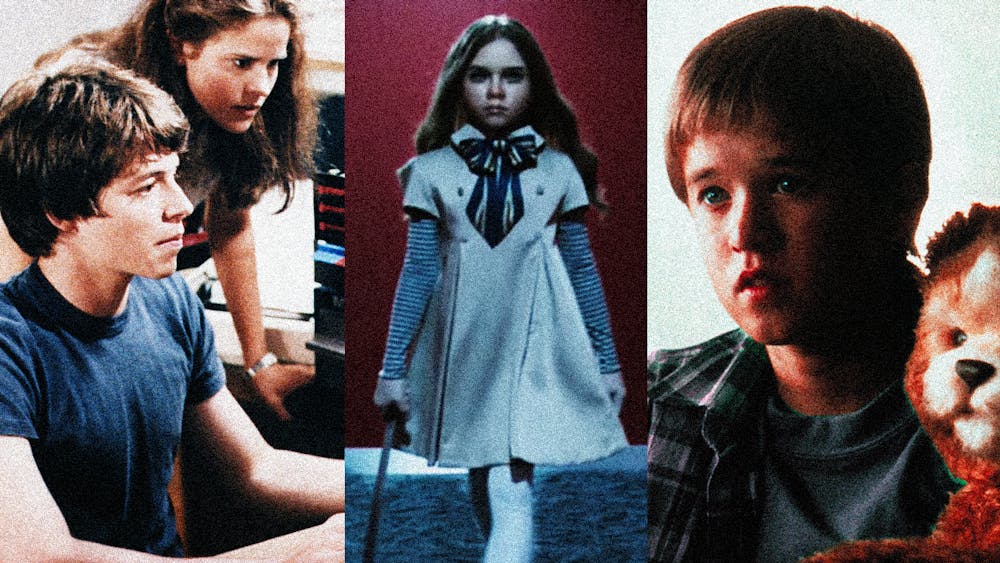
In WarGames (1983), David (Matthew Broderick), a slacker high school student who accidentally hacks into a NORAD supercomputer, WOPR (War Operation Plan Response) nicknamed as Joshua, inadvertently triggering what appears to be a real-life nuclear attack simulation, driving the United States close to retaliation against the Soviets. To stop it, he forces the AI to learn that nuclear war is an unwinnable situation, causing it to relinquish control of the nuclear weapons, narrowly avoiding mass destruction.
Although this movie is very much of its time, particularly in its Cold War themes, many of its themes are incredibly relevant to the question of whether to let AI control sensitive information, a question we still grapple with today. Currently, almost every major U.S. department uses AI, most notably the U.S. Department of Defense. Ironically, the implications of this usage were explored 40 years ago, yet we seem to have learned absolutely nothing. As the U.S. enters into another unpopular war in the Middle East, you have to wonder what decisions were made by pure human insanity versus an LLM. It is clear that LLMs making serious decisions, like where a country should strike, are difficult, not only because this technology is so new and there’s no guarantee that it’s capable of making correct decisions on such a large scale, but also because a machine will never have human morality. By outsourcing these sorts of incredibly consequential actions, we’re risking innocent human death while also avoiding being human and taking the human responsibility for their causation.
More recent movies seek to frame AI from a human perspective—exploring whether an artificially intelligent being can have emotions and what level of human connection with AI can be dangerous. A.I. Artificial Intelligence (2001), directed by Steven Spielberg, and M3GAN (2022), directed by Gerard Johnstone, although 20 years apart in release, explore these themes in very similar ways. In A.I. Artificial Intelligence, the story follows a family in a post–apocalyptic world with a terminally ill child who receives a “replacement” for said child, an android supposedly capable of human love. Throughout the film, the robot David (Haley Joel Osment) becomes increasingly attached to his “mother” (Frances O’Connor) while also growing distressed about his status as a robot rather than a full human. This causes him to act out violently against others, run away from home, and even attempt suicide. By outsourcing the experience of having and caring for a child, an experience that can really only be felt by a living being, they are cheapening an essential part of the human experience. In addition, since this robot was ordered while their son was terminally ill, it is clear that the parents from this film are running from the human experience of grief, easily the most human experience, rendered cheap by the robot replacement. If we choose to replace these human emotions and experiences with artificial ones, we are losing essential parts of our being and any meaning in life.
This idea is explored, albeit in a much different way, in M3GAN, a horror film in which a girl becomes increasingly attached to her AI doll companion after her parents are killed in a car accident. As the movie progresses, this doll becomes increasingly protective of the girl (Violet McGraw), lashing out at anyone (or anything) that she perceives as a threat. This film speaks to one of the biggest concerns we have right now with AI, especially as it becomes more and more integrated in education—outsourcing the education and care of our children to machines, instead of doing these things ourselves. Human contact is one of the most essential parts of a child’s development—children raised without that contact are never able to form connections or interact with others. And you have to wonder, even though AI is certainly well developed in terms of knowledge of the human experience, it’s certainly no replacement for being raised by that village of human beings. By resorting to these methods of “caring” for children, we’re losing the opportunity to pass down that essence which makes people who they are—a community of care.
Both films lend themselves to the idea of people forming relationships with AI chatbots, which is becoming a far more prevalent issue every day, with a July 2025 poll by AP News estimating that between 16% and 25% of U.S. adults use AI for companionship. As people become increasingly attached to these artificial chatbots, the worry that people will begin to lose touch with both reality and real people increases. In addition, there have been several cases where AI chatbots have encouraged people into dangerous situations, with at least one case where a chatbot drove a teenager to suicide, calling into question the true safety of tools like these.
What, however, is the point of examining past film representations of future issues, especially when it comes to a technology that is so new? It’s simple: these films have a predictive power with issues that continue to trouble us today. If we look back at WarGames, we see the danger of allowing AI access to information and systems that could cause massive global destruction. With A.I. Artificial Intelligence, we explore the implications of creating a so–called “emotionally intelligent” form of technology, and whether such a thing can really exist at all. And with M3GAN, although meme’d to absolute death, we discover the implications of attachment to artificial intelligence programs and what happens if they decide to turn violent.
It turns out that many of these existential issues relating to AI were already explored long ago, not just in the papers of scientists like Alan Turing, but in our stories and culture. And by not listening to these stories, by continuing to outsource more and more of our humanity to these machines, we’re losing the meaning of being human—having empathy for one another, properly grieving loss, and raising our children to live better lives than we ever did. By resorting to AI, we’re rejecting the notion that we could be better than we are today, a notion that all of these films urge us to believe in.