I don’t tend to think too much about being culturally Chinese. It’s like breathing—it doesn’t require much conscious effort, and it only stops when I die. Recently, however, TikTok, YouTube, and other media channels have pushed me to think about being Chinese a lot. Gua sha, qipao, Labubus: As a full–time Chinese person, it’s astonishing to suddenly find millions of non–Asian people exploring the nation and culture I was raised in. All the more surprising to me is that this surge in interest is happening now, when the United States and China are locked in fierce conflict on technological, economic, and geopolitical fronts. The fight for the “real” China—an implacable Communist police state or lifestyle brand—is no longer happening in the Taiwan Strait, but on TikTok.
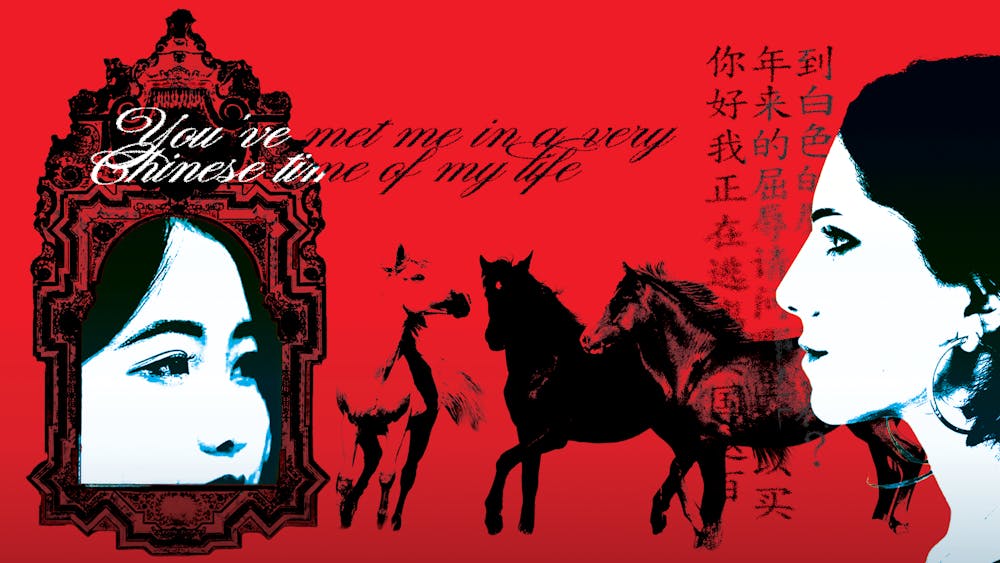
The memory of the pandemic era also remains fresh, and the dissonance is dizzying. Just four years ago, Asians and Chinese Americans like myself were relentlessly attacked as carriers of disease and physically assaulted for the crime of being ourselves. Now, over half a million Americans are on Rednote (a Chinese social media platform), Douyin—the Chinese name for TikTok—makeup is trending across social media, and suddenly everyone finds themselves in a very Chinese time of their lives. Just as it has upended so many other facets of our lives, maybe social media has brought down the digital Berlin Wall separating the East and the West.
I hope so, I really do. I hope we can see beyond the scary headlines about how China will conquer the world, and instead get to know the 1.5 billion people there as people. Take it from someone who grew up there, Chinese people do not spend every waking moment planning the destruction of America. They worry about making a living, sending their kids to good schools, finding someone to spend their lives with—in short, the same things as us. Contrary to its modern reputation for poverty and crudeness, China also has an ancient and rich culture dating back close to five millennia, replete with incredible poetry, literature, music, fashion, you name it. It’s heartwarming to see other Americans, inundated by a daily barrage of fearmongering about China, marvel at the beautiful silhouette of a Tang Dynasty robe or the glistening skyline of Shanghai.
I fear, however, that this recent surge in interest in China doesn’t bring us closer to a future of mutual acceptance, but rather to the exotic view of China from the past.
Ever since China (then the Qing Empire) and the United States first established relations in the 1840s, American rhetoric has positioned China as our diametric opposite. In the late 19th century, as hundreds of thousands of Chinese people migrated to the United States in pursuit of a stable living, American politicians of every stripe demonized them as “coolies”—disease–ridden, simple–minded slaves as opposed to independent, clean American (i.e., white) workers. As immigration restrictions tightened and many Chinese laborers in America returned home, American observers still found use in lionizing America as a nation of Christian pioneers, liberated from the heathen backwardness of the Old World as embodied by China. During the Republican Era, as Chinese cities like Shanghai became centers of commerce and crime, American media reflected common perceptions of China as a modern Sodom and Gomorrah, a nation of morally bankrupt drug addicts seeking to corrupt upstanding Americans. When the Chinese Communist Party won the Chinese Civil War, and China turned from a staunch ally to a sworn enemy of the United States, longstanding anti-Chinese racism was repackaged into the McCarthyist trope of the Dirty Reds, despotic barbarians seeking to infiltrate and destroy American freedom.
At the same time, in what seems like a clear contradiction, China remained the beautiful and exotic Orient, an object of immense American cultural fascination. Chinese porcelain, furniture, pagodas, and pavilions were all the craze in American homes and gardens. This obsession went all the way to the top—George Washington ordered much of his silverware from China. Department stores and catalogs raved about the newest “Chinese” styles, from dragon pendants to “pagoda sleeves” inspired by traditional Chinese dress. Even Chinatowns in New York and San Francisco, where thousands of actual Chinese people lived and worked, weren’t immune to America’s preoccupation with a cartoon China. After San Francisco’s Chinatown was destroyed in a catastrophic earthquake and fire in 1906, it was rebuilt with dragons and elaborate tiled roofs, loosely inspired by Song Dynasty temples and palaces, instead of the original Victorian homes. To put that in perspective, it would be like if Lincoln Financial Field collapsed tomorrow (perhaps as divine retribution for the Eagles’ recent performance) and was rebuilt with a copy of the Statue of Liberty holding a cheesesteak next to the endzone. Regardless of their authenticity, from the 18th century onward, American consumers possessed an insatiable appetite for Chinese goods, which coexisted peacefully with their disdain for the country and people who produced them.
Sound familiar?
As much as history repeating itself is a compelling explanation, it doesn’t explain why the Chinese wave is happening now. Chinese culture has been fascinating for millennia, and media channels like TikTok and YouTube have been introducing Americans to it for at least a decade, so why this year of all years?
In 1903, the Chinese reformer Liang Qichao made his first visit to the United States. He had taken part in the abortive Hundred Days’ Reform, a desperate attempt by the Qing Dynasty then ruling China to reform and modernize. Despairing about China’s future, Liang wanted to cheer himself up by visiting our exotic republic. He was impressed by the towering skyscrapers of New York and the beauty of Central Park, though he noted of the city that “when you enter, the foul smell assaults your nose”—some things never change. The most striking thing about his account of his travels, however, is his reflection upon his own people. From his perspective, westerners spoke better than Chinese people—“when Westerners converse, if A has not finished, B does not interrupt,” while “with a group of Chinese, on the other hand, the voices are all disorderly.” To Liang, they also walked better, as “their bodies are erect and their heads up” while “we Chinese bow at one command, stoop at a second, and prostrate ourselves at a third.” His frustration with his own people extended beyond the talk and the walk to even the way Chinese people thought—“We lack lofty objectives … this is the fundamental weakness of us Chinese.” Fifteen years later, an admirer of Liang named Chen Duxiu would echo his sentiments, praising America and calling for China to welcome Mr. Democracy and Mr. Science, personified versions of what he perceived to be American virtues. Three years after that, he would go on to co–found the Chinese Communist Party—history has a great sense of humor.
As a Westerner myself, I think Liang had an overly rosy image of us. Nevertheless, as I scrolled through videos about China on TikTok today, the comment section was filled with American Liangs. Videos about Chinese herbal medicine inspired complaints about the exorbitant cost and side effects of American medicine. Vlogs documenting picturesque walks in Shanghai or Shenzhen elicit sighs about American homelessness, drug addiction, and urban decay. Content about beautiful Chinese makeup and delicious Chinese meals draws pitiful accounts of Sephora disappointments and microwaved Hot Pockets, respectively.
We’ve always held up China as our mirror image, but for the first time, that mirror is showing us our pores.
In 2018, when TikTok launched, Americans could reassure ourselves that no matter what China accomplished, it was still the same starving Communist backwater it had been when Deng Xiaoping initiated economic reforms in 1978. We had a good laugh at knockoff bags that said “Cough” instead of “Coach”, or a Land Rover clone called a Hunkt Canticie, and were happy to dismiss China as a land of sweatshops and intellectual property thieves. On the political front, the People’s Republic has been a one–party authoritarian state since its founding in 1949, while the U.S. has largely remained a representative multi–party democracy which the vast majority of Americans embraced. Like Liang, we were convinced that Westerners walked better, talked better, thought better. We reflexively dismissed Chinese culture as the output of an inferior civilization.
Fast forward to today, and faith in American democracy and societal progress has collapsed. Masked troops occupy our cities and ruthlessly murder anyone who dares dissent. Our economy teeters on the edge of a cliff, increasingly bound to a speculative bubble surrounding artificial intelligence. For the first time in our history, we’re not sure if our model is right and China’s is wrong. Going cupping, getting acupuncture, trying on a qipao, it’s as much about escaping from our world as it is exploring China’s. Social media platforms reinforce this new Orientalism, showing Americans the best side of China. The reality is, of course, that life in China has its flaws as well. Youth unemployment hovers around 20%, nearly twice the figure in the U.S. The popping of a multi–trillion-dollar housing bubble in 2020 wiped out many households, and brutal competition throughout every stage of academic and professional life has pushed millions of Chinese people to “lie flat” instead. This is to say nothing of the 300 million migrant workers who roam from city to city in China, living a precarious life providing the near–instant deliveries and cheap eats that we gawk at on our phones.
Nevertheless, I could not be happier that we are finally engaging with Chinese culture. My only fear is that we are rushing between one extreme and another, China as heaven or hell. A large part of the recent Chinese wave has been a no–questions-asked embrace of traditional Chinese medicine. Practices like gua sha rarely work as advertised—there is no evidence gua sha slims your face, and it doesn’t even go anywhere near the face traditionally. Other TCM practices such as cupping, and acupuncture are based on a belief in qi, a “life force” that flows through certain channels in your body and causes physical harm when it is thrown out of balance. Qi does not exist, and none of these methods are scientifically backed. As for herbal remedies, a nice mugwort tea probably won’t hurt you but it is neither medicine nor a substitute for medical care. A Western doctor showing up with a bag of leaches or a rusty scalpel to free you of your “black bile” would probably send their patient running screaming out of the room. We should be equally skeptical of outdated Chinese medical practices as we are of Western ones.
Speaking more broadly, we can appreciate Chinese culture and China’s incredible progress over the past forty years without sinking into nihilism. Our democracy is worth defending, modern medical science is not a scam, and the biggest obstacle to solving problems like homelessness is thinking they can’t be fixed. In our cynical age, these statements are eye–rolling, but that doesn’t make them any less true. Liang Qichao was proven wrong about China’s inferiority, and we can prove the cynics wrong about America too. With a more grounded view of both the U.S. and China, we can move beyond the oppositional framing the two countries have been locked in for the past two centuries. China doesn’t have to be worse or better than us, it can just be different.
Many commentators have accused the recent flood of Chinese content on TikTok of being a flash in the pan, or even cultural appropriation, but this is how it starts. Japanese and Korean culture were first sneered at, then curiously explored, then embraced by America. Cute clothes and foot baths are a great jumping off point, but I implore every person who’s in a very Chinese time of their life to go a step further and engage with Chinese literature, film, or an actual Chinese person. Then we can accomplish what our governments cannot, choosing peace in a time of war and unity in a time of division. The secret to being a Chinese baddie? Keeping an open mind.