The trip to visit my grandmother almost didn’t happen. Before we even boarded the plane to Chongqing, China, I came down with an eye infection from my ortho–k contacts and couldn’t be exposed to light for more than five seconds without my eyes watering. Ma and I debated cancelling the trip, but I was firm about wanting to see my grandmother. Eventually, Ma gave in.
I don’t remember landing, but I remember the ride to my grandmother’s house—how the light trembled through the taxi window in parallel lines, how I kept my eyes shut no matter how much I wanted to look. How Ma kept saying, “We’re almost there,” until the car finally stopped, and how I opened my eyes—barely, but just enough—to my grandmother standing in the doorway. Six years since I'd last seen her, and I could only take her in fragments—a hand, a doorway, and her slight hunch. Every time I tried to look, the light punished me for it. But I looked anyway.
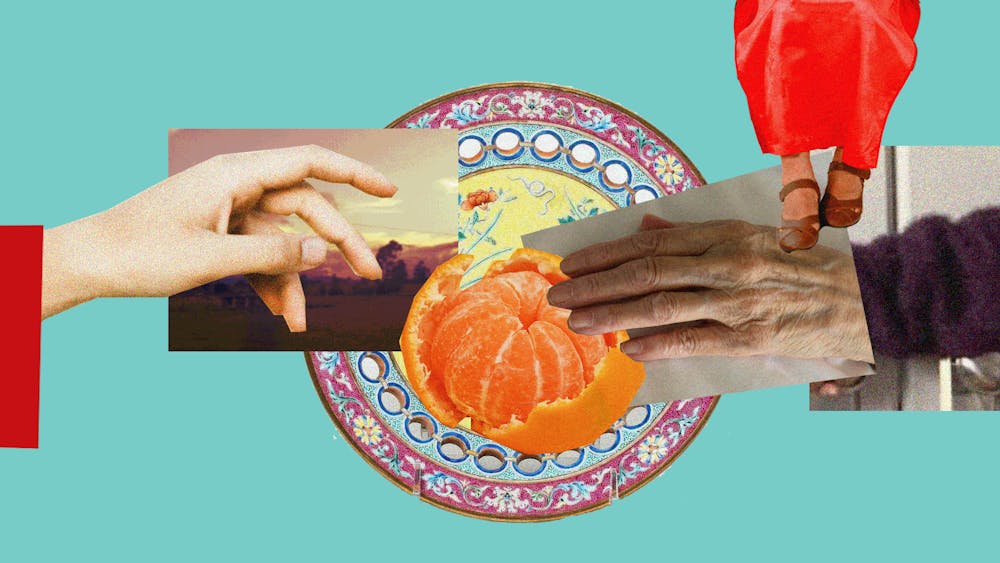
In China, the body is sacred. It is not a machine that you run into the ground and grieve later, nor can you replace it when it breaks. My grandmother, at 92 years old, knows this better than anyone else. The morning after I arrived—my eyes still flushed red—I found her at the kitchen table with a pocketknife in hand, a small hill of orange peels collecting at her elbows. “Here,” she said, pressing the slices into my palm. “It’s good vitamin C and will help your eyes.”
I hadn’t seen her in six years, but her first instinct was still to tend to me. The last time I saw her, I was still in high school, small enough that she could cup my face with a single hand. But there, in the dining room with light pooling in through the window and falling across her face, I found no signs of aging—her hair no whiter and her skin still smooth, as if six years had only passed for the rest of us.
At the ophthalmologist, a short man with a half–shaven beard told me that I had cysts in my eyes and drew a picture of my eyeball—the cysts labeled and circled—so I could have “better clarity.” He prescribed me antibiotic eye drops and swimming goggles to wear at night so that my eyes would retain more moisture and heal faster. In the morning, I woke to find that the goggles had indented themselves into my face overnight.
“You look like a panda,” Ma laughed.
She wasn’t wrong. Both of us were afraid that the goggles would suction my eyeballs out, so I stopped wearing them after two nights.
The city of Chongqing is built so deep into the mountains that you lose track of elevation—optimal conditions, as it turns out, for learning that along with weak eyes, I also had weak legs. Here, Ma and I lived in verticals—skybridges intersect buildings at the 15th floor, staircases dissolve into open plazas, and what looks like a street ahead might actually be a rooftop.
“I grew up walking these hills,” she called towards me as she climbed the Hongyadong, already ten steps ahead on the stairs. I told myself that I was falling behind because we weren’t on an even playing field—I hadn’t grown up here, and my body wasn’t accustomed to the new terrain. But then my right knee started aching, and I ran out of excuses.
At the hospital, the doctors took an MRI of my right leg and told me I had a torn meniscus—“who knows for how long,” they said, which was another way of saying that my body has been cataloguing its losses, and I hadn’t been paying attention. While they were at it, they also checked my scoliosis. A doctor traced my spine the way you trace a river on a map, following every bump and fold as if it were a path.
“It’s definitely curved,” he said.
Ma always says to me, in Mandarin, that “你是我身上的一塊肉.” The rough translation: I used to be a part of her body, which is to say that everything that hurts me hurts her too. Which is also to say that when three parts of my body started failing all at once, she cried. I had not seen her cry in years.
“This is all my fault for not teaching you to take care of yourself,” my mother sobbed to me while we were at lunch with my grandmother. My grandmother, meanwhile, kept peeling oranges and pressing them into my hands.
Ma and my grandmother joined forces and decided that I need to start going to a Chinese chiropractor. During the 17 days I spent in China, Ma forced me to go three times. The chiropractor cracked my neck in a way that unraveled earthquakes throughout my body. He pressed his thumbs along the knots of my spine, as if kneading a flimsy piece of dough. After we finished our sessions, the chiropractor often prescribed me exercises to do at home—chin tucks, standing against the wall with my back flat, and other movements that would make me look stupid. At home, my grandmother watched me practice the exercises in the living room and was inspired to show me the leg–strengthening exercises that she’d been doing every day so that she wouldn't have to use a wheelchair. We exchanged information and health secrets—a new currency between us that allowed us to know each other, and our bodies, more fully.
Every day in China, my grandmother insisted on making me meals that would take her three hours to prepare, using bones and herbs whose names I still don’t know how to translate. She said that she would have accomplished nothing if I weren't “as fat as a pig” before I left. For the first time since high school, I ate breakfast every morning at a table that was never empty. I let myself be fed, my body giving into sustenance—tomatoes and eggs, black chicken herbal soup, and steamed pork with rice flour. For the first time since college, I strayed away from Panera Bread and Chipotle, and started taking care of myself—even if my grandmother was the one making me do it. Every meal was a form of medicine undoing, slowly, what years of carelessness had forged.
Ma, more than ever, verbally piled onto the text reminders that I often ignore when I'm in college and away from her: Always blow dry your hair before you go to sleep, never eat or drink cold things when you’re on your period, and always start your days off with a glass of hot water (but not so hot that it’ll scald your throat and tongue). Here, in China, with my knee wrapped in herbal medicine and skin still indented by swimming goggles, I found that I didn't have an excuse to protest. For the first time, I didn't want to either.
On our last day in China, Ma and I took a taxi to the airport before sunrise. My grandmother insisted on coming downstairs with us to flag the taxi, even though Ma told her not to. Before I could climb into the backseat, she pressed something into my palm: a peeled orange.
In the taxi, Ma laughed under her breath—half exasperated, half grateful—and I held the orange like a warm stone.
“Are you going to learn to take care of yourself when you’re back in college,” my mother asked, “so that these things don’t happen again?”
I thought about it—actually thought—rather than saying “yes” to make her stop asking.
“Yeah,” I finally responded, tossing an orange slice into my mouth. “I will.”
Ma always tells me that I used to be a part of her body. In Chongqing, I saw where that kind of love came from: my grandmother’s oranges, her cooking, her health secrets—care passed down and practiced until it became instinct. To love them is to love this body that I’ve inherited. To treat myself gently, maybe, is the only way to love them back.