Before checking out the Institute of Contemporary Art’s newest exhibit, my knowledge of the Shakers was limited to whatever morsels of information I had gleaned from my early morning APUSH class in high school … which is, safe to say, not very much. After an afternoon of squatting down next to handcrafted stools to examine the wood grain and squinting at wall text for so long that an elderly lady exaggeratedly cleared her throat at me, I can’t say that my understanding of their lives has much improved. The concept is definitely fascinating, but as I roamed the gallery space, I was left questioning whether it was the best fit for a contemporary art museum … at least in its present state.
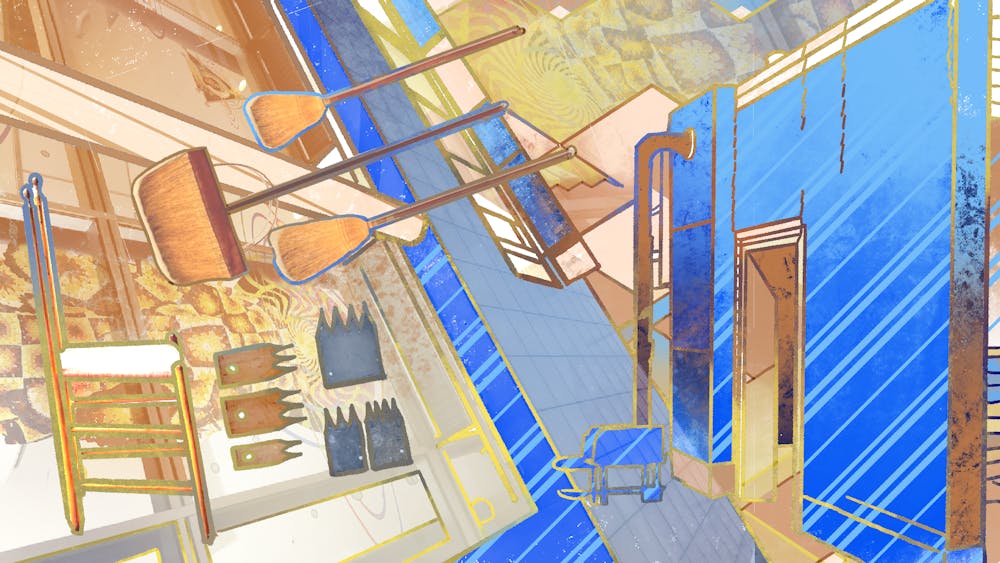
The Shakers are a religious sect of Christians who live in celibate communes, build furniture, and worship God with ecstatic dancing—originally called “Shaking Quakers” before their name was shortened. The exhibit combines historical artifacts from the height of Shaker popularity in the 19th century and works from contemporary artists inspired by Shaker ideals. It seemed fitting that upon first entry, my eyes were immediately drawn to a life–sized blue replica of a Shaker meeting house, which viewers are encouraged to walk through and closely examine.
I typically enjoy interactive elements in museums, but this meeting house centerpiece unnerved me. From the unnatural color to the sterile white walls surrounding the structure’s skeleton to the ghostly chorus of chanting voices emanating from a hidden speaker, my first feelings toward the Shakers were unease and disconnect. This palpable separation between viewer and artist carried through to much of the rest of the showcase, too.
The upstairs level held the bulk of the Shakers’ artistic magnum opus—their handcrafted furniture. From the brief website search I had done before visiting the exhibition, and the many photos of rocking chairs and stools displayed on said website, I had expected a walk around the ICA to evoke warm memories of couch–hunting in IKEA with family, or improvising dramatic arguments in fake kitchen sets with friends. Instead, examining the Shakers’ pieces reminded me of the time I spontaneously went into a Design Within Reach store in Beverly Hills. The clientele seemed both artsy and stodgy, the attendants looked concerned that my grimy hands might sully the furniture (which in the case of the ICA, is totally fair; I’m just not sure why an actual furniture store was so concerned about me touching their display chairs), and the wares themselves were spread out under glaring lights, as if in an operating room.
Despite this, I loved the furniture I saw on display, and their accompanying well–written labels taught me about the Shakers’ philosophy. My favorite section of the exhibition lay across the back wall of the upper level, where huge blue banners draped from the ceiling, emblazoned with a poem written with advertorial language often used for pain relief medications, such as “helps relieve stiffness” or “improves blood flow.” Titled I Want to Believe, the work by contemporary artist Finnegan Shannon explores the idea of having faith in technological support for disabled individuals, and coupled with Shaker–made wheelchairs and children’s cradles, this section of the exhibit is especially powerful in demonstrating how contemporary work can build off of historical ideas.
Another highlight of the exhibit was a projected video of a dance company performing a modern interpretation of a Shaker worship circle, created by contemporary choreographer Reggie Wilson. Though watching it only occupied a fraction of my time at the exhibit, this expressive depiction of the Shakers’ passion and sense of community taught me more about their lifestyle and beliefs than any of the wall labels or timelines ever could. Besides the vivid lapis banners and feverish dancing, though, the room felt strangely empty and cold—an effect created by the modest number of stools, wardrobes, and end tables sparsely scattered within the barren walls of the room. The “white box” museum model is often ideal for showcasing art, because it allows for a blank canvas that pieces stand out against, but the model falls flat for furniture and other household items. Rather than feeling any sort of connection to the Shaker ideals of community, inclusion, and devotion that were touted across the walls, I felt a palpable distance from them after seeing their works sprawled across an empty, fluorescent room. I wondered if the children who had once eaten breakfast on these stools, the elders who had shared stories while crouched in the rocking chairs, or the adults that had taken solace in the meeting house would feel laid bare by their belongings being stripped of their natural environments for the appraisal of strangers. After all, should something really be considered art in retrospect if the artist made it not to be looked at, but lived with?
The museum’s bare design made it hard not to feel disconnected from the Shakers, even after learning more facts about their beliefs and traditions. Walking amongst the last remnants of people’s lives, it was difficult to dissect their handiwork in any meaningful way without having a nagging sensation of wrongness. An ongoing debate in the art world is whether “art” is defined as such because of the artist’s intention or the viewer’s interpretation. Regardless of whether intent is required to make something “art” or not, though, I felt like I was robbing the Shakers’ crafts of their sacred utility when I examined the works. The Shakers deserve to be remembered, but there is a profound irony in the fact that a community commended for its togetherness and fervor is being studied in unaffected silence.