
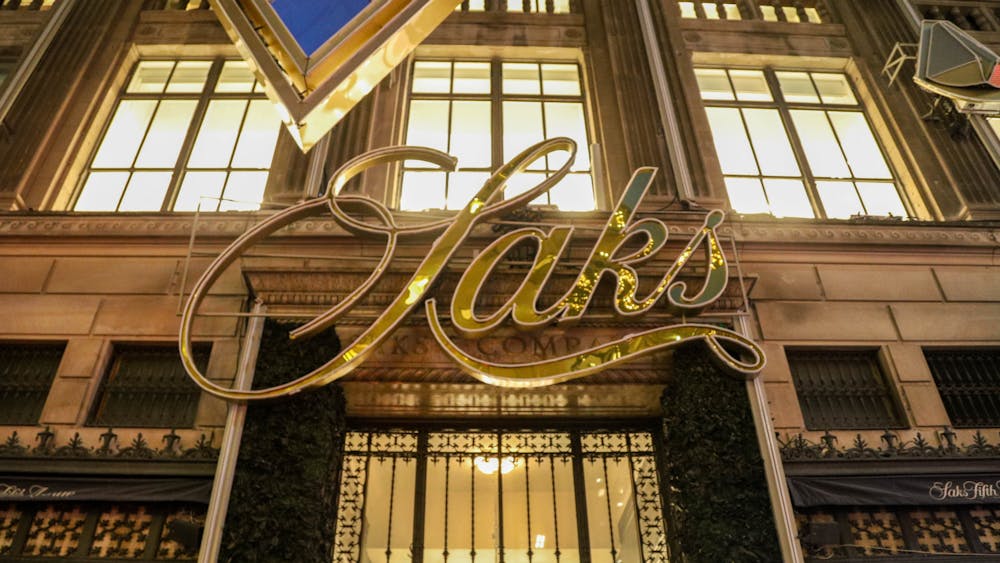
If there was any doubt before, it is certainly clear now—the department store, or at least its traditional format, might just be a slowly dying art. Are the days of walking through the revolving doors into bustling department stores, dedicating entire afternoons to riding up–and–down escalators, combing through floors and floors of clothing, shoes, bags, cosmetics, and perfume, now just a figment of the past?
Saks Global—one of the biggest luxury retail groups—recently filed for Chapter 11 bankruptcy, sending longtime shoppers as well as the luxury fashion and retail industries into a frenzy. The company oversees Saks Fifth Avenue, Neiman Marcus, Bergdorf Goodman, and Saks OFF 5th. In just the Philadelphia–area alone, two Saks OFF 5th locations in Franklin Mall and Plymouth Meeting closed in January 2026 as a result of mass store closures. Saks Global announced it would be shutting down eight Saks Fifth Avenue stores, including a location in Bala Cynwyd, Pennsylvania that has served residents for decades. Now, the closest store location is in New York. After the mass closures, Saks Global will be left with just 25 Saks Fifth Avenue stores, 35 Neiman Marcus stores, and two Bergdorf Goodman stores nationwide. Such rapid closures have left many people questioning whether there is even still a need for physical stores in a rapidly–digitizing luxury retail landscape. But, for in–store shopping enthusiasts and optimists like myself, there is a glimmer of hope. Through fresh, exciting, and immersive in–store experiences, department stores can perhaps put themselves back on the map.
Department stores were once the rulers of the American retail industry. In fact, the earliest department stores date all the way back to the 1840s and 1860s, when merchants began transforming “dry goods stores”—shops that would sell textiles, fabrics, and other supplies—as well as small clothing shops into “emporiums that departmentalized their vast inventory and offered copious services and amenities.” With urbanization and industrialization, a new middle class emerged with a desire to spend their money leisurely and department stores took advantage of the clientele. By the end of the 20th century, department stores became the retail standard, growing in both size and inventory. From apparel and furniture to luggage and books all housed under one roof, department stores quickly became the go–to place for anything and everything retail.
Above all, through placing an emphasis on the experience, luxury department stores in particular “emerged as powerful cultural institutions that elevated shopping into an art form” as stated by History.com. From elaborately artistic display windows that customers could gaze at outside to personal shoppers who assist with style transformations, luxury department stores created engaging, immersive, and sensory shopping experiences for consumers.
But in recent years, there have been debates surrounding the status of department stores: once a pillar of retail, these one–stop shops have seemingly fallen from grace. Tangibility, long–lines, and clothing racks have been traded for the convenience of clicking “add to cart” straight from the couch. In a rapidly evolving retail landscape where e–commerce is on the rise and younger, “digital” generations are now driving markets, department stores are fighting for relevancy in the consumer consciousness. Saks Global’s bankruptcy is the latest among a slew of department stores that have neared (and in some cases, succumbed to) extinction like from Macy’s and Barney’s to Lord & Taylor. As department stores continue to grapple with a seemingly perpetual cycle of debt, liquidation, bankruptcy, and mass store closings, the question becomes whether the death of the department store is sooner than we think?
Saks’ bankruptcy broke headlines on January 13, 2026, when it announced a “transformative financial transaction” according to a press release from PR Newswire. The release declared that Saks Global would voluntarily file for a Chapter 11 case in the U.S. Bankruptcy Court for the Southern District of Texas. Now, Saks urges longtime shoppers on their website not to go into a frenzy, stating “Saks Fifth Avenue, Neiman Marcus and Bergdorf Goodman stores and ecommerce experiences remain open to serve customers as usual. The company remains focused on delivering exceptional products, elevated luxury experiences and highly personalized service.” And while Saks seems optimistic about maintaining its operations, the dozens of shut–down locations across the country indicate otherwise. Saks OFF 5th and Last Call stores were the first to go—many of which had already begun ceasing operations.
When Saks made the move to take over Neiman Marcus and Bergdorf Goodman—competitor luxury retail department stores—in a 2.7 billion dollar acquisition deal in 2024, it seemed as though they were on a steady path forward. Initially, the acquisition was a promising venture for the future of the department store: in the aftermath of the pandemic, traditional in–store retail was greatly struggling to both compete with e–commerce and capture the attention of younger consumers.
So where exactly did Saks go wrong? According to Barbara E. Kahn, the Patty and Jay H. Baker professor of marketing at the Wharton School, there isn’t just one reason. But even before they acquired Neiman, Saks had long been crumbling under the pressure of severe unpaid debt. According to CNBC, “From the very start, the company was struggling to pay its bills—which led to angry vendors and little room for error.”
The acquisition of Neiman only exacerbated matters, causing liquidity problems. Saks and Neiman paid off debts from the agreement, but were left unable to pay their actual vendors which lead to late payments. Khan notes that Saks’ inability to pay their brands and vendors ultimately impacted the overall quality of their merchandise and infrastructure. “[If] you’re not paying your merchants for their inventory, they’re going to stop supplying. And when they stop supplying, Saks doesn’t have the good brands anymore, and it starts getting worse and worse and worse,” Kahn says.
So is all lost for department stores? Kahn, as well as myself, argue that there is still hope. Of course, thanks to technology, e–commerce is steadily on the rise when it comes to retail purchases today. According to Forbes, research anticipates that 23% of total retail sales will occur online by the year 2027, with the e–commerce market expected to reach over $7.9 trillion. Social media also plays a major role in influencing the purchases that consumers make online: consumers spent $992 billion on social media retail purchases in 2022, and the market is expected to reach $8.5 trillion by 2030.
But as a self–proclaimed shopaholic, I firmly believe that there is truly something invaluable about brick–and–mortar department store shopping. There’s something gratifying about entering a physical space—sifting through clothing racks, trying things on, wondering whether or not you’ll find something you fall in love with—that you simply just can’t get through a screen. And clearly I’m not alone in this sentiment. As Business.com says, “Traditional retail stores are still responsible for the majority of sales in the U.S.,” providing unmatched spaces for tactile experiences, instant gratification, and social engagement that cannot be achieved digitally. In other words, stepping in a store is arguably what makes the shopping experience.
“I believe that even people who want to buy luxury see value in a department store, as opposed to having to go separately to a Louis Vuitton,” Kahn similarly shares. As compared to shopping at stand–alone luxury–brand boutiques, Kahn argues, “I think there’s still value in going to Saks, because they’re all in one place. So it’s an equation that kind of makes sense, but you have to understand who your customer is, and sometimes you're making decisions that may not make short term financial sense, but they may, in the long run, bring in the revenue that keeps them alive.”
So in–store shopping is still in demand, but where do department stores go from here? Kahn says that the next step, especially with the rise of e–commerce, is to pay attention to the most valuable asset of all: Generation Z. Despite being dubbed the “online” or “digital” generation, Gen Z values tangible in–store shopping experiences: 45% of Gen Z spends time shopping in–store as opposed to 37% who shop online, a much larger percentage for in–store shopping compared to other generations. Four times as many Gen Z shoppers said they preferred to shop for luxury goods in person compared to Baby Boomers.
“Yes, they’re digitally savvy. They like to buy things online, but they really appreciate the store experience. That’s what the data show. They’re still going into the physical space,” Kahn says. “Now, they’re using the physical space differently,” she added.
So physical retail stores like Saks can still have a viable place in the retail world, but the traditional department store model is no longer cutting it. In order to stay afloat, stores need to keep themselves culturally relevant. This can be done by implementing an omni–channel retail model—known as “phygital retail” that streamlines both online and offline shopping experiences—and by creating tangible but experiential, immersive shopping experiences. This way, department stores can find themselves getting customers, especially young ones, through the revolving doors.
“I think [Gen Z] like physical stores, maybe not in the same way, but they like cool experiences. They like to buy. They like the social aspect of it. You do something to get me into the store. I’m going to be there—sell me something I want to spend my money on. It may not be product so much. It may be experience. It may be food and beverage. It may be entertainment,” Kahn says.
Since 1874, Macy’s has become synonymous with its lavish, elaborate holiday display windows unveiled each year, causing tourists and fascinated onlookers to stop in their tracks and gather outside the store. The iconic flagship Louis Vuitton store in New York at 6 East 57th St. features the Le Café Louis Vuitton on the fourth floor of the building. Here, visitors can take a break from browsing products to try menu items from French chefs, like caviar, smoked salmon, and avocado tartine. Tiffany & Co. offers shoppers ample experiences to choose from at their own flagship store location, from dining at the Blue Box Café to participating in a high–end jewelry workshop. Luxury department stores and boutiques are finding new ways to implement creative, engaging in–store experiences that merge traditional retail shopping with food, entertainment, and excitement. Through bringing fresh ideas into their stores, department stores can hopefully thrust themselves back into relevancy.
After all, Kahn says it best: “I don’t think the younger generation [don’t] want to go to department stores. I just don’t think they want to go to their father’s department store or their mother’s department store. They want a new one.”