
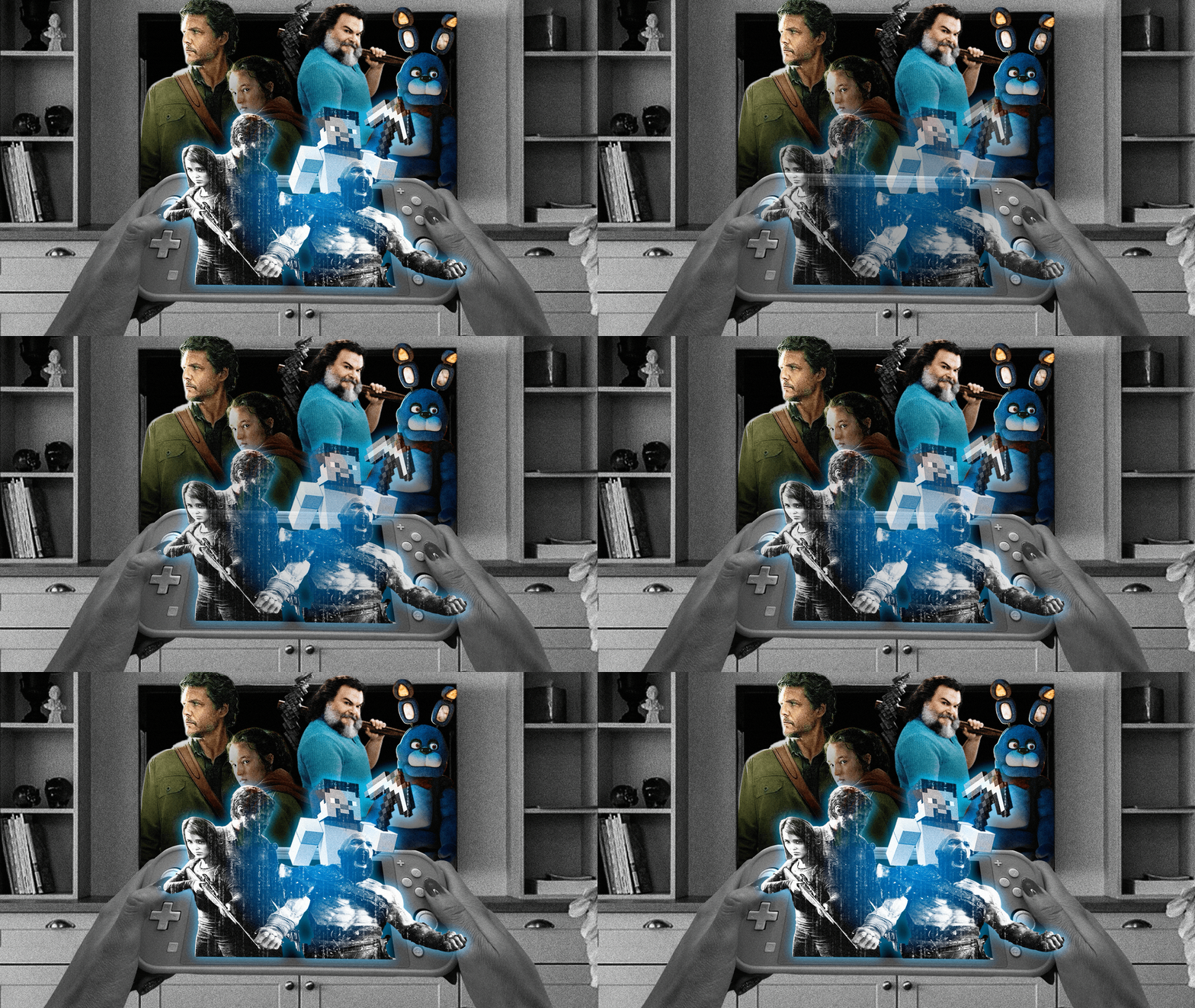
Sorry, maybe I should rephrase. What is a video game adaptation supposed to do?
That sounds like a dumb question, but it’s probably the only useful one when discussing this intersection of media. These films and shows tend to get lumped together as if they all face the same challenge, when that really couldn’t be farther from the truth. Adapting The Last of Us isn’t the same task as adapting Minecraft, and certainly neither of those is the same as adapting Tetris.
The most obvious answer to “what makes a good video game adaptation?” is also the most annoying one: It has to be a good movie or show. That is true—if the writing is weak, the pacing drags, and the characters are flat, no amount of “faithfulness” saves it.
But there’s still something different about video game adaptations compared to adapting books, comics, or plays. A game isn’t just a story, it’s also an interaction—it’s narrative plus participation. In many cases, that participation is the point. Sometimes the story is the hook; most of the time, it’s the feeling of doing it yourself. In an adaptation, an entire dimension of the source material disappears—you’re removing the player from the equation.
Uncharted is a useful place to start. The games are already doing an Indiana Jones impression: treasure–hunting adventures with wisecracks, collapsing ruins, and unforgettable, indescribable set pieces. But the reason they work isn’t because Nathan Drake is the most original protagonist ever written, or because Sully is some wildly emotional character. They work because the player gets to be the one in control. The appeal is the sensation of climbing, falling, shooting, escaping, and improvising your way through danger.
So what happens when you adapt Uncharted? You turn a playable movie into a regular one. By removing the one thing that made it distinct, what’s left isn’t terrible by definition, but it’s instantly less essential. It becomes just another treasure–hunting film in a world full of treasure–hunting films. The spark was the gameplay. Without that, the whole thing feels like an imitation of an imitation.
But that’s not the case for every game. Some have little to no story in the first place, which weirdly gives adaptations more freedom, not less. Tetris is probably the clearest example. There is no mythology, no precious lore, and no beloved cutscenes waiting to be recreated. So, the movie does something smarter: It makes the game a plot device. It’s a movie about the rights to Tetris, the people behind its distribution, and the strange chain of events that turned a block–stacking game into a global obsession. Gran Turismo does something similar. It’s not really “adapting” the fictional world of Gran Turismo so much as telling a real–world story about someone whose relationship to the game changed his life.
These movies sidestep the central problem entirely. They don’t pretend the games have a narrative big enough to translate directly, they instead build films around the games’ existence, not their internal plots (or lack thereof).
Then there’s another category, which might be the most mainstream version right now: movies like Mario, Sonic, and Minecraft. These don’t have rich stories to recreate, but they do have worlds, iconography, recognizable elements, protagonists, antagonists, colorful settings, distinct tones, and, most importantly, visuals which audiences already know and want to see in motion.
These adaptations are less about “translating” a plot and more about expanding a premise. They take what’s thin in the games and stretch it into feature–length shape. That’s why people get excited when familiar elements show up—it’s not always because the story is so compelling; sometimes it’s simply the pleasure of recognition. “There’s that character!” “I’ve visited that location!” “I remember hunting down that thing when I was a kid!”
That may sound shallow, but it’s real—and it works. Otherwise, these movies wouldn’t keep making piles of money.
Minecraft is probably the most stripped–down example. There’s no real story to adapt, so the movie just creates one as an excuse to move through the world, hitting the beats people expect, showing the tools, the mobs, the environments, and building something functional around that.
Five Nights at Freddy’s sits in an interesting corner of this category, because the source material is solely gameplay: Sitting in a security office, watching cameras, managing power, and trying to survive the night—that’s the experience. But over time, fans—and the games themselves—fleshed out a dense mythology underneath that gameplay loop: hidden minigames, scattered clues, books, timelines that barely hold together, and a central figure in William Afton, a serial killer whose crimes literally haunt the animatronics. There’s a “story” now, but it’s less of a clean narrative and more something that has been assembled over years of interpretation.
The movies pull from that version of the material. It uses the names—Mike and William Afton—the core ideas of possessed animatronics, missing children, and a buried history of violence tied to the restaurant itself. But it’s not adapting a single storyline so much as it’s adapting what fans collectively understand the lore to be, which makes it a strange hybrid. It’s not building from nothing like Minecraft (no pun intended), but it’s also not translating a fixed narrative like The Last of Us. It’s working from something in between: a world where the appeal comes as much from piecing things together as from the core gameplay itself.
Mortal Kombat is another useful example, because it proves that not every game loses its identity when adapted. The Mortal Kombat games don’t have some towering narrative full of sophistication. They have lore, yes, and a tournament structure, and characters people recognize, but the core appeal is not so subtle: It’s watching these people fight and destroy each other in grotesque ways that draws people in. That gimmick translates almost perfectly to the big screen. You don’t need the player’s participation to make a Mortal Kombat adaptation feel like Mortal Kombat. You need blood, bodies splitting apart, named fighters, “Get over here!”, fatalities, and a bracket–shaped excuse to keep it all moving. Unlike Uncharted, the charm of which depends on the player embodying the action, Mortal Kombat’s core pleasure survives being watched.
Then we get to the harder cases. The ones that are “good” but still raise the question of whether they are worth it.
HBO’s The Last of Us is probably the clearest example. The show is well–acted, well–directed, well–produced, and, for those who never played the games, a great story. There is no reason to deny any of that. But for those of us who did play the game, it creates a strange problem, because what, exactly, are we getting out of it?
Yes, there are small changes. Yes, there is the occasional fresh idea. But for the most part, it is following the original story so closely that it stops feeling like a reinterpretation and starts feeling like an extremely expensive retelling. Joel and Ellie still meet, still bond, still lose, still arrive at the same emotional destinations. If you already know the story, lived in it, and felt its rhythms, then seeing it again in a new medium doesn’t necessarily deepen it.
That doesn’t necessarily mean The Last of Us is a bad adaptation—on the contrary, actually—but it plays very differently depending on who’s watching. For the newcomers, the show is revelatory. For existing fans, it becomes a test of how much pleasure there is in repetition.
That’s where the real question reveals itself. Not just “what makes a good adaptation?” but “who is it for once it exists?”
There seem to be two paths for a video game adaptation to justify itself. The first is to do something different enough that even fans get a fresh experience. Fallout is the best recent example of this. It takes place in the world of the games, uses their tone and iconography, and still tells a new story with new characters. It isn’t asking players to sit through the same narrative again, instead giving them another angle into a world they are already attached to. That feels worthwhile.
The second path does just the opposite; it’s aimed at people who haven’t experienced the games before. For them, narrative–heavy game adaptations work—they get a great story, told well, in an accessible format—no prior attachment required. For more casual fans, though, it can feel a little pointless. They recognize the beats, they remember the characters, and without meaningful changes, it starts to feel like an unnecessary retread. At best, it’s a clean retelling; at worst, it’s redundant. This is a riskier path, because if the execution slips at all, the whole thing starts to feel useless. But when it works, it taps into something real. And this is where I get caught in my own contradiction.
If I am saying direct retellings don’t do much for existing fans, then why am I so excited for Prime Video’s upcoming God of War show?
I am a massive God of War fan. I love the stories of the 2018 game and its sequel, God of War: Ragnarök. I recite the dialogue. I feel the emotional beats. I know the reveals. And yet, I want to see it again—maybe even beat–for–beat. I want to hear “Don’t be sorry. Be better.” I want to see Kratos and Atreus learn and grow together. I want to watch the same monsters show up and the same emotional landings hit, because I think the material is that strong.
And that’s where the argument shifts.
For the people who really love something—the ones who know it inside and out—repetition isn’t a flaw, it’s the appeal. These adaptations say, “this story is strong enough, and you love it enough, that seeing it again will still satisfy you.” My God of War is someone else’s The Last of Us.
The answer is frustratingly simple, which is usually how you know it is the right one. Some stories are worth repeating, and some aren’t unless you change them. Uncharted isn’t worth retelling because the gameplay is the point. Mortal Kombat is easy to repeat because its appeal is visual and immediate. Fallout earns its existence by being new. And others fall between.
If you love something enough, you’ll return to it in new forms as long as those forms clear a certain quality threshold. That threshold differs from person to person, and from property to property, but the logic is the same. Fans don’t always need novelty—sometimes they want confirmation that the thing they love still works somewhere else.
So, finally, what makes a good video game adaptation? It still has to be a good movie or show, but more importantly, it has to solve the problem of losing the player. If it replaces what was lost, it works (Fallout is a new story in a familiar world; Tetris and Gran Turismo build real–world stories around the games). If it proves nothing essential was lost, it also works (Mortal Kombat because the appeal survives being watched; Mario & Sonic because recognition and iconography are the appeal). If the core story bears repeating, it can still work for the right audience (God of War for me, The Last of Us for others, all great for those unfamiliar). And some sit in between (Five Nights at Freddy’s adapts loose lore more than a singular story or gameplay loop). If it does none of those, it fails (Uncharted loses the gameplay without adding anything new).
The truth is, the only bad way to approach video game adaptations is to assume there’s one formula.