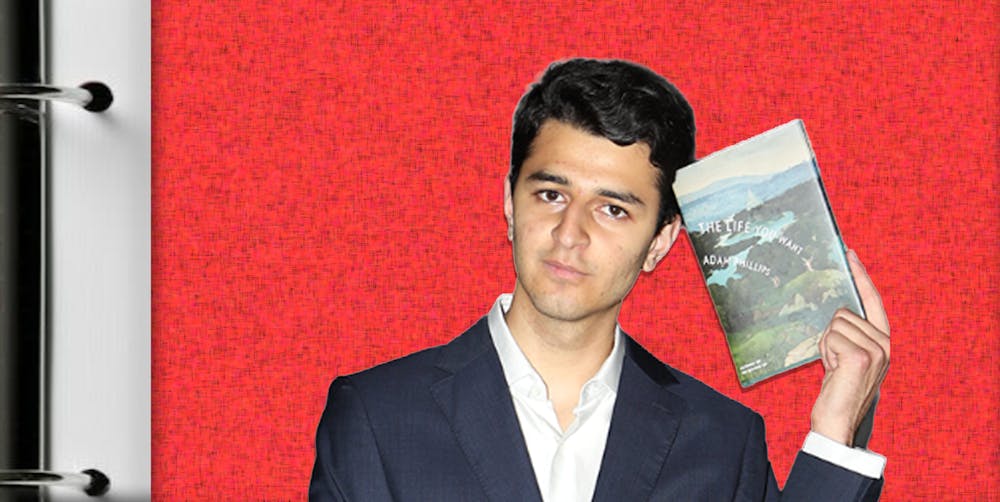
On a warm April night on Locust Walk, Francesco Salamone (W ’26) smiles as he recounts his many travels and experiences funded by the SNF Paideia Program. During the summer of his junior year—a time many Penn students spend sucking up to their internship managers to secure a return offer—Francesco tried out life as a Buddhist monk at a temple in a Japanese fishing village. He’s also tried out beginner classes in classical ballet and filmmaking, and spent time purchasing mystery boxes of books in Rome. While he doesn’t believe in making firm choices for his future, Francesco currently aspires to become a professional psychoanalyst.
Francesco came to the Wharton School as a first–generation low–income student from Palermo, Italy. When he first arrived on campus, he was eager to stick to the well defined, pre–professional path that past students had clearly carved for him. “Freshman year, I did the finance clubs and went to New York to do work for them,” he says. “I remember presenting at Apollo.” He laughs and makes finger quotes as he calls it “a sexy firm.”
“It was in an office overlooking Central Park, and [it was] my first time in New York. I thought to myself, ‘This is it. I’m winning,’” he explains. “So I spent all of my sophomore fall preparing for recruiting.”
Though he joined all of the right clubs, talked to all of the right people, and prepared all of the right materials, Francesco never felt like he was being nourished. By the time January of his sophomore year came around, he says, “I just had a meltdown. I couldn’t function.” He was taking the course “Existential Despair” at the time, which was the first time he felt he had a safe space on campus. It was “not safety from challenge, but comfort in accepting challenges,” he says. “It created space for the discomfort I’d been suppressing, and it came out like a tsunami.” By the end of the semester, Francesco had withdrawn all of his job applications.
In Sicily, Italy, students don’t get jobs straight out of college. They need more time, more degrees, more unpaid internships for even a slim chance at a decent salary. The “sexiness” of Apollo and the lifestyle it promised were incredibly attractive—as such, Francesco attached his self–worth to his professional future.
“I thought I was worth $150K a year because I was going to apply to those jobs. There’s something good in that confidence, but it’s also problematic when what you actually want is something else entirely,” he says. “My failure as a traditional business student is [a success] at shifting the criteria. The standards I was failing by were ones I’d internalized from Penn—and they’re no longer my criteria.”
Stepping back from the recruiting timeline allowed Francesco to expand his understanding of what business really is. “Business is polymathy par excellence. You cannot be a good business person unless you do everything else that isn’t business,” he says. “Marketing is applied literature. The business cycle is a conceptualization of life. We can’t avoid a recession any more than we can avoid getting sick. The question isn’t how to avoid it—it’s how to contain the fluctuation, how to have a smooth landing.”
To Francesco, business isn’t just a career path, but a way of understanding the world. The fields of liberal arts and business are complementary, not opposed. “The humanities teach you to fall in love with questions,” he says. “That’s a much richer life. Not financially, but psychologically. You’re never bored.” His life now is a product of his refusal to obsess over rules he broke and his decision to start paying attention to the new framework he’s living by.
As head teaching assistant of WH 1010, a class that serves as an entry point for every incoming Wharton student, Francesco found himself tasked with the responsibility of instilling curiosity in them.
“I think if I’ve done one thing well, it was to take the position with extreme responsibility. I was in charge of a community of 33 TAs that reached 633 students for the class of 2029,” he says. “The way we talked about things, the TAs we hired, had an impact on everyone’s first–year experience.”
To make the class a positive environment, Francesco focused on training TAs to ask real questions and connect with students in their one–on–ones. One such question simply asked, “What are your values?” He explains that “sometimes students are never asked that. You create a safe space and build from there.” Intellectual curiosity, he maintains, is fostered through one–on–one conversations.
Francesco measures his success as a head TA through the time he spent with students. “The best compliment I received as a TA is when I’m talking to a student, we’re scheduled to meet for 45 minutes, and they say they have somewhere to be right after—yet they then end up staying long after,” he explains. “Suddenly, the mysterious meeting fades as they realize the conversation they’re having is one they’re not typically having.”
Though his life today is radically different from the one he envisioned when he first came to Wharton, Francesco has no regrets. His decision to embrace his intellectual curiosity is one that has expanded his identity and given him a sense of purpose.
“My curiosity keeps expanding, it never narrows. That’s why it's hard to think about a job; it feels too limiting,” he says. “Even academia, which is what people pursue when they love learning, requires you to choose a department. I want to read everything.”
During his four years at Penn, Francesco has built his own education by poring over the books in Fisher Fine Arts Library, engaging in one–on–one conversations with professors and students, and using grants from the SNF Paideia Program to travel across the world and explore disciplines he had never before considered. Through it all, he’s held onto the stubborn belief that everything has something to teach him.
One quote Francesco loves is, “knowing what you want stops you from figuring out what you want.” Thus, as of right now, he has no immediate plans for his life after graduation. Vaguely hoping to train as a psychoanalyst—a very one–on–one profession—he imagines that he’ll be immersed in teaching, reading clubs, and community. Perhaps he’ll be in Europe, surrounded by the weight of centuries of history and culture.
Francesco is not finished figuring anything out—and he’ll be the first to say so. “Everything I talk about is something I struggle with,” he says. “I don’t come from a place of having figured it out. It’s me screaming that I haven’t. That’s what makes it welcoming for others to join.”
On Locust, the night is still warm. Francesco isn't going anywhere in particular. He plans to go back to his room to read, with no music and no screens to distract him. For someone who arrived at Penn chasing the skyline of Manhattan, it turns out that the life he was looking for is much quieter—but also much larger.