
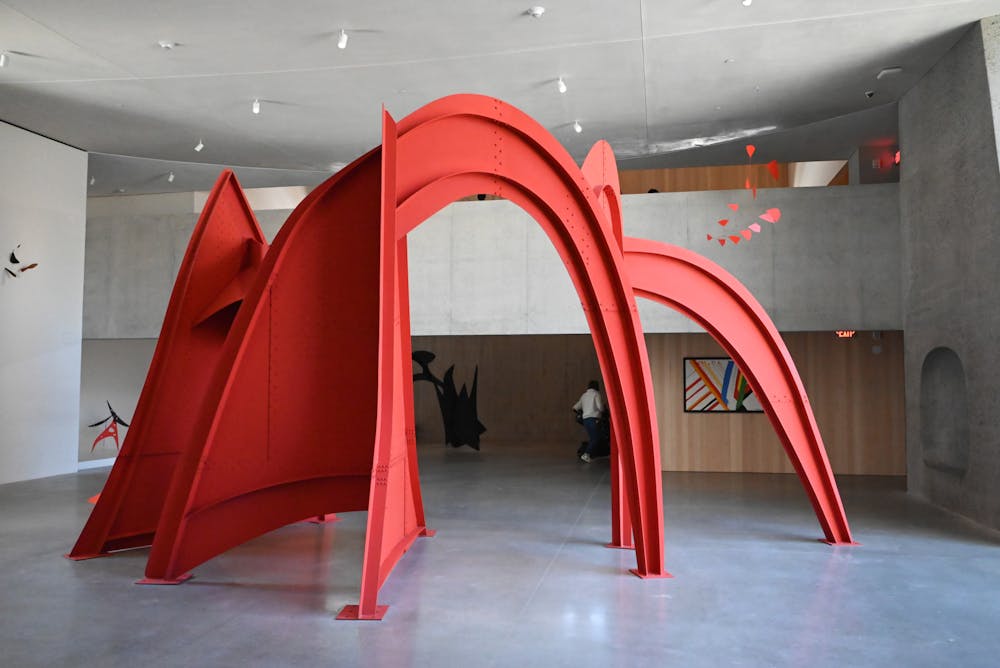
The Calder Gardens opened during the remnants of autumn and on the cusp of winter on Sept. 21, 2025. Previously a dormant garden, sculptural and real flowers have now stretched their bodies above the ground to surround the buildings and Calder sculptures. The stark contrast between the man–made steel sculptures and the wispy flower petals produce a jarring outcome, one that challenges beauty in its entirety. The capitulums don’t exist simply for beauty—instead, they adopt impermanence as an essential component of the center’s mission.
The plants’ growth throughout the seasons is similarly cyclical. Sepia tones of November seep into the garden and onto the building, while winter brings snow and a cooler palette. Like Calder’s work, the garden breaths, ever–changing.
Beyond beautiful botanicals and artwork, Calder Gardens cultivates community, social connection, and economic growth. It’s also an ode to Alexander Calder, his family, and the Philadelphia art history scene. The Calder family’s lineage is a key part of Philadelphia’s DNA. The installation includes an “altar” to the family, with paintings by Nanette Lederer Calder, and sculptures by Calder's father Alexander Stirling Calder and grandfather Alexander Milne Calder. The Calder Gardens are dedicated to Calder's lasting legacy with the institution acting as an interconnection between art, architecture, nature, and curation. Although the youngest Calder is the most famous of the family, each member deservedly belong in the altar. Alexander Milne Calder designed the William Penn statue on top of City Hall. City Hall took 30 years to build and Milne Calder designed its other 250–plus statues. Alexander Stirling Calder also created the Swann Memorial Fountain in Logan Circle, which features three allegorical figures acting as the Delaware River, the Schuylkill River, and the Wissahickon Creek. He taught at the Pennsylvania Academy of the Fine Arts and at the Philadelphia Museum of Art.
The Calders paved the way for other artists, alongside Philadelphia's Percent for Art ordinance. The policy was enacted in 1959 and requires 1% of the city's construction budget to go towards public art. This enhances communal spaces and creates a vast collection of works, transforming the city into an outdoor art gallery fostering pride and tourism.
Philadelphia’s rich history of public art doesn’t just transform neglected spaces and reflect local culture—studies indicate that it also reduces local and daytime crime. The public art sector contributes around $3.4 billion to Philadelphia’s economy.
With support from the City of Philadelphia, The Barnes Foundation, and the commonwealth of Pennsylvania, the Calder Foundation and Philadelphia philanthropists founded a nonprofit organization to launch the Calder Gardens. The Barnes Foundation and Gardens act together as an inventive collaboration between two major art institutions. The Foundation provides aid and training to the Gardens’ administrative functions. The garden consists of more than 250 plant varieties across seven areas conceived by Dutch garden designer Piet Ouldolf. The building design is inspired by Herzog & de Meuron and centers a rotating installation of artwork by Calder spanning his 50 year long career. The artwork, which includes both permanent and temporary installations, parallels Calder’s own experimentation; it becomes a simultaneously fleeting, but static environment that encourages introspection and repeat visits. The Calder Gardens venue hosts programs, performances, screenings, lectures, and other events that continue Calder’s legacy of contemporary art innovation.
The outdoor garden include perennials, trees, shrubs, and climbers that support local pollinators and wildlife. The works on display aren’t chronological nor do they act as a strict narrative. Instead, they encourage viewers to project their own emotions and experiences onto the unguided exhibition. For some, a Calder mobile—a type of kinetic sculpture consisting of suspended abstract shapes, wire, and rods—is just a spinning object. But for others, Calder says, “it may be poetry.”
In the Open Wall Gallery, the newly installed Putney Mobile is on public view for the second time in the work’s history. The Mobile had been in a private collection for decades before the Calder Gardens’ purchase. It’s a highly personal work of Calder and captures his philosophical core, as a spectator completing their art through multiple perspectives.
Reviews for the Calder Gardens mention their hatred for the lack of guidance throughout the exhibit. However for some, this freedom allows for a visceral experience, facilitating connections between the gardens, architecture, art installations, and the individual. The Calder Gardens utilizes its visual rhetoric to evoke emotion in the viewers, and its embodiment of “no-design” architecture challenges the traditional museum narrative. Instead, the art subverts the grandiose expectations of art history, cultivating intimacy with an understated building and subterranean galleries. Its glassy walls contrast the elaborate physicality of the Philadelphia Art Museum, located just down Benjamin Franklin Parkway.
Through its garden, architecture, and artwork, the museum creates an immersive environment that evokes individual discovery and connection, rather than didactic learning. Given the breadth of freedom, the Gardens serves as an experiment that asks: when given free will, how will people interpret and react to artwork and its surroundings?