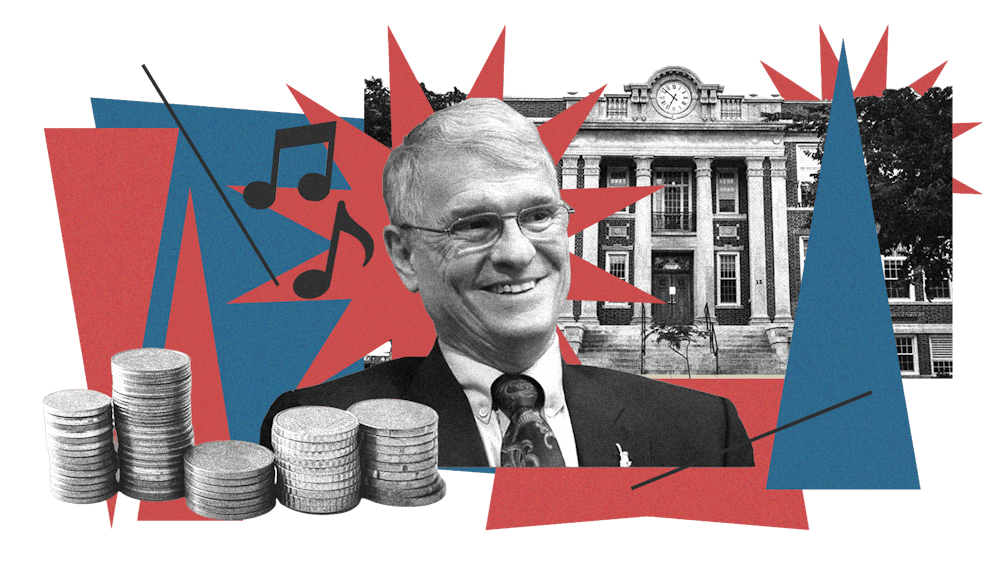
On Nov. 3, citizens across Pennsylvania will head to the polls to pull the lever and elect their next governor. The top two contenders in the race need no introduction—Democrat Josh Shapiro, defending his record as an incumbent, and Republican Stacy Garrity, who seeks to leverage her position as state treasurer to earn a seat in the governor’s mansion. But lurking at the bottom of the ballot is a candidate far less familiar to the ill–informed voter: Ken Krawchuk, a Libertarian.
When he sits down to talk to Street, Krawchuk hardly comes off like a politician. That’s a good thing, in his book—he despises being compared to the people he’s dedicated his life to throwing out of office.
“When people call me a politician, I say, ‘No, no. I haven’t broken a promise yet,’” Krawchuk says. “Once I break a promise, then you can call me a politician. I promise you.”
Shirking the stiff, rehearsed demeanor of a career bureaucrat, Krawchuk is loose and off–the–cuff, coasting from idea to idea with grace and poise. He agitates for the privatization of the entire public school system, he pitches a new kind of currency to combat inflation in Pennsylvania, and he even waxes poetic about his borderline agentic Cybertruck. But although his discourse is often diffuse and sprawling, it eventually converges around a single point: the value of individual liberty.
Krawchuk used to be a Democrat—that is, until he started his first business.
“I was flooded with all this nonsense that the government wants me to do,” Krawchuk says. “You’re subject to this. You got that tax. This other thing. You got to do this. You got to do that. You got to file this. You got to post this.”
Eventually, Krawchuk founded a firm—Amendment 16 Limited—designed to help people just as frustrated as him get around having to deal with the IRS. Call his hotline (the pithy 1–800–THAT–IRS), and he’ll act as a middleman on your invoices, taking in payments from vendors and sending you the full sum minus taxes so he can pay the feds on your behalf.
It was Amendment 16 that would introduce him to the Libertarian Party. When one of his coworkers introduced him to an acquaintance familiar with the movement, he quickly came to admire the principles the party organized itself around. After attending a few meetings and soul–searching for a while, Krawchuk finally bit the bullet and registered as a Libertarian in 1993.
“We’re the party of principle. Every law we support or oppose goes back to one idea,” he says. “Your life, your way, as long as you respect others. [It’s] the golden rule on a political level.”
Krawchuk has had a long career in Pennsylvania politics. Alongside his day job running an information technology firm, he’s run for governor three times before in 1998, 2002, and 2018. Along the way, he’s assembled a murderer’s row of ex–governors as political opponents. The first he recalls is Milton Shapp in the ’70s (“I didn’t pronounce his name properly, let’s put it like that”)—more recently, he’s squared off against Tom Ridge (“Didn’t like Ridge”), Ed Rendell (“Rendell was nice to me”), and “Big Bad” Tom Wolf (“Man, what he did to Pennsylvania … ”). In each race, his share of the vote has hovered around just 1%—but this run, he says, is going to be different.
That’s because this time, he’s angry.
“The big difference in the other [races] was … I’m an IT guy. Problem solution, problem solution. Here’s the problem, here’s the solution. Problem solution. It wasn’t resonating,” Krawchuk explains. “This time it’s like—No! No! Yeah, we got problems. I’m mad as hell and I’m not going to take it anymore!”
Krawchuk is mad about a lot of things, from the Federal Reserve’s endless money–printing to the expansion of the American surveillance state. But the main issues fueling his run for governor are education and taxation—and for him, the two are closely intertwined. His proposal to fix declining youth literacy rates? Privatizing all public schools and getting rid of the property taxes that fund them.
Krawchuk describes the current model of public education as inefficient, quoting statistics that paint a dreary picture of Pennsylvania schools. Less than half of elementary students in the state can read proficiently—even fewer are meeting the benchmarks for their grade level in math. Rather than fixing a public school system that he believes has failed its youth, Krawchuk wants to get rid of the system entirely. He proposes taking the money that the state would typically spend on its public schools and giving it directly to families—$11,500 per child—to pay for private school education. “The big thing is, since we’re not funding the school districts, we shut them down. Since the school districts are what are charging the property tax, [the] property tax vanishes,” he explains.
The free market, Krawchuk argues, is the only agent capable of ensuring that schools and educators are properly incentivized to give Pennsylvania children the kind of quality education they deserve. With parents able to make choices about where to send their kids, high–achieving schools are bound to see an influx of students, while worse institutions will shrivel up and shut their doors.
“The best teachers are going to get paid the most and go to the best schools,” Krawchuk says. “Bad teachers—well, McDonald’s is hiring, I hear.”
Krawchuk believes that the public school system in Pennsylvania is so bad that it’s unconstitutional. He says he plans to sue the state of Pennsylvania to force them to privatize the entire public education system. “The constitution says, ‘There should be a fair and efficient means of public education.’ They’re not doing that,” he says.
In the event that he wins the case, he hopes to instate a citizen–elected board to set school curriculum requirements. Krawchuk is specifically suing the Pennsylvania governor as well as the head of the Pennsylvania State Senate and House of Representatives. “They’re our employees, and they’re screwed up. We’re the bosses. We’re going to talk to them and say, ‘You guys, you’re out of here. Enough is enough,’” he says.
But Krawchuk’s campaign to put your money back in your pocket doesn’t end there. While getting rid of taxes is all well and good, it doesn’t solve the national issue—the Federal Reserve’s endless printing of fiat money whose value isn’t backed by a commodity like gold. Today, he says, the American dollar has lost almost all of its old value, hitting consumers in the pocket and letting inflation run rampant.
Krawchuk knows he can’t end the Fed as the governor of Pennsylvania. Thankfully, he’s found a clever workaround in the Constitution. Article 1 of the Constitution forbids states to “make any Thing but gold and silver Coin a Tender in Payment of Debts.” So why not mint some coins?
Krawchuk is proposing the creation of a parallel currency of silver coins within the state called “A Silvan Penny” (a clever anagram of “Pennsylvania”). These coins, he says, will retain their value better than American dollars because they are—quite literally—worth their weight in silver. Business owners will then have the free choice to accept or reject the Silvan Penny as a valid form of payment.
“The individual merchants can decide for themselves: Am I going to take silver?” Krawchuk explains. “Well, duh, of course I’d take silver, you know? We just have to give them the opportunity to do that.”
Krawchuk’s campaign strategy is as unorthodox as his ideas. He’s poured quite a bit of time into creating a series of song parodies designed to disseminate his small–government message among the masses. Perhaps the most interesting is “The Flocked Up Blues,” an anti–surveillance ballad sung by a jazz singer Krawchuk knew from his time as a radio anchor. Its music video, a minimalistic slideshow edited on Movie Maker, opens on a shot of Krawchuk flipping the bird at a Flock camera somewhere in suburban Pennsylvania. His musical crusade shows no sign of stopping—the candidate has a slate of parodies lined up for release over the next few weeks, all centering around education reform. Pennsylvania voters will soon be treated to subversive renditions of classic tunes from John Lennon (“Imagine there’s no school districts”), The Rolling Stones (“I can’t get no / Education”) and The Beatles (“You say you want an education…”).
Of course, no amount of online work can replace the retail politicking essential to any successful campaign. Krawchuk recently engaged in an eight–day pub crawl across Pennsylvania, meeting his supporters at any local watering hole willing to accommodate him. But without the budget for a campaign bus or a private chauffeur, Krawchuk had to get around the state the only way he knew how—in his Cybertruck.
Krawchuk loves his Cybertruck. It saved his life once, he says. He was coming back from a late–night party with his wife in New Jersey, driving back towards his home in Abington, Pa. The last thing he remembers is being on the freeway about to cross the Delaware River back into Pennsylvania.
“Next thing I know, I’m in the middle of the Walt Whitman Bridge, and the car is beeping at me, saying, ‘Wake up, idiot! Wake up!’” Krawchuk says. “I fell asleep at the wheel. The car saved my life, me, and my wife.”
It should come as no surprise that he also idolizes the man behind the vehicle—Elon Musk (C, W ’97). Krawchuk speaks about Musk with a reverence often reserved for the Apostles, brimming with excitement as he gushes over the tech billionaire’s numerous ventures. In his youth, Krawchuk worked in naval intelligence, where he would pore over periodicals detailing the latest innovations in aeronautics and spaceflight. It was around 2002 when he started to read buzz about the upstart Musk, who had just founded SpaceX as a concept–test of commercial spaceflight.
“He said, ‘I’m going to start rockets.’ Everybody’s like, ‘You’re an idiot. It’s all going to blow up,’ and everything like that.” Krawchuk recalls. “And I’m watching, like, ‘This guy is amazing. He knows what he’s doing. He knows what he’s talking about.’”
As a self–proclaimed “geek” with a background in technology, Krawchuk has also found a new intellectual sparring partner in Grok, Musk’s proprietary chatbot. He spoke to it at length, he says, about the potential effects of abolishing the Federal Reserve. He turned to it for legal advice when filing his lawsuit against the state. He even relied on it to pilot his Cybertruck from bar to bar after knocking back a few West Coast IPAs on his pub crawl. He always fact checks what it says, he assures us—but to him, Grok’s excellence is just further proof that Musk is driving humanity into a brighter future.
“The guy is letting the blind see, letting the cripple walk. The guy’s rewiring his own mechanical arm. How can you hate the man? He’s getting us off the planet. He’s putting data centers in space, right? Instead of on Earth, put them in space where they’re not going to bother anybody,” Krawchuk says. “Everything that he is doing, he’s doing it’s all for the good of humanity. Somebody says, ‘Oh, he’s a trillionaire.’ Well, yeah, he deserves every penny! Look what he’s doing for us.”
Although today Krawchuk can’t be seen as anything other than outspoken, he describes his start in politics as shaky, diminished by his early lack of public speaking abilities. During his first debate, he says, he “felt like Alice on the wrong side of the looking glass.” When he ran for township commissioner in 1997, he found going door to door to speak to constituents was easier. Of course, one–on–ones with voters could be difficult in their own way. “You knock on somebody’s door: ‘Hi, I’m Ken.’ … I said, ‘I’m a Libertarian.’ And she says, ‘Oh, that’s nice. I’m Presbyterian.’”
Today, however, Krawchuk seems capable of speaking about virtually any topic on the fly. He credits his success to Toastmasters, a nonprofit organization dedicated to helping members build their communication and public speaking skills. Now serving as leader of the Drexel Toastmasters club, Krawchuk is hardly the same nervous introvert he was when he first entered politics. His gregarious and sometimes confrontational style has led him to take his politics beyond the debate stage, agitating for individual freedoms on the airwaves and in the streets. In 2020, during the rollout of COVID–19 social distancing regulations, he organized a series of rallies which involved going to the homes of every Pennsylvania legislator who voted in favor of the lockdowns. “One, he’s yelling at me: ‘Wait, you should have made an appointment. Come to my office,’” Krawchuk says. “Like, dude, your office is closed. You know, where else are we going to go? So, we’re coming to your house.”
Krawchuk’s crusade rests on some relatively simple electoral math. Many voters, he observes, are content to sit out of off–year elections. Almost 1 million fewer Pennsylvania voters participated in the 2018 gubernatorial race than the 2020 presidential—2 million fewer voted in 2022 than in 2024. One out of six voters, he claims, aren’t registered with either major party—all it’ll take for a Krawchuk victory is winning out among independents and peeling off some Republicans disaffected with Garrity.
“You crunch the numbers, you find that all it takes for me to win is to attract the vote of one out of six voting–age Pennsylvanians,” Krawchuk says with a grin. “One out of six can stop their tricks.”
To jump from 1% of votes to 1 in 6 might seem idealistic, but Krawchuk is deadly serious about his work. He points out that even if he doesn’t win, he’ll have succeeded just by offering Pennsylvanians a different path forward. As one man, Krawchuk knows he can only do so much with his own choices. But to choose for others? Well, that wouldn’t be very Libertarian.
“I’m not looking for a legacy,” Krawchuk says. “I’m aiming to do the best I can for the most people without being a dictator.”
“I come not to seize power, but to bury it.”