Back in late May, I was taking a stroll through Soho with a friend when we stumbled upon hordes of people standing under the blazing New York City sun in a line wrapped down the block. Not only were we mindblown at the sheer size of the crowd, but also that it was all for Mimi’s Frozen Yogurt, despite there being numerous other local spots in the area to grab a cool treat.
Was Mimi’s worth it? Why has this “line culture” become so prominent in both New York and other cities, and more importantly, why are people so willing to wait?
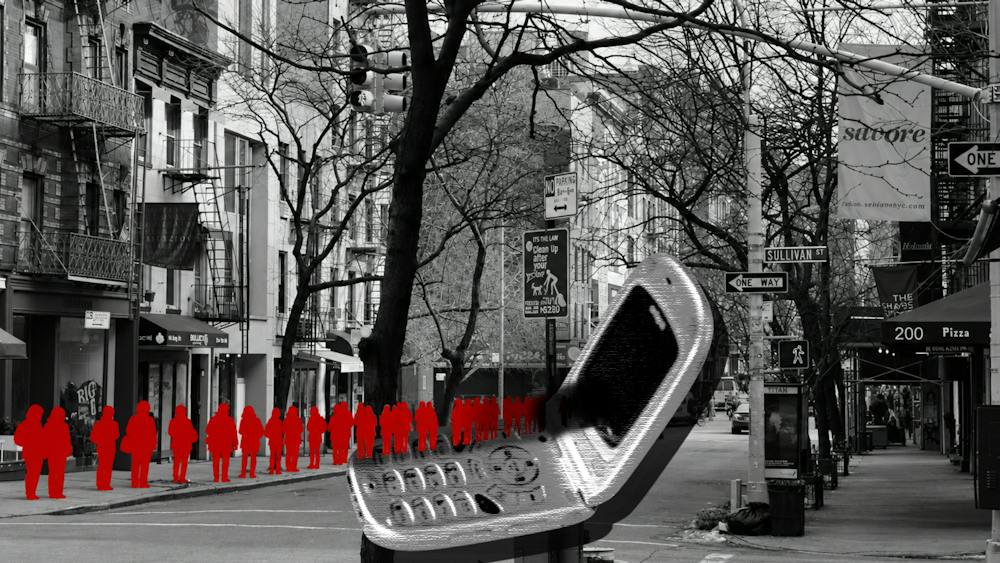
Long lines in cities are nothing new, of course. In one of the most densely packed cities on the planet, waits are practically a rite of passage. But New York has always prided itself on its hustle—on moving, on getting where you need to go. Yet here we are confronting a new normal: people willingly and eagerly planting their feet on the pavement for the latest trend, no matter how long it takes.
Social media is saturated with clips of eager New Yorkers queuing up for the hottest restaurants, snacks, and pop-ups across the city. And Mimi's is far from a fluke. Hundreds can be spotted camping out first thing in the morning for the viral Dot Cakes at Butterfield Market’s locations on Manhattan’s Upper East Side. According to the New York Times, lines for the sprinkle–dipped, icing–glazed $11 one–serving cakes start to form as early as 6 a.m., rain or shine.
From Coach pop–up trucks to L’Industrie Pizzeria, lines are wrapped around the block for practically hours on end, and the internet has opinions. One TikTok video captioned “the nyc wait line epidemic is getting out of hand” shows a line wrapped around the corner for Blank Street, known for its specialty flavored coffee and matcha drinks. In another clip, a user deadpans, “the line for caffe panna at 1:15p on a friday … does no one in nyc have a job???” panning across a sprawling queue of people stretching four blocks deep for a scoop of internet–famous ice cream.
But this isn’t just a New York problem. Infatuation Chi, a TikTok page that provides recommendations for Chicago–based restaurants, has a post entirely dedicated to popular spots with long lines. “The lines are long, the wait is endless, but in the end is it all worth it?,” the caption reads, forewarning visitors what restaurants are worth sticking it out for. From Community Goods to Olive Young and Ramen Nagi, videos across social media show people standing in lines all over, even in the rain. In Philadelphia, TikTokers have captured videos of lines wrapped around the corner for spots like Blank Street or Brandy Melville. In Charlotte, N.C., an Axios article spotlights Brü—a Black–owned coffee shop specializing in matchas and lattes—which, in just three months and around 20 pop–ups later, regularly draws crowds of over 100 people. “And if you spend any time scrolling the Charlotte social feeds,” the article notes, “you’ve likely seen a content creator singing its praises.”
When it comes to this rise in line culture, social media is undoubtedly to blame. An influencer posts a glowing review of a croissant, a flavored latte, or whatever is trending that week, and suddenly, it’s everywhere, flooding feeds until the curiosity becomes impossible to ignore and people feel compelled to see for themselves what all the fuss is about. These platforms have become the supreme arbiters of where people eat, shop, and spend their weekends in the city.
But the more interesting question might be why we are so eager to follow. A long line outside a restaurant used to send people walking in the opposite direction—now, it generates curiosity, hype, even FOMO. There is something about seeing several dozen people standing outside a door that makes you feel like they're all in on something you aren't, and that feeling—that low–grade anxiety of missing out on whatever everyone else has already discovered—is more pervasive now than ever. We have become so thoroughly wired to let our feeds tell us where to be and what to want that the line itself becomes a kind of confirmation: proof that this is the place, this is the moment, and we better not miss it.
Our desire to be part of the trending experience has even made waiting a source of content. People film themselves standing, updating viewers on their progress and dedication to securing viral items, as if the process itself was worth documenting. And often, there isn’t much else motivating them. Many of these lines carry no special incentive. While some pop–ups might offer small free samples or discounts, others offer nothing else but the opportunity for a “post–worthy” moment.
Sure, people are allowed to spend their time however they please. Plus there’s something genuinely exciting about finally tasting that bagel or slice of pizza you’ve been seeing on your feed for weeks. Lines drive revenue for local businesses, and waiting alongside strangers for something you're all equally eager to try can be its own kind of communal experience.
But, at the same time, cities have thousands of food spots and activities that exist outside of heavily–circulated social media recommendations. There is nothing wrong with exploring all that a city has to offer outside of what your algorithm recommends or where you see dozens of people waiting in a line. Within a few block radius anywhere in metropolitan hubs, there are a plethora of local restaurants and businesses that offer unique and authentic foods, products, and experiences to try, many of which have been in operation for decades.
Letting your algorithm guide you every once in a while is fine, but sometimes the best experiences are those you just happen to stumble upon.