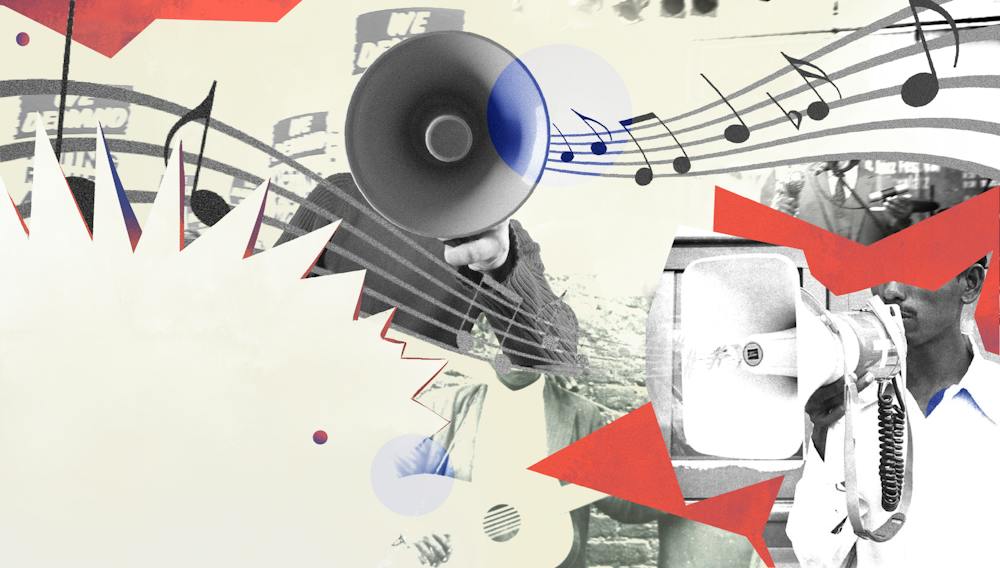
What comes to mind when you think of a “resistance musician”? Pete Seeger, maybe? Bob Dylan? Try to think of a modern example, however, and you’re likely to draw a blank. With the nation—and the world—engulfed in crisis after crisis, there’s certainly no dearth of tragic news for musicians to write about. And yet the idea of a “radical musician” feels like a relic of the past. A single song could once hold a movement together, moving through a crowd like a shared breath—and while music still shares an important role in building cohesion at protests, every song still sung by radicals was written by the bards of movements past. Music once played an important role in turning individual fear into collective hope. So, what happened to that music? And more importantly, what happened to that hope?
During the Albany Movement in Georgia, Reverend Martin Luther King Jr. said that protest songs “give the people new courage and a sense of unity.” During the Civil Rights Movement, singing together was important to “keep alive a faith, a radiant hope in the future, particularly in our most trying hours.” Songs opposing segregation were written to be performed in groups—words like “we” in the gospel standard “We Shall Overcome,” the unofficial anthem of the movement, were important in reinforcing group identity. The songs of this era took inspiration from church choir music. The faith they invoked, however, was not in a particular God. It was in liberation.
This unwavering faith has long been an essential cornerstone of political messaging. Especially in the 1960s, artists used the prophetic present–future tense to draw a contrast between the suffering of today and the promise of justice tomorrow. In Sam Cooke’s 1964 masterpiece “A Change is Gonna Come,” for instance, the central phrase “is gonna” presents change as a kind of historical inevitability.
The gospel and soul sounds of the Civil Rights Movement were only one form of protest song popular in the mid–20th century. The early 1960s brought folk and blues music opposing the Vietnam War to the center of the musical landscape. In the 1960s and 1970s, the looming threat of nuclear war and the persistence of American imperialism created stark divides between the people and the state. Although they were cultivated in an environment of terror and violence, many of these songs expressed a kind of unflagging hope for the future. In the majority of these folk resistance songs, the focus is shifted away from the individual and towards the community.
Mainstream pop had its role to play, as well. One of the most prominent examples is the 1985 song “We Are the World,” which featured performances from more than 45 singers, including Michael Jackson, Diana Ross, Stevie Wonder, and Cyndi Lauper. The song was produced to raise money and awareness for the 1983–1985 famine in Ethiopia, and it became the eighth best–selling single of all time. The song raised over $80 million and sent 90% of its funds to Africa—the other 10% went towards aid for hungry and homeless communities in the United States.
Compare the overwhelming success of “We Are the World” to the reception of Gal Gadot’s COVID–19–era cover of John Lennon’s “Imagine.” The song (which also featured appearances from almost two dozen other celebrities) was met with immediate backlash and quickly became symbolic of the out–of–touch naivety inherent to celebrity culture. It’s easy to explain away the song’s negative reception by gesturing at the patronizing elitism it revealed, but the lyrics of the Lennon song itself may also have had a role to play.
While the repeated chorus of Lennon’s song (“You may say I’m a dreamer / But I’m not the only one / I hope someday you’ll join us / And the world will live as one”) maintains the tradition of political songs’ use of the first–person plural (“us”), it casts change as a kind of unobtainable hypothetical. The song asks you to “imagine,” to think of “someday,” to dream rather than do. There is no promise of change—just a vague idea that maybe, somehow, theoretically, possibly, change might happen if you try.
There are few examples from recent years that represent a return to the atmosphere of hope cultivated in mid–century protest music. A Tribe Called Quest’s “We The People....” is angry, frustrated, and scared. It turns the American constitution’s language on its head, like an inverted national flag, to highlight the ways in which the American state has betrayed its people. Bad Bunny’s “LO QUE LE PASÓ A HAWAII” is a warning about gentrification and the loss of cultural identity, calling for resistance and preservation. The strong, belligerent tone these songs take reveals a cynical turn in our pop cultural artifacts—the hope of yesterday is nowhere to be found.
The active hope of the 1960s, seen in the gospel and folk ballads that drove the Civil Rights Movement and domestic anti–war campaigns, has collapsed in two directions. One branch of modern “protest song” has leaned into anger and combativeness, calling for the people to fight for a better world while refusing to accept the premise that that world was inevitable. The other, exemplified by Lennon’s “Imagine,” engages only in a kind of idle theorizing, imagining the world that may one day be without actually trying to bring it into existence.
It’s clear that the protest song in general hasn’t gone anywhere. But the particular kind of hopeful tune that animated past social movements has all but disappeared from the scene. Maybe the death of hopeful political music isn’t really about music at all, but about what we’ve stopped believing is possible together. Protest songs worked because they assumed a “we” worth singing to, a community that could sing, hear, and resist all at the same time. We haven’t lost the will to imagine a better world. We’ve lost the shared space that can help realize it. Until we find our way back to that kind of community, we may keep waiting for a change that could only maybe come.