Tucked away in a gallery of her own in the Philadelphia Museum of Art, Christina Ramberg’s A Retrospective is a masterclass in interrogating perceptions of women. As a part of the Chicago Imagists, her paintings encapsulate the pop culture styles of the late 1960s and draw inspiration from an eclectic range of sources, including flea market dolls, thrift store paintings, and dumpster mannequins that the artist has scavenged for. Leaving faces almost entirely out of her work, Ramberg establishes a mysterious sensuality with focus on hairstyles, hands, midriffs, and shoes, which the artist distorts to encapsulate the sinister expectations placed upon femininity.
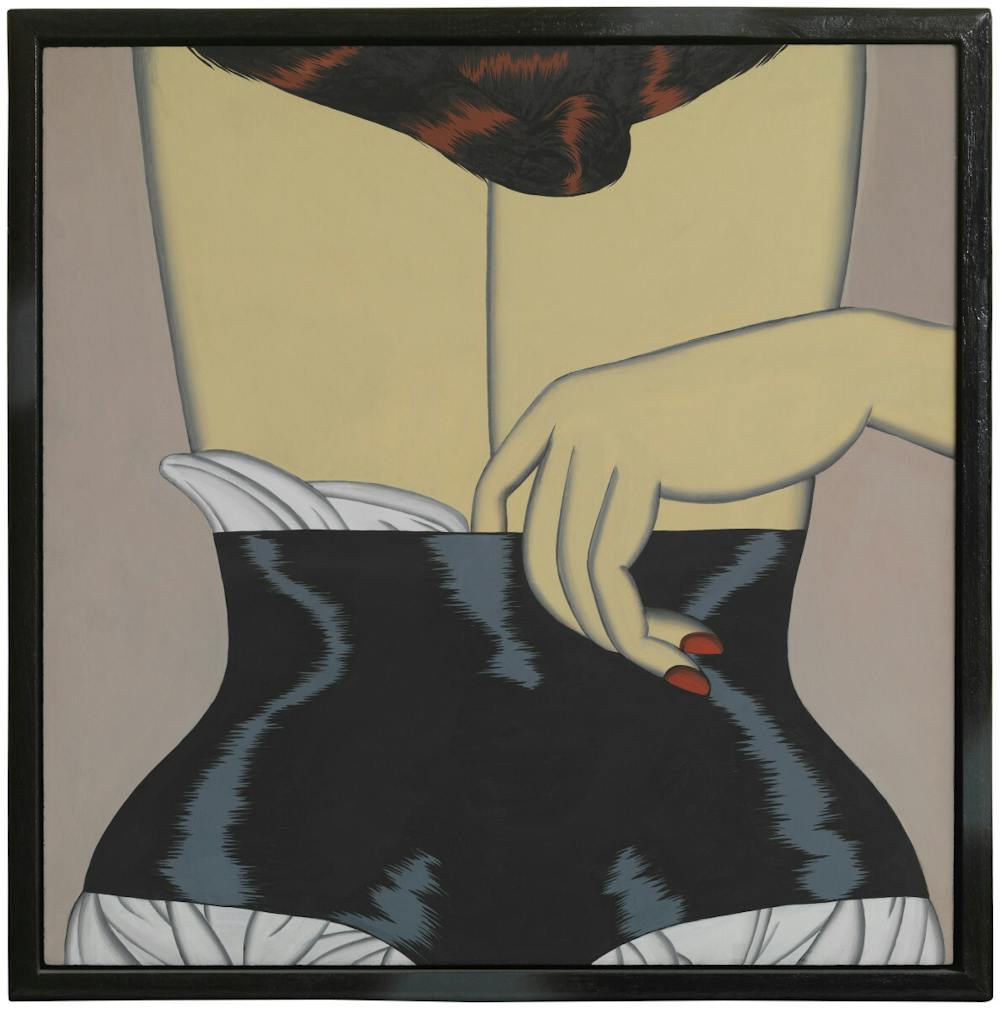
Upon entering the exhibit, visitors immediately encounter a series of Ramberg’s works that depict close–up details of female bodies clothed in raunchy corsets and stockings that are twisted in order to be confined within the constricting boundaries of the canvas. Central to the exhibit, the painting Loose Beauty is divided into two parts: one depicting the bust and one depicting the behind of a lingerie–clad woman, with skin slightly protruding from the restraining garments. Ramberg’s brushstrokes are smooth and confident with very little detail and texture included anywhere except for in crafting the garment’s lace, suggesting that the clothing may be more important than the body who wears it. Instead of using traditional shading techniques, Ramberg uses black and grey on the figure’s tan skin to make the lingerie appear to melt into her, creating a sickly, grey skin tone that seems manufactured to be dressed as she is—the body is constructed around the attire, rather than vice versa. The figure's body curves forcefully, with the sharp angles of the chest contrasting with the soft curves of the rest of her body, highlighting the unnatural shapes women are forced into to achieve aesthetic desirability. Other works with similar figures as this one present the female figure as a mimic of urns or vases, reinforcing the notion of women being treated as static decorative objects that are simultaneously admired and contained. Along the same lines, her piece Delicate Decline showcases a woman bent over with her arms raised in a vulnerable, almost submissive position. Headless, she is stripped of identity, reduced to the sum of her exaggerated curves. The attention to lace, fabric, and structure mirrors her other works, reinforcing the theme of women as ornamental objects rather than autonomous beings.
Hair, in Ramberg’s work, serves as a metaphor for control, femininity, and self–perception. In depicting hairstyles geometrically, with tightly–woven symmetrical updos, Ramberg creates a sense of discomfort in viewing the beautiful yet clearly restricting hairstyles of her subjects. One of many hair–centered works, her piece Cabbage Head sits on the back of a small wooden desk mirror, showcasing a woman with an intricate updo and red nail polish, her hair painstakingly arranged into a slicked back bun. On the right side of the painting, the woman’s textured hair starkly contrasts the constrained hair in the remainder of the work, emerging from the bun in an unruly, cabbage–like shape that suggests internal conflict—an unease hidden beneath a polished exterior. In focusing only on the woman’s hair, Ramberg suggests that the hair is the woman’s entire identity, emphasizing how perfection of image is thought of as a requirement for “womanhood.” Placing the back of the painting against a mirror amplifies this tension, as she is caught in self–examination, immanently critiquing the very standards she has adhered to. Ramberg’s other works, like Bagged, carry this examination further. Bagged presents a portrait of a woman with a bag covering her face, leaving only her eerily perfect hair visible. Despite the bag’s presence, the woman’s body glows with a yellow aura while her hair does not, emphasizing how her suffocating pursuit of perfection dims her. Works surrounding Cabbage Head contain profiles of women (the closest thing to faces in the entire exhibit) with patchy, “diseased” skin that further highlights Ramberg’s notion that beauty is often a fragile facade, failing to conceal an underlying emptiness.
Ramberg’s depiction of soft female anatomy in contrast to structured garments and hairdos brings a unique, abstracted perspective to the contradictions contained in the fetishising gaze placed upon a woman's body. Her pieces balance chaos and order, examining how rigid beauty norms warp identity and how an unruly vitality can occasionally break through. Others of Ramberg’s works, often simply called Untitled, reflect a parallel manipulation—of hair and clothing—to control self–presentation, a theme that resonates in contemporary discussions of beauty and self–image. Through her bold compositions, Ramberg reframes the conversation around beauty, making visible the often unseen tensions between self–expression and societal expectation. Her work remains a compelling critique of the ways in which femininity is sculpted, constrained, and ultimately, redefined.