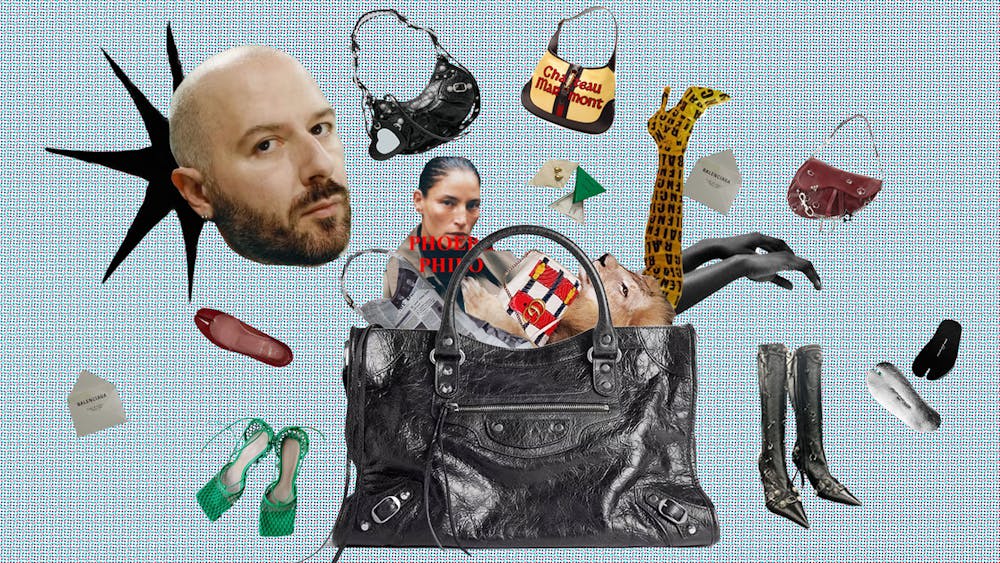
Demna Gvasalia is out at Balenciaga, and suddenly the internet remembers it used to be obsessed with him. The same people who called his work trauma–bait and clickbait are now posting wistful tributes to Le Cagole, as if they didn’t spend the last two years pretending not to get it. Fashion has always had a short–term memory, but lately, it’s not just short—it’s delusional.
In the past two years, the top fashion houses have swapped creative directors like they’re part of an incestuous trust fund dating pool. Dior, Gucci, Burberry, Ann Demeulemeester, Bottega, and Celine. No house has been safe, and the carousel isn’t slowing down. Some hires feel intentional. Others reek of boardroom panic in designer tailoring. But underneath the churn is something more interesting: a collective panic about who gets to define taste, sell fantasy, and shape a brand’s cultural relevance now that virality outruns vision.
Here’s what people forget: a creative director isn’t just a designer. They’re the author of a brand’s entire universe. They shape the shows, campaigns, casting, color theory, and storytelling. They don’t just decide what a woman wears; they define who she becomes when she puts it on. The good ones build a world so specific, you’d recognize it from a grainy backstage photo or a shoe on the subway. The bad ones dress celebrities.
Swapping out a creative director isn’t just logistical—it’s spiritual. A shift in identity, sometimes in values.
In an industry built on legacy and obsession, those shifts leave marks.
The Current Landscape: Edgelords, Minimalists, and Corporate Safety Nets
Demna Gvasalia – Balenciaga (2015– 2025)
Demna is, without exaggeration, the most important creative director of the 2010s. He inherited a house built on Cristóbal Balenciaga’s architectural precision and warped it into something unrecognizable—in the best way. Yes, there were meme–worthy moments: IKEA bags, Crocs with 4–inch platforms, show invites that doubled as burner phones. But the irony masked something more methodical. Demna is a real tailor, trained at the Royal Academy of Fine Arts in Antwerp and once head of women’s ready–to–wear under Nicolas Ghesquière at Louis Vuitton. His construction is precise, architectural, and almost mathematical. Even his most absurd silhouettes—gigantic puffers, hulking shoulders, collapsed couture gowns—are structurally immaculate.
Under him, Balenciaga became a study in post–Soviet bleakness and late capitalist absurdity. But even within that unease, he knew exactly how to sell. His Neo Classic gave Ghesquière’s Le City a facelift, not a lobotomy. Then came the Le Cagole—stupid, sexy, and brilliant. A chain–draped, mirror–charmed Y2K revival that managed to parody the it–bag industrial complex while also becoming one. It was bratty, bimbo–coded, and absolutely smart. Le Cagole wasn’t just viral; it was historically literate. It took the bones of Ghesquière’s motorcycle bag and turned them inside out. This is what Demna got right—provocation with foundation, experimentation with technique. Even when people claimed they hated it, they knew it mattered.
People forget that Vetements, the collective he co–founded, wasn’t just ironic. It was political. It was fashion for a generation raised on cynicism, one that understood that absurdity and sincerity weren’t opposites anymore.
Daniel Lee – Bottega Veneta (2018–2021), now Burberry (2022– )
Lee’s Bottega was sleek, tight, and immediate. His training under Phoebe Philo at Céline gave him a foundation in minimalist rigor, but he injected it with sensuality. He took a house known for whisper–luxury and cranked it up to Technicolor—same minimalism, but louder, glossier, inflated. The Pouch, the Lido, the square–toe boots, the padded Cassette bag—everything felt exaggerated, but somehow still wearable. And the green … that green.
His appointment at Burberry made sense on paper. A British designer returning to a British brand, but so far, the results have been uneven. He’s moved from Bottega’s inflated patternless branding to a gentler, heritage–informed Burberry—but reinventing the classic print and trenches takes more than nostalgia, and the results still feel half–formed.
The Burberry check is back, but it’s unclear whether anyone’s really looking.
Jonathan Anderson – Loewe (2013–2025 ), Dior (2025– )
Jonathan Anderson is a designer’s designer—someone who plays with silhouette, craft, and concept without ever losing control. At Loewe, he’s created some of the most technically and emotionally compelling clothes of the decade. Pixelated coats, ceramic dresses, and anthurium corsages. His work is tactile, surreal, and often deeply moving.
Now, with Dior, the stakes are different. Anderson has the range to handle house codes, but Dior’s history is cleaner, more tailored, and more beholden to tradition. Whether he brings Loewe’s weirdness with him—or lets Dior smooth out the edges—remains to be seen.
Alessandro Michele – Gucci (2015–2022)
Michele’s Gucci wasn’t just maximalist—it was maximalist with a PhD in semiotics and a crush on Oscar Wilde. Appointed seemingly out of nowhere from within Gucci’s accessories team, he transformed the house overnight. Out went the 2010s slick sex of the Tom Ford shadow years; in came a baroque, Renaissance–laced universe of pussybow blouses, talismans, embroidery, and soft boys in velvet tailoring. Gender became a costume. History became a moodboard.
Under Michele, Gucci was never minimalist, never quiet. It was emotional, heavily referential, often overloaded—but that was the point. He made fashion feel like a form of personal mythology. And it worked. Gucci under Michele became a cultural juggernaut, both critically and commercially. The Dionysus bag, the Princetown slipper, the fur–lined everything. He blurred Gucci’s borders until it was more aesthetic than brand.
By the end, though, the aesthetic began to fold in on itself—more and more intricate, less and less impactful. His departure was bittersweet. The vision had run its course, but no one since has been able to reanimate Gucci with the same intensity. Sabato de Sarno’s new direction was technically polished, but emotionally vacant. It sold luxury. It didn’t sell fantasy.
Hedi Slimane – Saint Laurent (2012–2016), Celine (2018– )
Every Hedi Slimane collection looks like it was designed at 3 a.m. by someone chain–smoking in a Saint–Germain walk–up, and that’s exactly the point. His Saint Laurent tenure remade the brand in his own image: thin, moody, black–clad, and utterly Parisian. It was a sharp break from Stefano Pilati’s softness, and it sold—hugely. He didn’t just redesign the house, he stripped it down, literally renaming it and abandoning Yves’ signature flourish. Critics balked, but the results were undeniable. Slimane’s Saint Laurent defined the aesthetic of early 2010s luxury: glam–rock minimalism, heavy on attitude, and light on color.
At Celine, he performed the same operation. The Old Céline girls, still mourning Phoebe Philo’s intellectual minimalism, watched in horror as the house became a stage for skinny teens in pleated micro–minis. Slimane wasn’t just uninterested in preserving Philo’s legacy—he actively rejected it. While that erasure was painful to witness, it was deliberate.
He’s a consistent creative director, if not a flexible one. His work never surprises—but it always delivers a clean, distinct world.
Ludovic de Saint Sernin – Ann Demeulemeester (2023 … briefly)
Ann Demeulemeester is a house built on poetry, melancholy, and restraint. It’s the Belgian gothic of intellectual fashion—the kind that broods instead of performing, that whispers instead of screams. Ludovic, meanwhile, is none of those things.
He arrived with a vision soaked in Instagram thirst. His Ann was sheer, wet, body–first. Nipples, lacing, harnesses. Sexy? Yes. Informed? No. The clothes weren’t bad—they just weren’t Ann. There was no dialogue with the house’s history, no emotional continuity with its founder’s spectral touch. It lasted one season.
Fashion likes shock. But it likes continuity more.
Tom Ford – Gucci (1994–2004)
Gucci was bankrupt when Tom Ford took over. It wasn’t sexy, or cool, or even relevant. It was a tired leather goods house with history and no heat. Ford’s brilliance wasn’t just in making Gucci hypersexual—it was in fusing that sex appeal with polish, confidence, and obsessive restraint. His silhouettes were tight, clean, and slightly menacing. A velvet suit in the Ford era wasn’t just clothing—it was a weapon.
What made Ford a great creative director wasn’t his eye alone, but his control over every detail of the brand. He directed the campaigns, cast the models, and styled the shows. He collaborated with Carine Roitfeld and Mario Testino to build a world where even the ads felt like status objects. It wasn’t just luxury—it was aspiration. When Ford left Gucci, he left behind not just a legacy, but a void. The brand has never fully recovered its cultural dominance. They’re still chasing the fantasy he conjured—and they probably always will.
John Galliano – Dior (1996–2011)
Galliano’s Dior was fashion as grand opera. Each couture collection was a self–contained universe—dripping in references, silhouettes pushed to theatrical extremes, and models styled like fallen royalty or alien goddesses. His understanding of historical dress wasn’t just academic—it was obsessive, and his technical fluency gave him the ability to distort and elevate it into something mythic.
What set Galliano apart wasn’t just drama or spectacle—it was depth. Every bias–cut gown, every panniered skirt, every kabuki–inflected jacket came from a place of exhaustive research and genuine reverence for the craft. His scandal and subsequent exile were devastating—not just because of what he said, but because the loss of his vision left a void in the emotional register of fashion. There has still never been another designer who could move audiences to tears with a neckline. At Maison Margiela, he found something quieter, stranger, more ghostlike. Yet his impact at Dior remains unsurpassed. He made people believe in couture again—not as status, but as theatre, religion, and dream.
Martin Margiela – Maison Martin Margiela (1989–2009)
Margiela is the designer other designers are still trying to decode. He refused to appear on the runway, spoke only through his collective, and numbered his labels instead of naming them. But what he gave the industry was a completely new visual grammar. A sleeve that was unfinished. A lining worn as a dress. A garment made of nothing but gloves or plastic or found trash. His deconstruction wasn’t just visual—it was conceptual. A refusal of fashion’s ego, hierarchy, and gloss.
Margiela wasn’t cynical. His work had warmth. There was humor in his absurdity, and tenderness in his refusal to present himself as a genius. He forced people to see the mechanics of a garment—to understand that luxury could be experimental, even awkward. He built a universe where imperfection was divine. Most designers have a muse. Margiela had an ideology.
Phoebe Philo – Céline (2008–2017)
Philo understood the psychology of dressing in a way that few designers ever have. Her clothes weren’t about attracting the male gaze or appeasing fashion’s trend cycles—they were about defending the woman wearing them. Wide–leg trousers, intellectual coats, the glove shoes, and the trapeze bag. Every detail in her collections, from a sleeve to a seam, suggested intention.
Philo is often reduced to “quiet luxury,” but that’s a misreading. Her work was often aggressively plain—anti–spectacle in an era obsessed with it. But beneath the austerity was poetry. She made clothes for women who didn’t want to perform their desirability. For women who had nothing to prove, and better things to do than dress for Instagram. Her Céline was less about beauty and more about integrity—a word almost no one in fashion deserves. And when she left, her audience mourned like something real had died.
A great creative director doesn’t imitate the archive—they interrogate it. They know what the house was built on and what deserves to be burned. They speak in silhouette and reference but never in nostalgia. Reverence makes for bad fashion.
The best directors don’t ask what’s trending—they ask what the world needs to wear to understand itself. They’re not afraid to sell, but they never pander. They trust the customer’s intelligence. Their clothes function as tools, or armor, or memory—whatever the moment demands. Every piece feels like it came from somewhere and is going somewhere else.
Most of all, they leave fingerprints. You can see it in the shoulder line, the clasp of a bag, the mood of a show. Their legacy outlasts the contract. Success in this role isn’t about noise. It’s about precision—in taste, in timing, and in vision.
Yes, most of the new creative directors are white men. That’s not nothing—but it’s also not the whole story. To reduce the current fashion turnover to a conversation about optics is to miss the deeper failure: it’s not about who gets the job, but what they do with it.Creative direction is about vision. Not representation for representation’s sake, and certainly not aesthetic diversity coded as identity politics. The issue isn’t just that the appointments look the same—it’s that too many of them feel the same. Safe. Sanitized. Scared of risk. We’re in an era of brand management, not revolution
Take Alessandro Michele and Demna, their worlds couldn’t be more different. Michele brought intimacy, softness, and sentimentality to Gucci—a magpie romanticism that felt like a shrine to every boy who grew up loving velvet and baroque jewelry. Demna, by contrast, gave us paranoia, post–Soviet silhouettes, and capitalist dystopia. They were both maximalists, but in completely different emotional registers. To flatten them into the same narrative is lazy. One quoted Walter Benjamin. The other staged a show in a mud pit.
The stakes have been lowered. Fewer risks. Less confrontation. More merch in nicer fabrics won’t suffice.
Musical chairs is only fun when the music’s good.