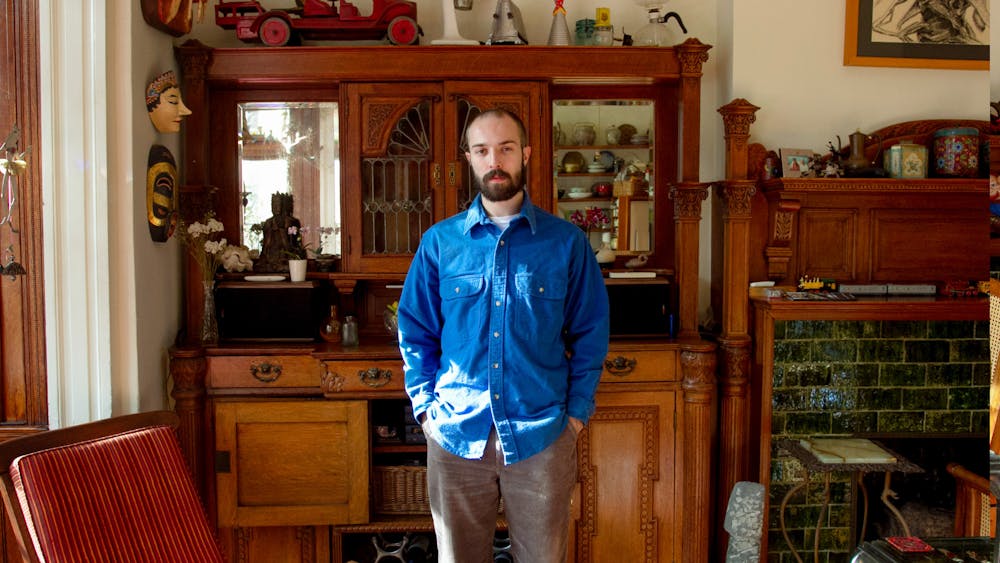
This past December, Grant Pavol (C ‘22) doused himself in yellow paint, put on a white collared shirt, and headed out into the freezing cold streets of New York City dressed as The Simpsons family patriarch, Homer Simpson. He was shooting a music video for “Twin Sized Bed,” a song off his recent EP College—released just this January. The soft, melancholy tune differs drastically from its video companion, which culminates in a scrappy fight scene between Pavol and another Homer look–alike, played by Pavol’s friend and influencer Patrick Doran.
“I don’t feel very comfortable lip syncing or trying to look cool and sexy on camera,” explains Pavol. “So I kind of made it a rule. I was like, ‘I want to make music videos. I want to do weird shit.’”
The two Homers relied on an old, tattered winter coat Pavol had found in his basement, taking turns while filming outside in the frigid weather. Seeing as they were covered in layers of paint, neither wanted to risk ruining something of value; sharing would have to suffice. Pavol’s cold, yellowed hands were cracked and bleeding by the end of the day.
Luckily for him, Pavol managed to escape the chilly weather for a couple of scenes. One of the shoot’s more memorable moments happened inside a grocery store, where Pavol and his team—shooting guerrilla–style—didn’t necessarily ask for permission before filming. “There’s a shot where I’m looking at all the beer as Homer, and an employee came up to me while I was shooting it. I was like, ‘Oh, he’s gonna kick me out,’” explains Pavol. “Sorry, man. We’re out of Duff,” the worker said, referencing the show’s fictional Springfield beer brand.
Almost a month after Pavol finally scrubbed off his cartoon complexion—an ordeal he describes as “horrible”—the surrealist, old–Internet style video was released on YouTube. Since then, it has garnered a little over 4,500 views and is currently the most streamed song off College on Spotify.
Following the release of College, he dropped Left That Party in May, just five months later. Although released in close proximity to each other, the EPs could not be any more different. Both sonically and lyrically, Left That Party’s clear pop–rock influence is a stark departure from the mellow, somewhat nostalgic sound of College. “The idea was kind of to have them loosely match the seasons—not in their topics, really, but just in the vibe,” explains Pavol. “So College is pretty sparse and kind of depressing. I put it out in January, and Left That Party was spring because it’s power pop. It’s kind of breezy and fun [and] easy to listen to. [It’s] ‘listen to it outside’ kind of music.”
From here, the singer is looking to shape his remaining two EPs around the vibes he associates with the seasons they are set to release in. It’s a release schedule that will allow him to “start chipping away at the iceberg” of different sounds, without the possibility of intimidating audiences with an all–encompassing album.
Pavol’s multifaceted genre exploration began in Philadelphia, where his passion for music is rooted.
He attended Friends Select School, a pre–K to 12 Quaker school in Center City, Philadelphia. When he reached high school, Pavol befriended a senior involved in Philly’s noise music scene. He began following his friend to shows, watching experimental bands like Palm play up close. He admits that “It kind of blew my mind."
When it was time to pick a college, Pavol gravitated towards Penn. The academics and prestige were obvious reasons, of course, but also to keep his high school band together.
Pavol didn’t have the most traditional college experience. He’ll be the first to tell you that. Besides an awkward four years fragmented and haphazardly sewn back together by the COVID–19 pandemic, Pavol lived in the now–defunct Haus of Yarga for a year. It was inside this former frat–punk house that he learned the ins and outs of the music industry. “You’re dealing with touring musicians every day, [and] a lot of them would crash in the house—in the living room or in the basement,” Pavol says. “You get a real sense of the economics of the industry on an independent level. You learn all the tricks of booking and maintaining connections. Beyond that, you learn a lot about the commitment that it takes to make something work on your own terms.”
When he wasn’t talking down cops called for the many noise complaints Yarga garnered, Pavol did go to class. He majored in history and English. The latter set the groundwork for his future in songwriting.
“Simone White, who’s now one of the heads of the poetry department, kind of taught me how to read poetry … how to just basically make my mind blank and interpret and try to not impose my own external logics or thoughts onto pieces of work,” Pavol explains. “And then Ron Silliman was my advanced poetry advisor. He taught me a lot about how to open myself up when I’m writing,”
Pavol also credits Silliman for getting his songwriting on a strict schedule; the professor requires his students to have a new, creative piece every week. Before taking Silliman’s course, Pavol had only written when he experienced “a very, very strong emotion” that he felt he needed to express. Silliman’s weekly deadlines challenged that, as the new way Pavol approached class assignments quickly bled into his personal work. He began adhering to a strict routine, writing anywhere from two to six songs a week. In the time between his 2021 album Reflections and his EP releases this year, he claims to have written over 150 songs.
Pavol is a fully independent artist. After college, he collaborated with and played bass for Shamir, an alt–rock artist from Las Vegas. The partnership almost materialized into a record deal, but the label pulled out at the last minute, claiming to have signed too many artists that year already.
“You could either call it ‘hitting rock bottom,’ or call it ‘having an epiphany,’” Pavol says. “As much as I have plenty of friends and collaborators that love my work and want to help me, ultimately, it's my responsibility to make my own way in the music industry.”
Pavol was crushed but determined. He launched a fully independent venture modeled after lessons learned at Yarga. He handles his own PR, books performances, plans music videos and even creates his album art by hand. Both covers for College and Left That Party were created by Pavol physically drawing on printed photos from his phone’s camera roll.
“I was happiest and most fulfilled making music when I was in high school and in college,” he continues. “I was just putting stuff out and playing shows and having fun and not really worrying about who’s going to hear it.”
And Pavol is going to keep having fun—even if it means buying another bucket of yellow paint.