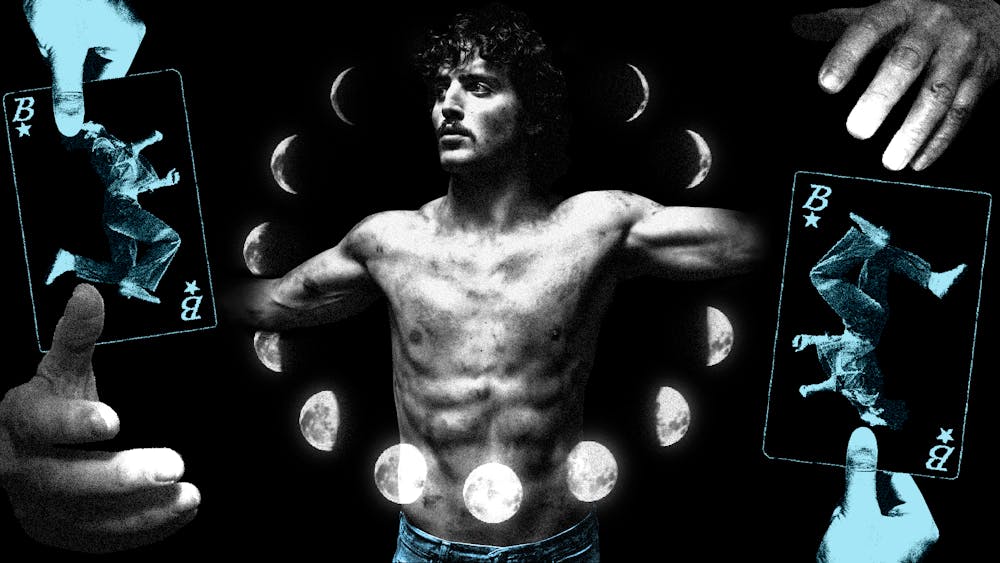
It’s hard to miss him on your TikTok feed—half–tucked into a glitter jumpsuit, leaping off a piano mid–ballad, or staring wistfully into a camera while the sound of his own breathy falsetto plays in the background. Benson Boone, the 22–year–old pop crooner whose music seems genetically engineered for Spotify’s Today’s Top Hits playlist, has become something of a walking paradox. He is both a phenomenon and a punchline, and it’s something he is all too aware of.
Boone’s rise to fame hasn’t been a straightforward sprint through American Idol (which he left voluntarily) or a record–label fairy tale. It’s been meme–fueled, irony–laced, and algorithmically optimized. Whether intentionally or not, Boone has become the poster boy for Gen Z’s ouroboros–like attention economy, where mockery and adoration are not opposites but mutually enriching forces. In other words: The more people hate him, the more famous he gets. And the more famous he gets, the more people hate him. Delightfully postmodern.
Scroll through TikTok and you’ll find a peculiar genre of videos that simply state, “I hate Benson Boone for no reason,” as well as some shorts that attempt to justify the hate Boone gets. Then there are the stitched videos of his performances—many of which involve melodramatic gestures and slow–motion acrobatics—captioned with things like, “Why is he singing like he’s being chased by a Victorian ghost?” or “Me when no one clapped after my third grade talent show.” Yet these very videos rack up hundreds of thousands of views, often boosting the very songs they’re ostensibly mocking.
Boone, for his part, is in on the joke. Or at least he’s performing like he is. In one now–viral TikTok, he says, “I just read a comment that said ‘idek why I hate Benson Boone but it feels right.’ Like WHAT!!? How am I supposed to improve after reading that? At least say something valid like ‘He low key just flips everywhere can he [do] anything else?’ or even ‘I just don’t like his songs even though I’m basing my opinion off the only one that I’ve heard over and over’ (super valid).” Boone’s response to the hate so finely straddles the line between irony and sincerity that it’s hard to tell if he’s self–aware or just cleverly managed. But maybe that’s the point. In 2025, feigned cluelessness is its own brand of savvy.
This phenomenon of artists weaponizing mockery as fuel for success isn’t entirely new. Rebecca Black turned ridicule into redemption. The Chainsmokers leaned into frat–boy loathing and rode it to Grammy nominations. Even Nickelback has carved out a lucrative niche as the band you love to hate (and secretly hum along to). However, Boone’s case feels more unique to our current media climate. It’s not just that he’s being memed—it’s how he’s being memed. The conversation around him doesn’t exist in binaries (talent vs. cringe, artistry vs. attention–seeking); it loops endlessly through layers of irony, sincerity, and commodified personality.
Clearly, it works. Boone’s streaming numbers are staggering. His song “Beautiful Things” dominated charts earlier this year, peaking at No. 2 on the Billboard Hot 100 and earning over 700 million streams on Spotify. That success didn’t come from a traditional fanbase; it was the result of him being everywhere, all the time, until people started listening simply because they couldn’t avoid him. People don’t necessarily love Boone, but they certainly notice him. And in this attention economy, visibility is currency, no matter the sentiments attached to it.
Case in point? Boone’s recent single “Mystical Magical,” which debuted live at the 2025 American Music Awards and instantly went viral for the lyrics: “Moonbeam ice cream / taking off your blue jeans / dancing at the movies / ‘cause it feels so mystical magical.” The track became a meme overnight, with TikTok full of videos parodying the phrase as the song climbed charts, hitting No. 13 on the UK Official Singles Chart and No. 9 in Ireland.
Crumbl Cookies even announced a limited–edition “Moonbeam Ice Cream” cookie: pastel–frosted, Oreo–dusted, and unabashedly over–the–top. For fans, it was a dreamlike crossover, with people showing up to stores, backflipping and singing “Mystical Magical” when ordering. For critics, however, it confirmed everything they already suspected: that Boone’s brand of hyper–sincere whimsy had officially crossed from melodies into merchandise. The lyric that began as a punchline was now a literal dessert, showcasing Boone’s knack for transforming viral mockery into commercial viability—one pastel cookie at a time.
What’s especially interesting is how Boone’s aesthetic—earnest and glittery—both fuels online mockery and forms the core of his appeal. He’s not trying to be too cool to care, nor is he hiding behind irony or detachment. His vocals are raw, his lyrics are earnest, and his performances are so unfiltered that they verge on musical theatre. He is, in short, the kind of artist who invites reaction. And in today’s music industry, reaction is revenue.
Of course, there are costs to this kind of exposure. Boone’s online presence, especially his willingness to acknowledge the hate he receives, walks a thin line between control and chaos. On one hand, he’s cleverly redirecting criticism into clicks. On the other, he’s still subject to a parasocial swirl of judgment, projection, and overexposure. When every performance is meme bait, it’s easy to forget there’s a real person behind the piano flip.
Perhaps Boone is less a victim of the moment than a product of it. His trajectory reveals something about how modern culture functions: Art doesn’t need to be loved, it just needs to be discussed. Every eye roll, every stitched TikTok, every joke at his expense only feeds the machine. He knows how the story works now. It doesn’t matter if people are laughing with you or at you, as long as they’re still watching and talking about it.
There’s a moment on “In the Stars,” a song sung with the breathy conviction of a man clinging to a cliff’s edge, where Boone cries out, “I’m still holding on.” It’s meant to be about love, probably. In fact, it’s also an apt metaphor for his current balancing act: holding on to sincerity while dancing through ridicule, glitter jumpsuit and all.
Though Benson Boone may not seem like the voice of a generation, he’s certainly the algorithm’s favorite son. Today, those two roles might be one and the same.