
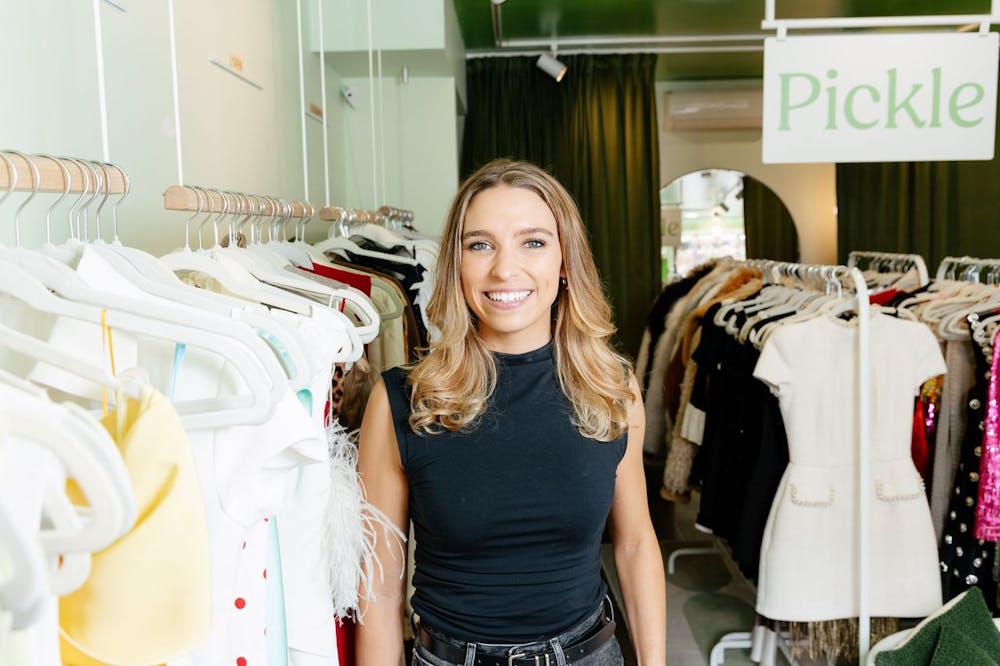
Three years ago, Julia O’Mara (E ’19) was sprinting across Manhattan—not to a meeting, not to a show, but to someone’s front door with a rented dress in hand. It was early days for Pickle, the peer–to–peer fashion rental platform where she and her co–founder, Brian McMahon, played every role: logistics, product, marketing, and—most importantly—courier. “There were nine rentals last week,” she remembers telling McMahon. “Let’s get to ten.”
They did. Then they got to 20. Then 100. Now, Pickle moves more rental volume in a few days than it did in its entire first year. In the strange alchemy of startup life, every little yes is a victory after a thousand almost–nos. Today, Pickle is used by one in four women aged 18–35 in Manhattan. Its user base, revenue, and supply have all tripled or quadrupled year over year. In Los Angeles, where Pickle recently launched same–day delivery, order volume has increased fivefold since January. But to O’Mara, the most powerful growth metric isn’t financial.
“We [began to] see these pockets of friend groups and networks that were starting to build amongst users in Manhattan,” she says. “[We’d hear someone] say, ‘Oh, my friend recommended that I use Pickle. She had this amazing experience.’ And in my head, I was like, ‘I know who Clara is, because she was somebody who rented from us last weekend.’” That kind of intimacy—granular, grassroots, genuine—isn’t just a nice origin story. It’s the core of the platform’s success.
Before Pickle was a rental empire, it was a polling app. Launched in April 2021, Pickle “1.0,” as O’Mara calls it, allowed users to crowdsource decisions: what dress to buy, what shoes to pair, what color to choose. “[We wanted to] inject social proof into the purchase process,” O’Mara explains. “You’d post a poll—‘Option A, B, or C?’—and people would vote on it and help give advice.” Yet something strange kept happening. People weren’t only choosing between the options given; they were recommending other items from their own closets. Sometimes, they even offered to lend them.
That’s when O’Mara and McMahon saw the pivot. Why sell people something new when they’re eager to borrow what already exists? It’s the kind of idea that only makes sense in retrospect: fashion as a community–sourced utility. Your neighbor’s closet becomes your pop–up boutique. And your own clothes, formerly sunk costs, become income–generating assets. Inspired by Airbnb, Uber, and the circular economy, they restructured Pickle from the ground up in just three weeks.“No one had really tackled this peer–to–peer model of being able to exchange goods directly from person to person,” O’Mara says. “We really thought about why this didn’t exist yet for closets. And we wanted it to exist.”
Maybe it took a pair of outsiders to see it clearly. O’Mara’s background was in materials science engineering, not merchandising. She had worked in product at Blackstone, not Bergdorf’s. Her co–founder didn’t come from fashion, either. However, that distance gave them clarity—and, as it turned out, an edge. Unburdened by the conventions of the fashion world, O’Mara and McMahon didn’t care about dictating trends or deciding what people should wear. Instead, they simply listened to their customers. They studied what users were listing, what they were trying to monetize from their closets, and where demand naturally emerged. It was a process built on observation rather than assumption. The team conducted constant user interviews, tracked rental trends in real time, and—before courier partnerships, before scale—delivered every garment by hand, learning with each knock on a customer’s door.
This street–level view of New York proved invaluable. With every handoff came a new data point: how customers discovered Pickle, where the friction was, what didn’t feel intuitive. What began as logistical improvisation soon informed the architecture of the app itself, laying the groundwork for a more seamless user experience and, eventually, the integration of outside courier systems like Uber and DoorDash. Then, the company added a community “Looking For” forum where renters could post styling prompts—“Going to Italy, what should I wear?”—and lenders could respond with links to their items. The feature became one of Pickle’s most beloved, and eventually came to include AI–powered visual search: Users can now upload an inspiration photo to find lookalikes from across the platform.
Pickle’s users are not passive consumers. They’re co–curators, co–designers, co–investors. On the supply side, lenders have begun sourcing specific pieces. “We saw some lenders that were starting to think about their purchasing process and the way that they would invest in fashion in a different way because they could make a return on that investment,” O’Mara recalls.
It’s a kind of microcapitalism that feels oddly utopian. Not in the disruptive, buzzwordy sense—but in the literal, community–based one. A Pickle garment doesn’t come from a warehouse full of product. “It’s someone else’s item, [so] I’m going to treat it with love and care and return it in great condition,” O’Mara says. That love and care, it turns out, is Pickle’s most valuable asset.
Trust is engineered into the platform: There are reviews, renter scores, and insurance coverage (Pickle’s “Protection Policy” ensures items are returned as promised or fully reimbursed), but what really fuels the platform is the sense that each piece of clothing comes from a real human being. “It’s not going back to a large corporation,” she says. “It’s going back to another person that I might be friends with or run into on the street. That builds that other level of community.”
That sense of social accountability has created a uniquely tight–knit ecosystem. Early growth came almost entirely from word of mouth. Many rentals are still hand–delivered or picked up locally. The most successful lenders tend to be those who respond to renter requests, maintain their items obsessively, and treat their closets like curated storefronts. In return, Pickle rewards them with featured placement, badges, and increased visibility—part of its recently launched “Star Lender” program.
Of course, none of this came without moments of crisis. O’Mara remembers the winter of 2022 as a blur of 14–hour days. They were making deliveries from morning to night, burning through cash, and worrying that this might be the end of Pickle. “We got a million nos before we got a yes,” she says. She remembers talking to her mom before the new year. “She asked, ‘How long do you think you can keep doing this?’ And I told her, ‘Let’s check back in the summer.’ We never talked about it again.”
“I’m so glad that it went this way,” she reflects. There tends to be a default career path for Penn alumni—the one polished by prestige and packed with certainty. Consulting, finance, New York: The lanes were clearly marked, and she was already in one, set to begin her post–grad life at Blackstone, a textbook starting point for high–achieving Ivy League graduates. “I was transparently kind of set up to go and do that,” she points out.
Looking back, she says college Julia would be stunned by what she’s done, and maybe a little proud. “I would feel like, ‘You are so cool that you went on this really, really different path, compared to where you started and where you thought you might have ended up.’” In the company's early days, she’d ask herself, “Would anyone care if Pickle didn’t exist tomorrow?” Reflecting on the days when they had only about 50 customers, she notes, “I knew those 50 people would really miss our service and our platform. That kept me motivated.” Now, those 50 have become tens of thousands. New markets in Dallas, Chicago, and San Francisco are picking up traction. Men’s closets are next. Maybe travel gear after that. “You’ll go somewhere with an empty suitcase,” she says. “And you’ll be able to rent the fishing pole or kayak or whatever you’re using on vacation. Because all of those items already exist in that community.”
It’s a bold vision, but not an impossible one. O’Mara has built Pickle one closet at a time. One neighborhood at a time. One rental at a time. Sometimes, that’s the only way a revolution can begin. To call Pickle a fashion company is to ignore the deeper mechanics behind its success. O’Mara thinks of it as something else entirely: a behavioral platform. The business, at its core, is less about clothes than it is about habits—how people express themselves, how they shop, browse, borrow, and experiment.
Just as Pickle has evolved by watching its users, O’Mara has evolved by building it. A first–time founder with no manual to follow, she had to learn to do it all—management, fundraising, hiring, scaling—on the fly. There was no roadmap, only improvisation. Nevertheless, her background in engineering gave her one essential skill: problem solving. Every day presented a new set of challenges, and her job, more than anything else, became the art of triage: deciding what to fix now, what to build next, and how to think beyond the fire drill to the bigger picture.
Her leadership philosophy is simple: Surround yourself with people you can learn from. “One of our favorite things to [ask] when we’re bringing on new members of the team is, ‘Can I learn from this person?’ Because I’m not trying to hire somebody that I think I can only teach.” That humility, too, is part of Pickle’s DNA. It’s not trying to dominate fashion. It’s trying to democratize it through data and trust, giving users a thousand daily choices about what to wear, what to share, and what to keep in circulation.
When asked what she hopes people say about Pickle five years from now, O’Mara pauses, then smiles. “I hope they say, ‘It was the most incredible seamless experience. [I was] able to find whatever [I was] looking for right in [my] local neighborhood or city, and [I] had such an amazing experience, and [I’m] super excited to share it with a friend.’”
It’s an unflashy ambition, but a radical one. Not to sell more, but to share better. Pickle may scale, the cities may multiply, but its premise will always stay local: something borrowed, something worn, something remembered.




