I didn’t think I could still feel anything watching a superhero movie. Not in 2025 after capeslop became a term. Not after watching two decades of men with god complexes punch each other across cities while monologuing about loss, legacy, and their inability to cry.
I do, however, remember being 10 or 11, sitting in the back of my dad’s car after seeing Guardians of the Galaxy Vol. 2, quietly repeating lyrics from one of the songs so I could look them up later. Not because I liked superheroes—but because I liked the feeling of believing in altruistic men and found family.
I haven’t felt that in years. Everything since has been either trauma–dump mythology or content slurry: men with daddy issues, cinematic universes built on guilt, girls dying in Act 2 so a sad little self insert protagonist can have his emotional breakthrough.
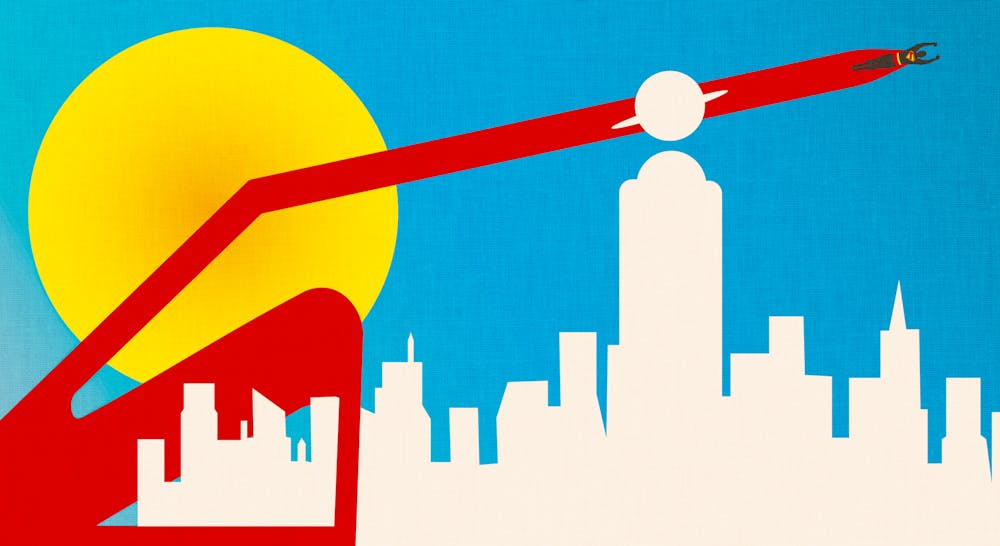
Then James Gunn’s Superman came out, and against every instinct in my body—I felt it again. That strange, stupid, warm thing; like I remembered the lyrics to something I didn’t know I’d forgotten.
Before the movie even starts, you can just tell Gunn cares. Not just about Superman, but about everyone around him—Lois Lane, Jimmy Olsen, even Green Lantern, who apparently listens to MF DOOM. That detail comes from the official Spotify playlists Gunn made for each character—because of course he did. Of course the man who resurrected Guardians of the Galaxy via ‘70s needle drops and raccoon feelings is now using playlists as character studies. Gunn doesn’t direct like a studio executive. He directs like someone who used to write Tumblr headcanons about what music his original characters would cry to. There is something uncomfortably sincere about the way Gunn writes: emotionally indulgent, slightly cringe, full of the kind of choices you’d only make if you were actually obsessed with the person you were writing about.
There’s a kind of tenderness to the film that doesn’t belong in a billion–dollar intellectual property machine. The post–Avengers: Endgame era of Marvel doesn’t do this kind of thing. It doesn’t care what songs its characters would cry to. It barely cares what they want. The whole pipeline has become so mechanical—movies made by committee, dialogue engineered for TikTok edits, everything designed to be flattened into a content calendar.
Gunn has said the film finally clicked for him when he realized that Superman shouldn’t just have a dog—he should have Krypto, and Krypto should be Ozu. Ozu is Gunn’s real–life rescue dog, adopted out of a hoarding situation, who spent years terrified of humans and tearing apart furniture, shoes, and one of Gunn’s wife’s tampons. At one point, Ozu ate a $10,000 laptop. The idea that a creature that volatile could also be loved—that Superman wouldn’t put him down or discipline the chaos out of him, but choose to keep showing up for him anyway—that’s what gave Gunn his story. He made a movie about choosing care—even when that care is inconvenient, destructive, or not particularly cinematic.
That warmth leaked into the real world. Searches for “adopt a dog near me” spiked 513% after the film’s release. More than 450 pets were adopted in the first 10 days of July, thanks to a Warner Bros. campaign that covered adoption fees.
For the last 15 years, superhero media has taught us that goodness has to be earned through punishment; that men only become kind after they’ve been broken. Atonement became the new origin story. Iron Man had to be an arms dealer. Batman had to be a fascist. Deadpool is funny because he wants to die. The logic is simple: boys will be boys, but they’ll also be tortured about it.
And then this Superman walks in—quiet, weird, warm—and just is good. No blood price. No girl dying. No city is reduced to ash so he can learn how to feel. He has nothing to atone for. He just calls his mom and loves his girl. In a genre that’s obsessed with grief and guilt, that feels borderline transgressive. It all orbits around the fact that Gunn’s Superman feels like he was actually raised. Audiences can feel the Kents in him—not as some abstract symbol of Americana, but as real people—salt of the earth Midwestern parents who told their son to do the right thing even when no one’s watching.
Even the supporting characters echo this tonal shift. In Zack Snyder’s Batman v Superman: Dawn of Justice, Jimmy Olsen is a CIA agent who gets killed off within the first 10 minutes. In Gunn’s world, Jimmy is just … Jimmy: sweet, funny, and a little awkward. His phone background is a picture of him and his cat. Women across Gotham are inexplicably obsessed with him, and he reacts like someone who genuinely doesn’t know he’s hot. He’s not edgy. He’s not broken. He’s just normal, and kind, and completely unbothered about it. What makes it work—what makes him work—is that he’s not performing macho arrogance or softboy submission.
And then there’s Lois. In Snyder’s version, she was reduced to a trope—the woman who exists to remind a god to stay human. “The one thing anchoring him to this world.” Ew. No woman wants to be an anchor. That’s not love. That’s weight. However, in Gunn’s film, Lois is sharp, annoying, messy, relentless in that classic newsroom way. You believe they fell in love arguing over headlines, not fate. She doesn’t keep him grounded—she keeps him honest.
That’s what makes this movie disorienting in the best way. We’ve become culturally suspicious of loved people. We trust antiheroes and orphans, billionaires in towers, men who sit alone in million–dollar rooms whispering apologies to ghosts. In his world, Gunn imagines something scarier: a world that did raise its boys right—and still tried to punish them for not becoming cruel anyway.
In fact, what’s actually punk in 2025? It’s not the loner with the kill count. It’s the guy who calls his mom, loves his girl, and picks up dog shit. The guy who has power and still chooses not to make the world pay for his pain.
Henry Cavill’s Superman was an isolationist and stoic fantasy. A Nietzschean Übermensch—above humanity, burdened by it, instructed by his own father to let children die if it meant protecting his secret. There was no moral inheritance, no warmth, no real community.
On the other hand, Gunn’s Superman gives us something else. There’s a monologue midway through the film that should’ve been cringe, but it isn’t: “I love. I get scared. I wake up every morning, and despite not knowing what to do, I put one foot in front of the other and I try to make the best choices I can. I screw up all the time, but that’s being human. And that’s my greatest strength.”
I didn’t expect Gunn’s Superman to make me feel anything. I didn’t expect it to feel so earnest—or weird in a way that felt familiar instead of forced. Yet it did. It reminded me of what it used to feel like, back when I was a kid trying to remember lyrics in the backseat so I could Google them later. Not because the movie changed my life, but because—for a second—it let me believe in something simple and good again.