
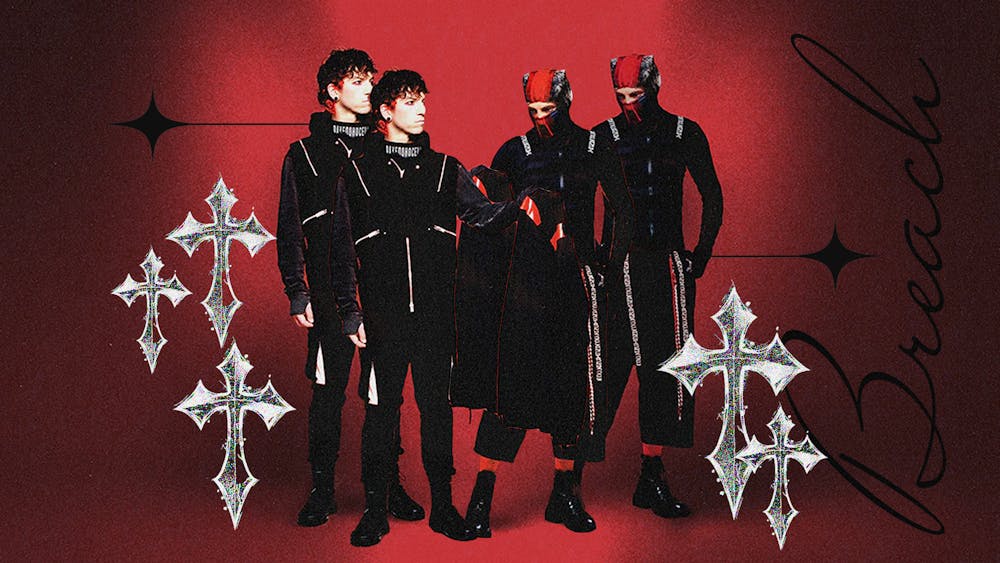
For more than a decade, Twenty One Pilots has built one of the most ambitious mythologies in popular music. Since the success of Blurryface, Tyler Joseph and Josh Dun have spent their last five studio albums creating the world of Dema: a city ruled by faceless bishops, an allegory for depression and self–destruction. Fans were cast as fellow travelers (dubbed “Banditos”) alongside Clancy and the Torchbearer (Joseph and Dun’s fictional stand–ins), fighting toward escape but always being pulled back into cycles of control. Breach, the duo’s latest record, finally closes this saga. But it doesn’t end in triumph. Instead, it insists on something quieter: Healing is cyclical, and survival is never permanent.
From its lead single, “The Contract,” Breach makes clear that the album isn’t about peaceful resolution so much as it is about confrontation. Joseph sings of promises, fear lurking outside doors, and the pressures of obligation, building urgency until it all erupts in one of the band’s most chaotic choruses. The song frames Breach as a negotiation with the self, a reminder that progress toward healing and stability comes at a cost. Where past records leaned on metaphors and obscure vulnerability, here Joseph lays it bare: the constant fear of relapse and the exhaustion of endless struggle always stay with you.
The album's actual opener, “City Walls,” is both the narrative and emotional climax of this album. The track revisits motifs stretching back to Blurryface and even their 2012 album Vessel, recycling melodic and lyrical fragments that feel like ghosts refusing to die. Its music video makes the album's lore more explicit: Clancy confronts Nico (the head bishop of Dema), defeats him, and then dons the bishop's robes himself. The implication isn’t that Clancy has become Nico, but that his role has been reshaped—it's less a clean escape than a reinvention. It’s a reminder that struggle is cyclical and never fully resolved. Echoes of "Heavydirtysoul", the opening track of Blurryface, weave through the song, looping the narrative back to where it all began. This refusal of closure is what makes Breach Twenty One Pilots' most honest album.
But not every track is tied so tightly to the myth. “Drum Show,” debuting drummer Dun on vocals, feels like a break from the lore—an interlude where the band acknowledges their partnership outside the weight of Dema. Fan favorites like “Tally” and “Center Mass” fall into the same category: songs that thrive more on the duo's energy and chemistry than the album's narrative. Their presence reminds listeners that the duo is still very much capable of writing crowd–pleasers without making every lyric an allegory.
When the focus does narrow, the results are striking. “Cottonwood” is Joseph’s most personal song on the record, a stark meditation on the passing of his grandfather. Stripped of spectacle, it reveals a vulnerability that entirely transcends the album's lore. “Intentions,” by contrast, leans directly into the narrative, as Joseph reckons with both the end of his Clancy persona and the collapse depicted in the City Walls video. Together, the two tracks frame Breach as the end of a story, but also as a reflection on endings in life itself.
These lore–heavy tracks do come with a trade–off. For longtime fans, they are deeply rewarding, packed with callbacks and coded imagery that allude to years of careful storytelling. For casual listeners, however, their density can be alienating, as they demand a level of commitment and attention unusual in mainstream pop or rock. But that very commitment to continuity may explain the album’s commercial success: Breach debuted at No. 1 on the Billboard 200, the band’s first chart–topper since Blurryface. It’s proof that the duo is less interested in chasing trends and more interested in rewarding an audience that has stayed with them through every page of their story.
Despite the narrative’s decade–long span, the central metaphors have remained consistent: Dema is an oppressive system, the bishops are the forces of control and shame, and Clancy—Joseph’s alter ego—is the self trying to escape it all. Through this arc, the band has explored anxiety, identity, relapse, guilt, and resistance. Breach is explicitly positioned as the final installment of that arc, and it emphasizes that no struggle is won once and for all. Doubt, fear, and resistance always return, in a variety of forms. Even as Clancy faces Nico and seemingly defeats him, there’s no promise that Clancy—or by extension, Tyler—will be free forever. The album dares to admit that healing is an endless process.
For listeners who followed every twist and turn of the saga, Breach offers a sense of resolution and catharsis, even if it's imperfect. For those new to the lore, it provides glimpses of what has come before but also enough emotional core to engage with the themes regardless. It matters that this is the end of the story, a story 10 years in the making. This “end” is not a neat bow, but a kind of release—Twenty One Pilots are leaving Clancy, Dema, and the bishops behind, while carrying forward all they’ve learned over the years.