
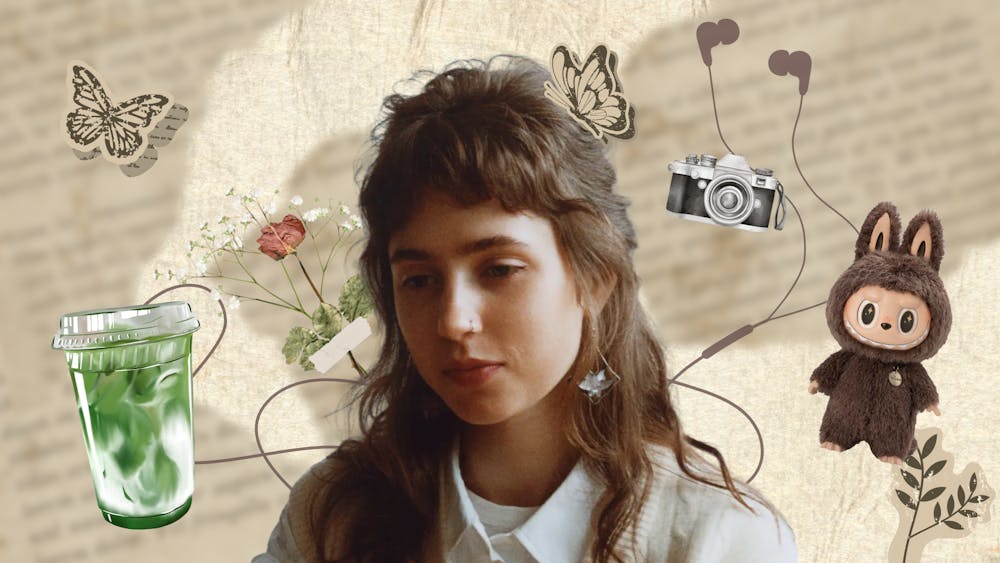
Every generation has its own version of the "enlightened young man”—ours happens to wear thrifted sweaters and read Sylvia Plath like it’s scripture. He traded in his tie–dye shirts for baggy jeans, Beatles mixtapes for female indie artists on streaming, organic food for matcha, and rebellious protests for fabricated feminine appeal. He is ... the performative male (cue Darth Vader soundtrack). Turn your head in any direct, and your gaze will land on one of his many manifestations; from campus contests (yes, even ours) to newspaper articles breaking down the trend for Gen Xers, his reign truly knows no bounds.
For those unfamiliar with the movement—or those living under a rock—the performative male emerged in earnest in late May 2025, as the picture of a man who projects a curated image of emotional intelligence, artistic lifestyle, and intriguing depth. He’s a man who performs to fit a woman’s ideal type. This man reads Sally Rooney, wears tote bags (with a Labubu of course), and—most importantly—listens to Clairo through his wired earbuds. What woman wouldn’t love him? Concurrent with the nature of almost all powerful online movements, the initial TikTok trend has spilled out into everyday life, from casual conversations to the niches of collegiate campus culture. But the memeification of this image has transformed the performative male and his hallmarks into shallow aesthetic shorthand—and one artist in particular has been caught in the crossfire. Clairo’s discography has undergone a cultural metamorphosis, from being seen as music that touched on female empowerment to acting as a front for a caricature of male feminism.
It's no secret that Clairo’s music has become the soundtrack of the “performative male” aesthetic. Songs like “Sofia” have become inseparable from these fictitious, though often accurate, caricatures. Clairo is everything the performative male stands for—she’s alternative, sensitive, feminine, and overwhelmingly digestible. While often perceived as an "independent" artist, Clairo is, in fact, the opposite: she's comfortably safe, and her music is consumable, mass–market and trendy. The spotlighting of an artist like Clairo as this epitome of feminism—even as the butt of a joke—demonstrates society's inability to meaningfully engage with or understand feminist music.
Don’t get me wrong, I truly do enjoy Clairo’s music. She is a recurring presence on my Spotify daylists and features on several occasionally frequented playlists with names like “sleepy vibey indie girl fall.” Her songs grapple with themes that attempt to transcend the superficial—the isolation that results from fame, the pressure to change her appearance to fit relationship standards, or the music industry's fascination with youth—while sporting a soundtrack that signals depth without demanding it. It’s no secret why she’s famous. The video to her breakout song “Pretty Girl,” filmed in her Syracuse dorm room, garnered 1.5 million views overnight and dealt with unrealistic female beauty standards. In her caption, she admits that while filming, she “felt really ugly, but realized that it’s perfectly okay to feel that way.” Statements like Clairo’s are applaudable and should not be entirely discounted. In fact, they can require a considerable amount of courage from young artists. But in the end, her music provides coffee shop comfort—her syncopated beats and synth bass lull the listener into a state where their problems are seen, heard, validated, and covered up with a cartoon Band–Aid. It is, of course, “perfectly okay.”
Clairo’s music fails to push any boundaries or challenge dominant social ideas. She is, after all, your friendly neighborhood indie girl: white, brunette (with fringe bangs), and clad in Doc Martens. She fits neatly into the box that society carves out for her, speaking out only as much as women are supposed to, discussing the topics a woman of her status is obligated to discuss, all while regurgitating ideas that have dominated white feminism for decades. In today's music industry, female artists are often expected to speak out on certain issues—namely body image, appearance, or the pressures of fame—in order to cultivate an air of authenticity that allows them to connect with audiences. Such discourse is encouraged, if not required, of these artists, but only if it fits within the confines of what is deemed acceptable.
Female artists can discuss a vague pressure to feel pretty, but specific discussion about society's body standards is rarely acceptable. They are allowed to discuss political issues, but only if they obscure their beliefs or put a positive spin on things. This cyclic need to discuss relevant issues while not crossing any societal boundaries has led many female musicians to repeat the same set of opinions—takes that has dominated popular feminism since its inception—while avoiding the third rail of media training: the grey area. Clairo is no different. Though her music has potential for true cultural commentary, she's succumbed to being the unofficial spokesperson of the almost–interesting.
A simple comparison to a multitude of other indie artists firmly establishes Clairo as one that lives squarely within the lines. Mitski, in “Your Best American Girl,” manages to comment on what it's like to be a woman of color in a relationship with someone of a different race. Instead of pretending to easily cross the divide between them, she admits that “there are parts of me you will never be able to understand, and I don’t think we can move past that.” She doesn’t tie up her music with a bow; she pushes boundaries and asks listeners to think deeply, to sit with discomfort. Mitski leans into a messy world with a desire to share her authentic perspective, refusing to twist her experience into an easily consumable narrative. Granted, Clairo can’t be faulted for her less genuine activism. She herself has never claimed to revolutionize the music industry. But the culture surrounding her music has hailed her as a leading light in “feminist” art, and the reality of her music falls quite short.
This sanitized version of cultural commentary dovetails nicely with the safety of the performative male trend. Clairo isn’t the face of the trend in spite of her music—she is essential to the performative man precisely because she’s safe to the point of blandness. No truly unconventional artist would suit the movement—even one that pretends to highlight non–traditional interests—because at the core of any social media phenomenon is a lack of radical culture. Clairo skyrocketed to fame because of how unradical her ideas are—because everything about her was truly digestible. So digestible, in fact, that rather than pushing boundaries as she intends to, her music slips easily into the mainstream—evidence that countercultures, once packaged for mass consumption, reinforce the very status quo they claim to resist.




