
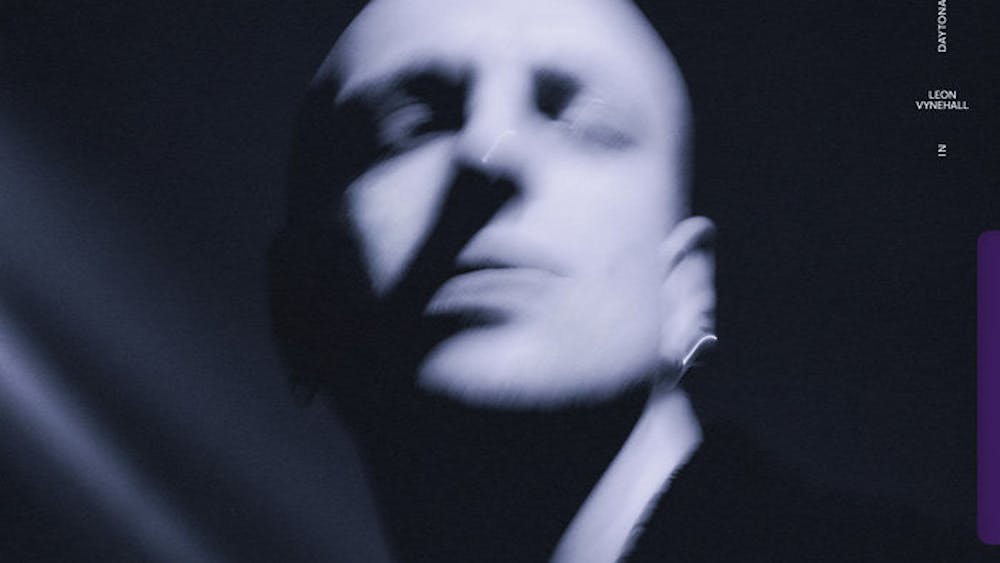
There’s no denying that Leon Vynehall is one of the most intriguing electronic producers working today. His earliest projects Music for the Uninvited and Rojus (Designed to Dance) are fresh takes on the broad genre of house, while the more minimalist Nothing is Still draws heavily on orchestral elements to tell the story of his grandparent’s emigration to the United States. Where Vynehall shines most is as a curator of vibes—every one of his releases is entirely self–contained, showing off his varied production talents in a new light. It's always Vynehall’s lush instrumentation that gives each of these projects their vital force, each successive track carefully built up layer by layer.
It’s strange, then, that his latest project, In Daytona Yellow, often lets his tightly–woven instrumentals fade from center stage, instead highlighting the vocal performances of his collaborators. Of the nine tracks on the album (not counting its minute–and–a–half ambient interlude), only three credit Vynehall as the sole performer. Vynehall brings in artists of various stripes to fill out the project, from the deeply political London rapper Jeshi to Midlands indie–folk group Chartreuse. It’s a bit jarring to hear the human voice leave the sample bank and form the center of his projects, but Vynehall does his best to integrate them appropriately, albeit with mixed results.
What Vynehall carries into this project from his past albums is his stellar ability to set the mood. Marking a departure from both the liveliness of his early work and the somber minimalism of Nothing is Still, In Daytona Yellow is both dark and maximalist. As Vynehall puts it, “In its essence, it is the embracing of vulnerability, the rejection of perfection, and the powers that come from doing so.” Every song feels fluid and cloaked in shadow, showing off Vynehall’s virtuosic and multifaceted production abilities. Vynehall even finds time, in interludes and outros, to weave in heavy orchestral elements (courtesy of string arranger Amy Langley) that reinforce the album’s ornate, if slightly grimy, atmosphere. The entire project holds together beautifully, even as the vocals that each track features differ greatly in style.
The best vocal performances on the album are those that feel like just another element of Vynehall’s production. On “Whip,” Jeshi strikes a difficult balance between making sure each of his bars stands out and keeping in line with Vynehall’s soft but pounding backing track. His vocals are treated with the same thick, metallic coat of production that Vynehall’s beat is, and while the track’s instrumental hardly varies, Jeshi’s asymmetric, staccato vocal performance keeps it feeling fresh for all of its nearly four–minute runtime.
Reversing that relation is “Cruel Love,” whose robust and constantly mutating instrumentation helps it stay afloat and uplift Beau Nox’s otherwise unremarkable vocals. The song’s chorus, which almost feels like a sample, drives home the album’s darker themes—”Cruel love / you’re dangerous, how can I trust you?” Nox croons. “Cruel love / still, I want more.” The track showcases Vynehall at his best, his instrumental incorporating both atmospheric, spacy synth work and fuzzy drums that drive the track forward. The two–minute–long post–verse breakdown is perhaps the best stretch of the entire album, with Nox’s vocals properly integrated as a minor element in Vynehall’s dynamic electronic soundscape.
On “Mirror’s Edge,” POiSON ANNA’s bilingual growls seem perfectly at home paired with a sharp, mechanical backing track and a stripped–down, reverberating drum line. The song’s chorus bursts out into more traditional club music territory, with POiSON ANNA shedding her gruff tone for airy vocalizations and Vynehall finally weaving in more traditional “house” rhythms. In terms of synergy, it’s clearly the highlight of the album, with the shadowy production and guttural vocals complementing each other perfectly.
Not every track blends together so cleanly, though. Some of the worst work is on “You Strange Precious Thing,” whose vocals (courtesy of Chartreuse) are mostly lifeless in both verse and chorus, plodding over a bit of string work and an empty, minimalist drum line. Vynehall’s beat doesn’t do anything novel, and the random samples and vocalizations he weaves in don’t fit particularly well with Chartreuse’s earthy vocals. “Scab” is in a similar situation—Vynehall begins the track with an intriguing drum part, moist and crackling, but TYSON’s layered vocals fail to add much of value, instead dragging out a promising beat and forcing it to adopt a more traditional verse–chorus structure.
Being made to support vocal performances like these leaves Vynehall less able to experiment and branch out with his instrumentals. Rather than fitting the album's vocals neatly, it too often feels like Vynehall’s beats have to compromise in their complexity to make room for the voices of his collaborators.
The substandard lyricism of many tracks only adds insult to injury. Though the album was certainly never expected to produce poetry, hearing over and over about dark romances and vague paranoias starts to get grating after the first five or six tracks. The raw emotion that Vynehall put into this project comes across clearly from the production alone—but it’s difficult to pick up on how meaningful the album’s words really are to him when they’re coming out of other people's mouths. On the balance, the vocal performances enfeeble more than enhance the dark and introspective tone of the album.
And then there’s the matter of Vynehall’s own vocals, which appear on the album’s opening and closing tracks, as well as the bizarre interlude “Slow Devotion.” “Slow Devotion” is a real low point for the album—the beat is shallow and fades in and out of the track aimlessly, while Vynehall’s vocals are so processed that he sounds at points like Baby T–Pain learning to breathe through the mouth. He also lends background vocals on other tracks, a task he’s far better suited for—singing backup to Kenzie TTH on “Romantica,” for example, Vynehall is more than serviceable at providing a floor for her swinging vocals to balance on.
The final song, “New Skin/Old Body,” features a poem whose first three lines, a rip from Leonard Cohen’s “Anthem,” can be heard on many of the album’s tracks: “Forget your perfect offering / For there is a crack in everything / That is how the light gets in.” Vynehall, sporting a cool, spoken–word delivery, extends Cohen’s lyrics as an almost alarm–like synthesizer slowly bubbles up and overtakes him. His final words reflect a sense of acceptance, albeit an uneasy one—“I am a strange loop.” It certainly puts a bow on the album’s introspective theme—but the instrumental—driven by moody, evocative strings—never really resolves itself, meandering before fading out and closing the album on a less certain note than it began. The closing track is a good encapsulation of the album as a whole—a clear–eyed project whose execution leaves a bit to be desired.
Artistic experimentation comes at a premium in today’s musical climate, and that’s particularly true of swings as wild as Vynehall is willing to take with each new project. But not every experiment is going to be a success. Though the album’s energy is immaculately curated and the production is unimpeachable, the risk Vynehall takes in centering vocal performances yields mixed results. Even the best tracks on In Daytona Yellow leave the listener wondering what could have been if the album’s instrumentals were simply given more room to breathe. For a project so personal, it’s a bit bizarre that most of its weight has been put on the shoulders of guest performers. Vynehall has shown time and again that he’s more than capable of pulling off any musical gamble he dares to take on—all he has to do is bet on himself.