Julia Ducournau has redefined body horror. She makes films about what happens when belief collapses and all that’s left is the body—hurt, grotesque, unrecognizable, still trying to mean something. Her breakout films Raw (2016) and Titane (2021), which turned her into a critic’s darling, obliterate the boundary between flesh and metal, motherhood and monstrosity. They’re some of the most emotionally destabilizing films I’ve ever seen.
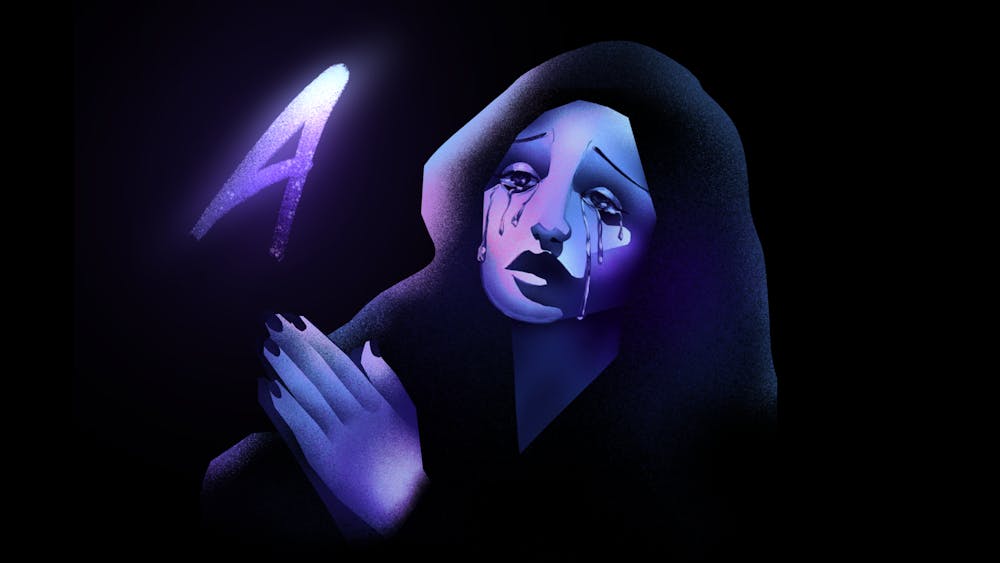
Her third feature Alpha (2025) follows the titular young girl (Mélissa Boros) caught in the emotional wreckage of a mysterious affliction known as the red wind—an illness that petrifies the body, marbles the skin, and silences speech. Alpha’s uncle Amine (Tahar Rahim), a recovering heroin addict, is already deep in its grip. Her mother (Golshifteh Farahani), a healthcare worker on the front lines who is already barely holding it together managing single motherhood and trying to support her brother’s sobriety, is consumed by the possibility that Alpha is next after her daughter tattoos an “A” on her arm with a dirty needle at a house party. In the absence of answers, Alpha watches her mother turn caretaking into obsession and grief into ritual. The dread of Alpha’s impending diagnosis is unrelenting throughout the film, and ambiguity is its own curse. That’s what makes Alpha such a fantastic horror movie—not gore or violence, but the overwhelming fear of watching someone you love turn into a ghost in front of you and not knowing if you’re joining them.
This is not similar to Titane—which I still consider one of the best films of all time, full stop. Alpha trades in something subtler but just as devastating. The body horror is still there—gorgeous, grotesque, grotesquely gorgeous—but it’s quieter now, like something sacred that no one wants to name aloud. It’s less transformative, but more painfully enduring.
Premiering at Cannes Film Festival 2025 under high expectations, Alpha stunned me with what it dared to withhold. As someone who loves Titane like it’s scripture, I didn’t expect something softer, sadder, more suffocating. But that’s exactly what Alpha is. Where Titane detonates the body into spectacle, Alpha lets it calcify into myth. It’s a film about spiritual trauma itself, whereas Titane is about the performance of it—not the church kind, but the kind that lives in families, in cultures, and in superstition that pretends not to be religious at all.
Alpha’s extended family—French Muslims—talk about the disease in hushed tones, like it’s not just an illness but a sort of possession. They talk about djinns, unseen forces, and something that’s been sent eerily like a biblical plague. And no one ever says it outright, but it all feels familiar: the whispers around people who are “touched,” the way we explain away pain when we can’t name it, the mythologizing of suffering in the absence of care.
It’s tempting to look at the red wind in Alpha and label it as “post–pandemic cinema,” to frame it as an AIDS metaphor or a nod to long COVID, long grief, long silence. But that’s too neat. Alpha isn’t trying to educate you about viruses; it’s trying to smother you with what it feels like to be cursed. Catholicism is full of saints of lost causes—coins buried upside down to sell houses, black veils over mirrors, novenas whispered on loop for forgiveness that doesn’t come. We burn candles for impossible things. We carry relics. We cross ourselves before we say something awful. No one calls it superstition. We call it devotion. But what’s the real difference?
The Tame Impala “Let It Happen” needle drop comes at a moment when Alpha is actively doing the opposite. She’s running—physically, emotionally, spiritually—from a party and from the gnawing fear that something irreversible has already happened. Her uncle is missing. She knows he’s using again. Her mother is unraveling. The red wind might already be in her blood. And there’s no one left to say anything reassuring.
Cultural understandings of illness, fate, and spirit—whether rooted in folklore, animism, or ancestral traditions—don’t disappear when Abrahamic religions enter the picture. They adapt. They hide inside religious language. They blur. And what emerges is often a hybrid moral framework into which suffering is always read, even if not fully understood.
Superstitions often carry the logic of preexisting cosmologies—ideas about balance, curses, protection, or spiritual contamination—but they get filtered through the rigid binaries of sin and purity that monotheistic religions enforce. Especially in Catholic and Islamic households, where ritual plays a central role, this mix can create a system where the body becomes a site of judgment. Something touched you. Something was sent. Something went wrong.
Alpha is gorgeously shot. The lighting feels biblical—chiaroscuro like Caravaggio, but softer and sadder. Every detail—the marbled skin, the cracked lips, the weight of the body as it petrifies—feels sculpted by someone who has seen pain up close and still wanted to make it beautiful. Ducournau’s world is as much about texture as it is about tone. You feel the disease in your own joints.
Rahim, who plays Alpha’s uncle Amine, lost 44 pounds for the role, all while promoting a different film, a Charles Aznavour biopic that couldn’t be more tonally distant. His diet during that time was brutal and ritualistic: specific quantities of cherry tomatoes and pistachios, consumed at set times. He described them not as food, but as a kind of controlled fixation. A substitute for a fix. And accordingly, his performance never slips into cliché or aestheticized addiction. He doesn’t act like a man who’s high. He acts like someone already turning to stone.
Rahim has described Amine not simply as an addict, but as a “fallen angel who’s had his wings cut off.” The metaphor fits—this is a character suspended in grief and guilt but still tethered to the living. “He still has a mission,” Rahim says. “It’s about freeing Alpha.” Whether or not the film grants that freedom is unclear. But his presence—fragile, decaying, strangely tender—is impossible to look away from.
Farahani, as Alpha’s mother, gives a performance that anchors the entire film. There is no villain in this story, but her character comes closest to embodying a kind of theological horror: a woman who keeps someone alive because she doesn’t know how to let him go. Farahani won the Excellence Award at the Locarno Film Festival for this role, and it’s obvious why. She doesn’t cry often in the film, but when she does, the expression in her eyes is uncanny—pain layered with anger, faith twisted by exhaustion. It feels like religious art, like depictions of the Virgin Mary’s grief. Not the sanitized Mary of Christmas cards, but the Mary of Mater Dolorosa paintings, the Mary who watches her son die and cannot stop it. Her devotion is inescapable, even violent. But it’s real. And it feels inherited, like this is what she was taught love should look like. That too becomes a kind of superstition.
There’s no catharsis in Alpha, which is fitting for a disease movie. Everyone is trying so hard to keep each other alive—through rituals, through obsession, through stories on what the red wind is and isn’t. But nothing is healed, the fog never lifts, and love never stops asking too much. I don’t think Ducournau is interested in resolution anyway; she’s more interested in what it costs to stay. I left the theater thinking about all the things we call devotion when we don’t know what else to do with our grief.